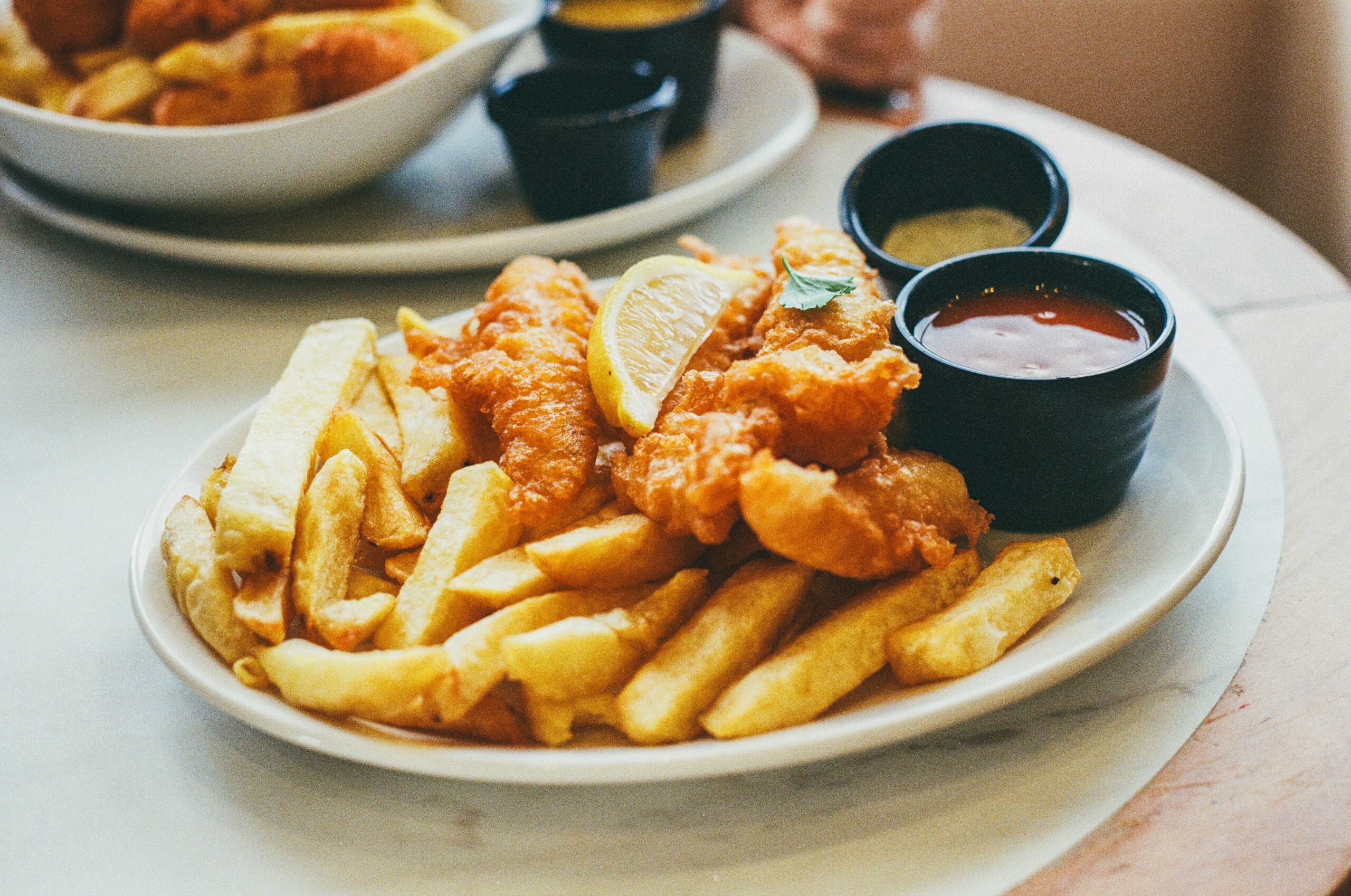
Image description: a plate of fish and chips. Photo by Nik
British consumers are being urged to “completely avoid” UK-caught cod after the Marine Conservation Society (MCS) downgraded the species to its lowest possible rating in its twice-yearly Good Fish Guide – a stark verdict on a fish that has been central to British culture for generations.
Cod populations have been in decline since 2015, driven by overfishing, rising sea temperatures, and wider ecosystem pressures affecting breeding and juvenile survival. The MCS says the situation has now reached a critical point.
Kerry Lyne, the guide’s manager, called the downgrade a “warning signal” and said the UK government needed to “address these concerns to allow stocks to recover.” She added: “The challenge isn’t that fish and chips will disappear, but that the species must be sourced from further afield.”
Science ignored
In September, the International Council for the Exploration of the Sea (ICES) issued scientific findings to the UK and European Union calling for a zero catch of North Sea cod in 2026, advising that any commercial fishing could threaten reproduction rates. The board warned fishermen to avoid catching off the west coast of Scotland, in the North Sea and in the English Channel.
That advice was not followed. The minister for Food Security and Rural Affairs, Angela Eagle, announced a 44% quota reduction instead, part of a joint deal with the EU and Norway that still secured 290,000 tonnes of UK fishing rights, valued at over half a billion dollars.
Hugo Tagholm, executive director of Oceana UK, was blunt in his assessment. “There’s a scandal in the making,” he told Inside Climate News, referencing the wide-scale extraction of iconic British species at unsustainable rates. “Consistently ignoring the science is what takes us to a bad place in the climate debate, in the nature debate, in the fishing debate. If we don’t follow the science, we’re going to end up in the wrong place. Science is absolute. Science is not politics.”
Industry pushback
Not everyone agrees with the MCS’s assessment. The Shetland Fishermen’s Association had already warned that restrictions on cod catches had been marred by procedural delays, technical errors and scientific uncertainties. The SFA’s chairman James Anderson, skipper of the whitefish vessel Alison Kay, said implementing zero-catch quotas for cod would be “fleet-ending madness.” The association warned that a 44% catch reduction would mean losses of £16m for the Shetland economy and a “hard year for fishing crews across all fleet sectors.”
A wider crisis
This is not the first reckoning for British fisheries in recent months. Last year’s MCS guide warned that mackerel stocks were nearing a breaking point from overfishing, and grocery retailer Waitrose has since announced it will suspend all sales of mackerel beginning later this month.
Chris Graham, head of sustainable seafood and ocean regeneration at MCS, said: “It’s deeply concerning seeing so many of our iconic fisheries – from cod to mackerel – under increasing pressure. We need strong action from the UK Government to support a transition to low-impact fisheries and sustainable seafood farming.”
With the UK importing around 80% of the seafood it consumes, MCS is calling for improved management of domestic fisheries to help rebuild stocks and reduce reliance on imports.
What to eat instead
The MCS recommends European hake as the preferred alternative to cod. Icelandic cod and haddock – particularly varieties caught from the North Sea and Scotland – are also cited as more sustainable options, alongside seabass from the North Sea, English Channel and Celtic Sea, UK blue mussels and freshwater trout. Only langoustine caught by pot and creel in areas such as the North Minch, South Minch, Skagerrak and Kattegat retains the guide’s top green rating.
The cultural stakes are high. With over 160 million portions of fish and chips sold each year in Britain, the news is bound to send shockwaves through an industry already under pressure. Adrian Fusco, a third-generation fish and chip shop owner from Whitby, Yorkshire, described the announcement as the “perfect storm,” adding to already escalating costs driven by quota reductions and sanctions on Russian-caught white fish. “Hopefully the UK palate will change over the next few years,” he said. “Nothing beats the nostalgia of walking down the pier with fish and chips. People today want their children to experience that too.”