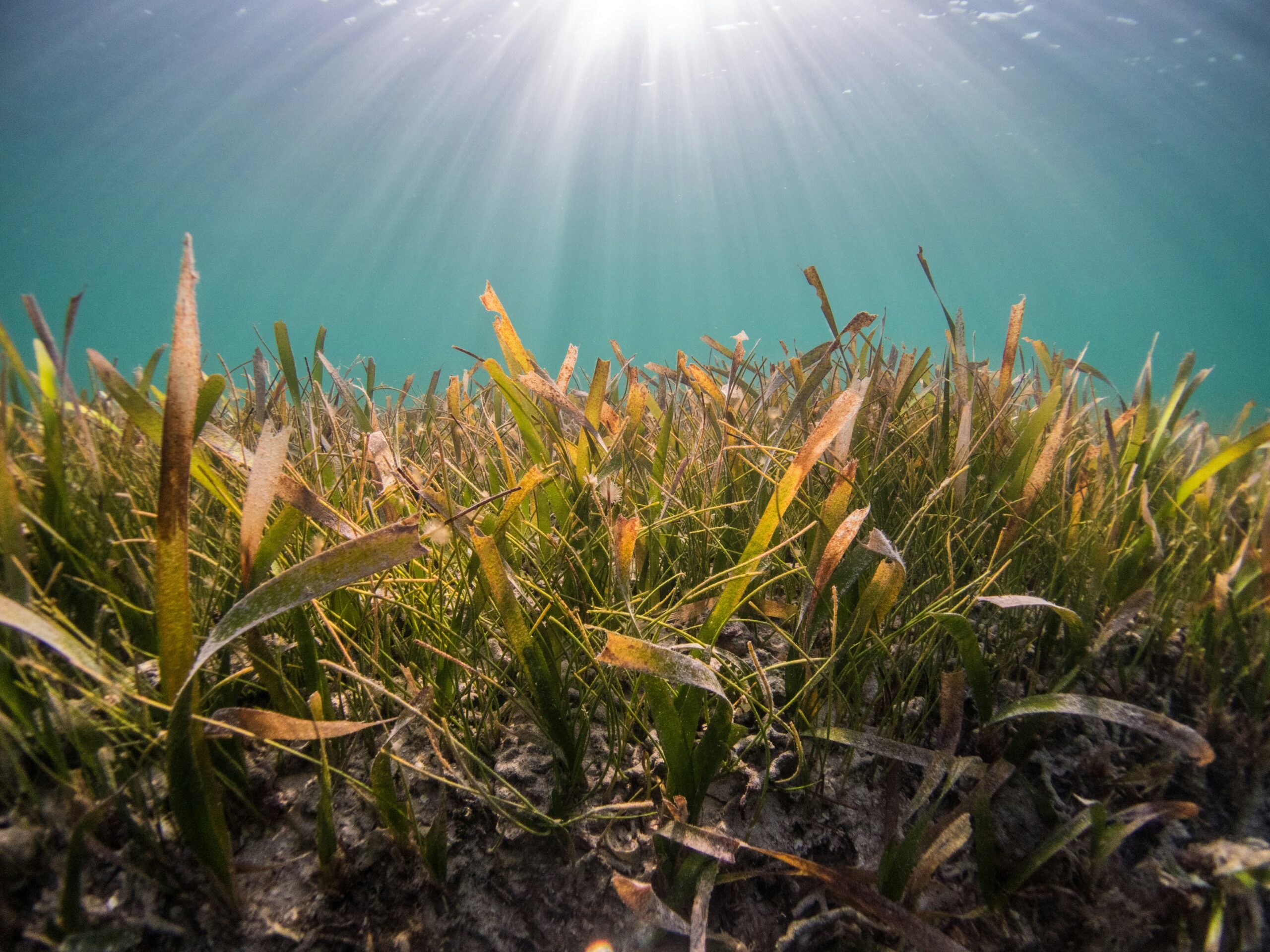
Photo by Benjamin L. Jones
The Marine Management Organisation has published comprehensive guidance on seagrass protection and recovery, highlighting the importance of this marine habitat which has declined by over 40% in the UK since the 1930s.
The guidance provides information on UK seagrass, the value of this underwater flowering plant, and the MMO’s role in supporting its protection and recovery in English waters. Seagrass is the only marine flowering plant able to survive and pollinate fully submerged, forming beds or meadows in shallow coastal areas where they receive plenty of light.
The decline since the 1930s is mainly attributed to coastal development, pollution and wasting disease, as well as physical disturbance. The habitat prefers sheltered bays and lagoons protected from significant wave action.
There are two recognised species of seagrass in the UK. Zostera marina is found in deeper water in fully submerged conditions to about 10 metres deep, typically on sand, mud or coarse gravel. Zostera noltii is found in shallower water on sandy shores.
The guidance emphasises that seagrass is “one of the most valuable coastal ecosystems” and provides a range of ecosystem services. Seagrass beds contribute to the maintenance of fish and shellfish populations, providing stock for the seafood industry. This ecosystem service brings benefits to society through food, nutrition and employment.
Seagrass serves as a nursery and home for a wide variety of marine species. Both species of seahorse native to the UK—spiny seahorse (Hippocampus guttulatus) and short snouted seahorse (Hippocampus hippocampus)—are commonly observed in seagrass beds and are protected under Section 9 of the Wildlife and Countryside Act 1981.
Under section 140 of the Marine and Coastal Access Act 2009, it is an offence to intentionally pick, collect, cut, uproot or destroy any plant in a Marine Conservation Zone which is a protected feature. As a wild flowering plant, the removal or uprooting of seagrass plants is prohibited and managed by licence under the Wildlife and Countryside Act 1981.
The MMO has duties, alongside other public authorities, for furthering the conservation objectives of marine protected areas. The organisation is responsible for assessing and managing the impact of marine non-licensable activities to further conservation objectives of England’s inshore marine protected areas within 0-12 nautical miles.
The guidance recommends that recreational users check navigational apps for mapped seagrass or sensitive marine habitats and avoid anchoring in those locations. Users are encouraged to use advanced mooring systems or ecomoorings where provided.
The MMO has published accompanying guidance for divers and snorkellers on seagrass beds. It is an offence to intentionally kill, injure or take a seahorse, or to intentionally or recklessly disturb a seahorse whilst it is occupying a structure or place it uses for shelter or protection.
Anyone diving or snorkelling must have a wildlife licence if intending to do something likely to disturb seahorses, including taking photographs or filming. The guidance advises that if incidentally encountering a seahorse, observers should not spend more than five minutes observing, never move or touch the animal, and retreat slowly if signs of stress are displayed.
Stressed seahorse behaviour includes swimming away or making erratic movements, rising into the water column with a curled tail, holding the head in a downward posture, turning away, or darkening in colour. The MMO advises that images shared publicly should model best practice guidelines, and photographs suggesting an offence has occurred may lead to enforcement action.
Natural England advises that anyone planning to collect seagrass seeds or plants should liaise with the organisation on methods and suitable locations prior to collection, to enable projects to progress without hindering recovery of designated seagrass beds.