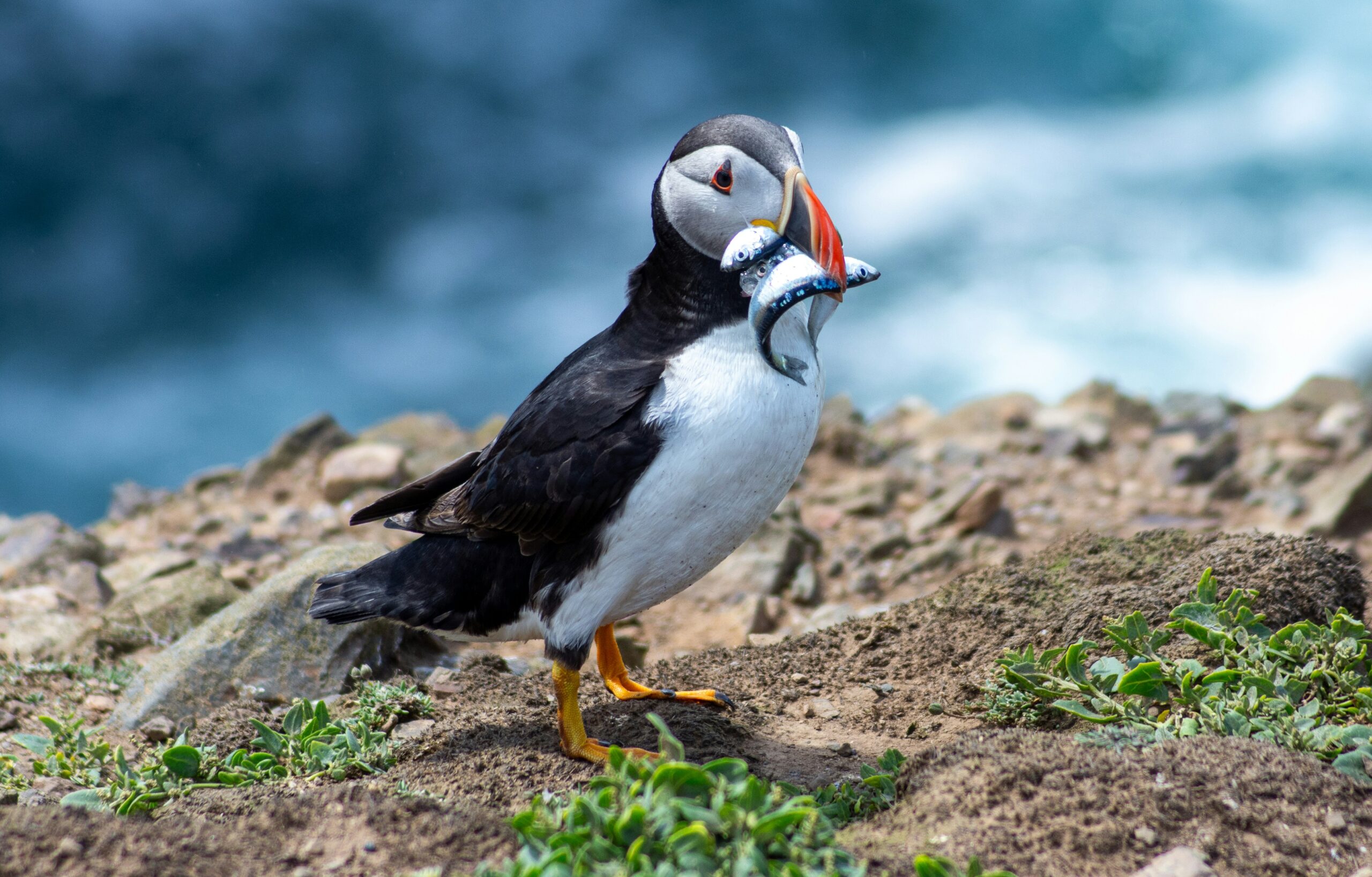
Image description: A puffin with fish in its beak. Photo by Tim Morgan
Defra published its updated UK Marine Strategy Part One on 7 April 2026 – the first full update since 2019 and the opening of the strategy’s third six-year implementation cycle. The headline finding is stark: the UK is failing to meet Good Environmental Status in 13 out of 15 indicators used to measure ocean health – despite Marine Protected Areas now covering 38% of its waters. Fish communities are deteriorating, seabed habitats continue to decline, marine bird populations are falling, and overall ecosystem health remains mixed.
A mixed picture for marine ecosystems
Grey seals are a relative success story, with stable or increasing populations meeting GES. Measures to remove invasive mammals from important island seabird colonies are also proving effective. But the picture darkens considerably elsewhere. Cetaceans have not met GES, with bycatch identified as a key contributor to their failure across the Greater North Sea and Celtic Seas. Harbour seals are declining in specific areas and have not achieved GES in the Greater North Sea. Marine birds have not met GES in either region — with non-breeding bird abundance in the Greater North Sea dropping below a target that had actually been met in 2019, representing a step backwards. Breeding success has fallen in both regions.
Fish communities present a similarly troubling picture. The report highlights long-term declines in large fish, including significant reductions in species such as cod and saithe, alongside continued pressure from fishing activity and wider human impacts. The species composition and size structure of demersal fish communities has deteriorated in the Greater North Sea and Celtic Seas, and that deterioration is reflected in the food web assessment, where the overall picture across all indicators is one of decline. Benthic habitats have not met GES overall, though two thirds of broad-scale benthic habitats in the Celtic Seas have now reached the threshold, the document notes recently introduced protective measures “will take time to achieve their long-term aims.”
Fisheries: improving but not there yet
Commercially exploited fish and shellfish have only partially met GES. For the assessment period 2016–2021, 42% of marine quota fish stocks and 11% of non-quota shellfish stocks achieved GES – an increase of 9% and 6% respectively since the last cycle. The direction of travel is positive, but the figures show how far the UK remains from healthy, well-managed fisheries.
Litter, noise and contaminants
The UK has not met GES for marine litter, though there are “encouraging reductions in beach litter and plastics found in the stomachs of fulmar.” Seafloor litter remains high in the Greater North Sea. Underwater noise status is uncertain – threshold values for GES have yet to be defined – but both impulsive and continuous noise indicators show an increasing trend. Four heavy metals (lead, mercury, copper and zinc) and two persistent pollutants remain above environmental thresholds, meaning the UK has not met GES for contaminants overall.
The MPA paradox
The finding that 38% of UK waters are protected yet seas continue to decline points to a fundamental implementation gap. Jonny Hughes, Fisheries Policy Lead at Blue Marine Foundation, told Oceanographic: “Continued massive overfishing, refusal to ban bottom trawling even in supposedly protected areas and non-existent monitoring or enforcement means it’s hardly surprising that the seas are in such a bad state.” Calum Duncan, Head of Policy and Advocacy at the Marine Conservation Society, pointed specifically to the absence of fisheries management measures within many MPAs, noting that the Scottish Government’s proposals for fisheries measures in Scotland’s offshore MPAs are still awaited.
Climate change: an accelerating backdrop
UK seas are warming, acidifying and becoming more oxygen-depleted, particularly in late summer, with the fastest rates of sea surface warming in the southern North Sea. Marine heatwaves are becoming more frequent. The assessment notes that climate change has not yet been identified as the primary driver behind most individual GES failures — but as Oceanographic observes, the direction of travel is clear and the implications for future GES achievement are significant.
What happens next
The strategy sets the framework for Defra and the devolved governments to work toward GES across all UK marine waters over the next six years, aligning with obligations under UNCLOS, UN Sustainable Development Goal 14, the OSPAR North-East Atlantic Environment Strategy 2030 and the Kunming-Montreal Global Biodiversity Framework. Assessment results are publicly accessible via the Marine Online Assessment Tool (MOAT). The next update is expected in 2030.