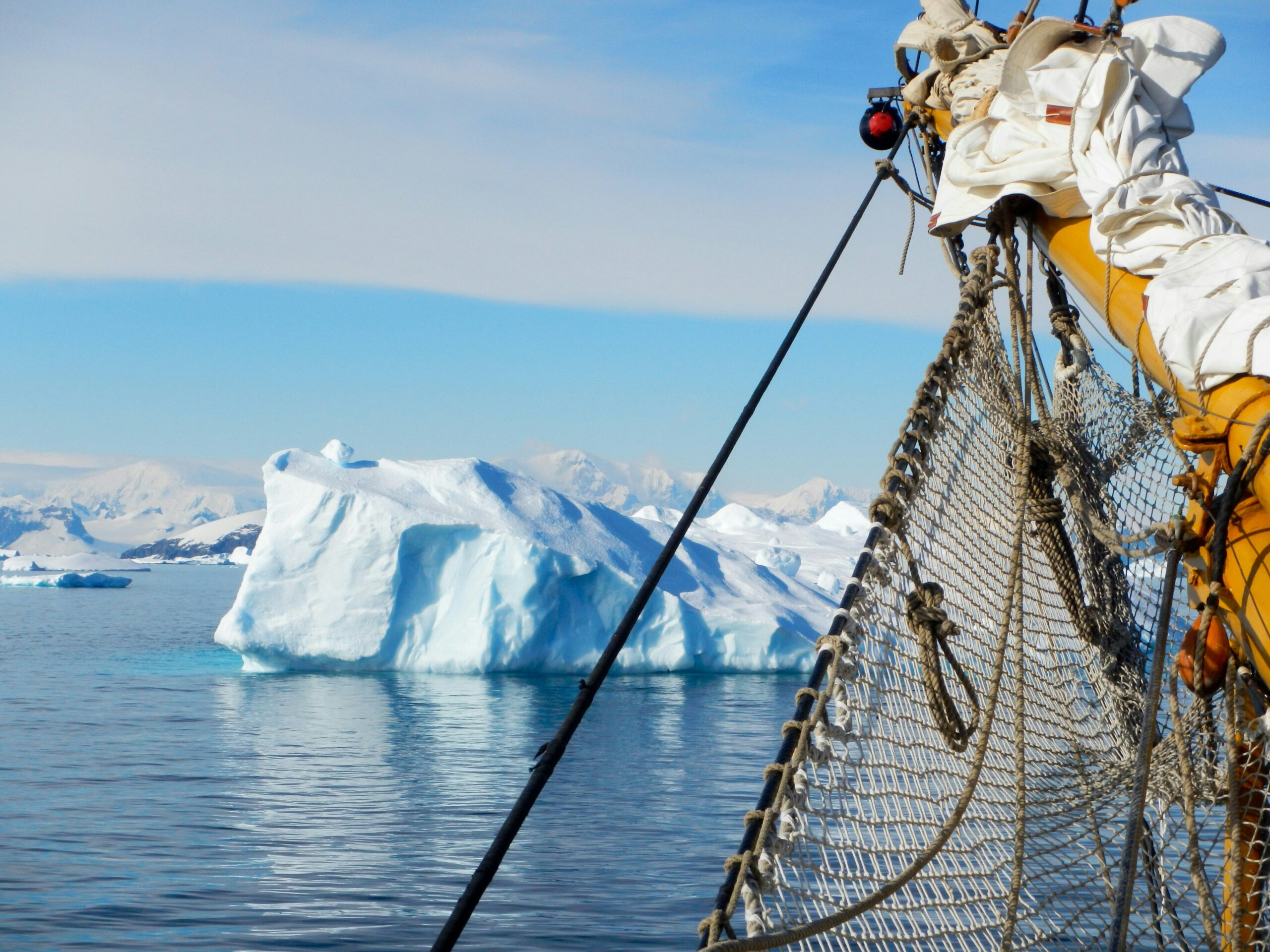
Photo by Torsten Dederichs
The world’s largest krill harvester is at the centre of a growing dispute over its “sustainable” certification, after WWF and the Antarctic and Southern Ocean Coalition formally objected to a proposal to recertify the fishery under the Marine Stewardship Council’s blue tick label — the latest development in a year of mounting pressure on Antarctic krill governance.
Norway’s Aker QRILL, which accounts for around 60% of the entire Antarctic krill harvest, has held MSC certification since 2010. The company’s products – primarily used as feed in farmed salmon and as health supplements for human consumption – carry the blue tick label to indicate they come from a sustainable, well-managed fishery. The MSC recently released a draft report for its fourth recertification of the fishery, proposing even higher sustainability scores than in previous assessments. Both WWF and ASOC have now filed formal objections, triggering an independent adjudication process that could result in a change to the certification or the imposition of new conditions.
A fishery already under strain
The dispute comes in the wake of an unprecedented early closure of the 2024–25 Antarctic krill season. CCAMLR confirmed the shutdown after the fleet hit the 620,000-tonne seasonal catch limit months ahead of schedule – the first time in the fishery’s history this had occurred, with the season cut short on 1 August when it should have run until December. The closure followed a record surge in catches after a longstanding conservation framework requiring fishing vessels to spread their effort across a wider area was allowed to lapse, with no new management plan agreed to replace it. In one hotspot near the Antarctic Peninsula, the catch through June 2025 was nearly 60% higher than the entire previous season’s haul.
At CCAMLR’s October 2025 annual meeting in Hobart, Norway proposed almost doubling the catch limit for krill in the Southern Ocean – a proposal that heightened diplomatic tensions at a meeting already overshadowed by the arrest of Leonid Pshenichnov, a 70-year-old Ukrainian marine biologist and longtime CCAMLR delegate, by Russian authorities on treason charges. Russian documents described Pshenichnov as having “defected to the enemy’s side” by advancing proposals that would restrict krill harvesting, allegedly harming Russia’s economic interests. The UK called for the release of arbitrarily detained civilians; Australia expressed grave concern. The meeting ended without agreement on new marine protected areas around the Antarctic Peninsula, or on any interim conservation measure.
Why the objections were filed
At the heart of the certification dispute is the question of localised depletion. The krill industry’s central defence rests on the claim that total catches represent less than 1% of estimated global krill biomass, but critics argue this figure masks a more damaging reality on the ground. Krill biomass has declined by 70–80% in parts of the Southern Ocean since the 1970s, coinciding with the growth of commercial harvesting. Holly Parker Curry, ASOC’s marine protected areas campaign director, put it plainly: “Everything that lives in Antarctica either eats krill or eats something that eats krill.”
The Antarctic Peninsula, where fishing has now concentrated, is home to approximately a third of the species’ entire population and is a critical feeding ground for humpback whales, chinstrap penguins, seals and seabirds. Three humpback whales were found dead or seriously injured last year in the cylindrical nets used by vessels to harvest krill. New research cited by WWF shows that concentrated harvesting is reducing humpback whale pregnancies as a direct consequence of reduced krill availability. Australia’s humpback whale populations have recovered to an estimated 50,000 on the East Coast after commercial hunting was outlawed, but conservationists warn that recovery is now threatened by growing pressure on their food supply.
The Antarctic Peninsula is also one of the fastest-warming regions on Earth. The British Antarctic Survey warned last year that climate-driven changes are happening faster than expected, placing krill populations under compounding pressure; krill depend on sea ice for crucial stages of their life cycle. Beyond their ecological role, researchers have found that krill remove and store in the ocean 20 million tonnes of carbon annually – equivalent to taking five million cars off the road each year.
WWF’s Rhona Kent, Polar Oceans Programme Manager at WWF-UK, said: “Super trawlers dragging massive nets through the feeding grounds of whales, in pursuit of the very prey those whales depend upon, cannot credibly be described as sustainable. No label or certification claim can obscure that reality.”
Claire Christian, ASOC’s executive director, said: “This case highlights a clear mismatch between the certification and the contemporary reality of the Antarctic krill fishery. The assessment did not fully analyse the unique realities and risks of a fishery that operates in one of the most climate-sensitive ecosystems on Earth.”
A founding partner turns critic
The WWF objection carries particular weight because WWF is itself a founding partner of the MSC. Sea Shepherd, whose vessel Allankay has been monitoring krill super trawlers in the Southern Ocean for three years, noted that “the ‘sustainable’ label on Antarctic krill is unravelling, and it’s being challenged by the people who created it.” Peter Hammarstedt, Sea Shepherd’s campaign director, said: “For the past three years, our ship expeditions to Antarctica have documented the growing conflict between whales and super-trawlers competing for krill.”
WWF is calling for an immediate moratorium on krill fishing and a review of the MSC certification until CCAMLR agrees more precautionary fisheries management measures, including an updated krill fisheries management plan and the establishment of a Domain 1 Marine Protected Area around the Antarctic Peninsula.
Retail pressure mounts
The controversy is also reaching consumers. Holland & Barrett, one of Europe’s largest health and wellness retailers, will have fully ended the sale of all krill products by April 2026, the first major UK retailer to do so. The decision followed the submission of photographic evidence from Sea Shepherd depicting industrial super trawlers operating among foraging whale pods in a proposed marine protected area. Sea Shepherd has co-created the Antarctic Krill Pledge with Holland & Barrett, calling on retailers worldwide to commit to ending krill product sales permanently.
MSC and industry response
The MSC acknowledged “the sensitivity of the Antarctic ecosystem and the role of Antarctic krill as a keystone species within it,” and said the formal objections would be examined by independent adjudicators. Aker, for its part, launched the Ocean Stewardship Initiative in January 2026 under King Charles III’s Sustainable Markets Initiative, aiming to help establish one of the world’s largest marine protected areas in Antarctica. The company is also a member of the Association of Responsible Krill harvesting companies, which has established voluntary no-fishing zones around key penguin breeding and foraging areas near the Peninsula.