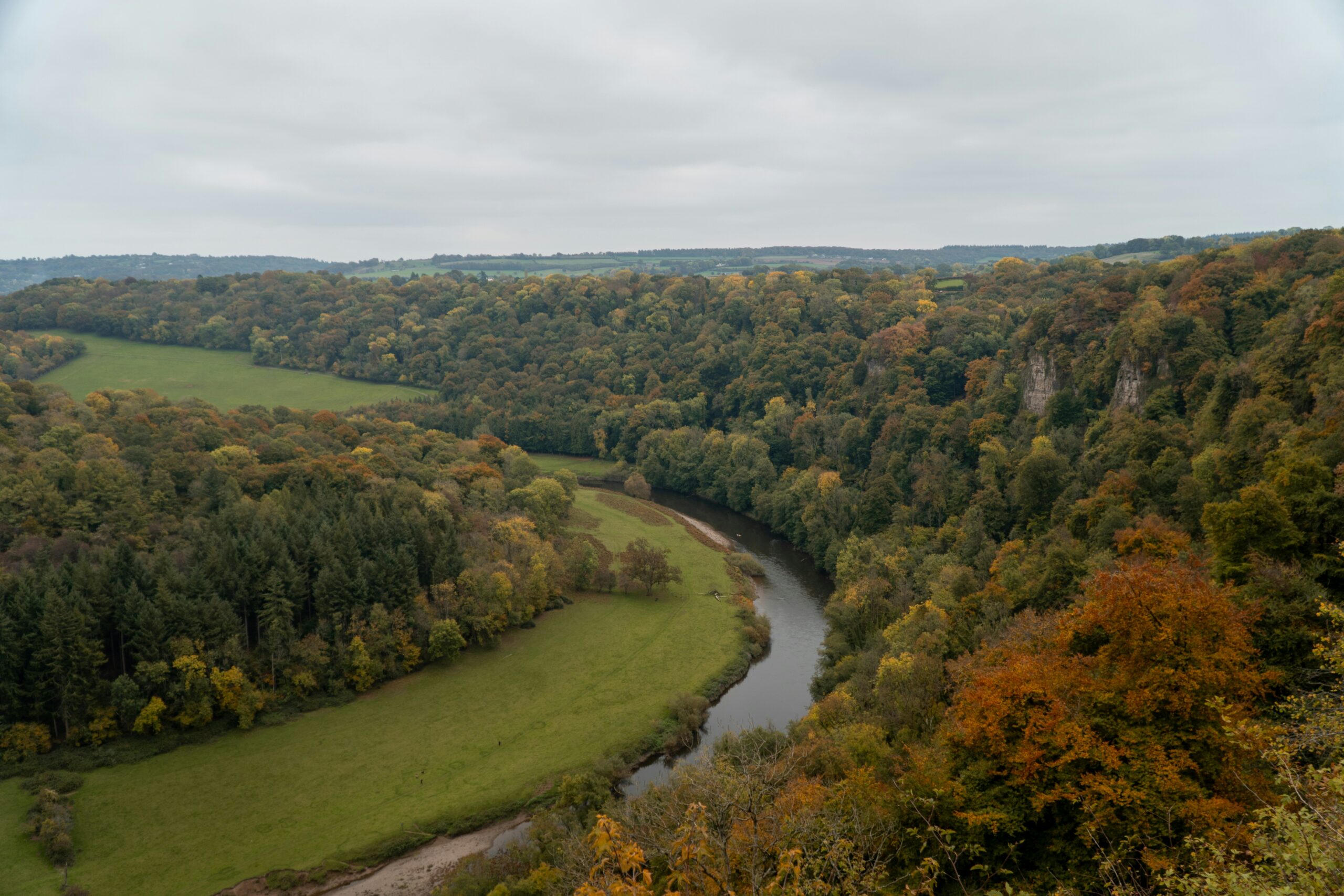
 Image description: A winding river flows through a forested valley in autumn. The image was taken in Symonds Yat, Ross-on-Wye, UK. Photo by Rob Wingate on Unsplash
A rights of nature approach
The Wye’s whole catchment has been formally acknowledged as a living ecosystem in what supporters call a UK first. Launched at the Hay-on-Wye literary festival, the charter sets out six rights: to flow, to biodiversity, to be free from pollution, to be supported by a healthy catchment, to regenerate, and to be represented in decisions affecting the river.
Herefordshire and Powys councils have already adopted the charter, with Gloucestershire and Monmouthshire expected to follow. The combined coverage spans the river’s 130-mile course from its source in the Cambrian mountains of mid-Wales down to the Bristol Channel.
Following an international movement
The initiative draws on the wider rights of nature movement, which has previously seen ecosystems granted legal personhood in Ecuador, Colombia and New Zealand. In a UK context, the framework reframes the Wye as a living entity rather than a resource. Significantly, the rights in the charter sit alongside, rather than displace, existing environmental legislation.
An ecological crisis
The charter arrives against a backdrop of ecological collapse. Excess nutrients from industrial chicken farming, compounded by sewage spills, have driven algae and fungus blooms throughout the Wye. In 2023, Natural England reclassified the river as “unfavourable – declining”, with a subsequent action plan attributing problems to farming, wastewater and climate change.
The biggest environmental case in UK history
The crisis has triggered what lawyers describe as the UK’s largest environmental pollution case. More than 4,500 residents have joined a High Court claim against Avara Foods, its subsidiary Freemans of Newent, and Dŵr Cymru (Welsh Water). The action alleges farmland run-off containing phosphorus, nitrogen and bacteria from poultry manure, alongside sewage discharges, have caused widespread harm. An estimated 23 million chickens are reared in the catchment at any one time. All defendants deny the allegations.
Giving the river a voice
The charter does not replace existing regulations but introduces a parallel mechanism for representation. In 2025, ecologist Dr Louise Bodnar became the first “Voice of the River Wye”, taking a voting seat on the Wye Catchment Nutrient Management Board. The charter formalises this representational principle, complementing initiatives such as phosphate credit schemes for wetland creation.