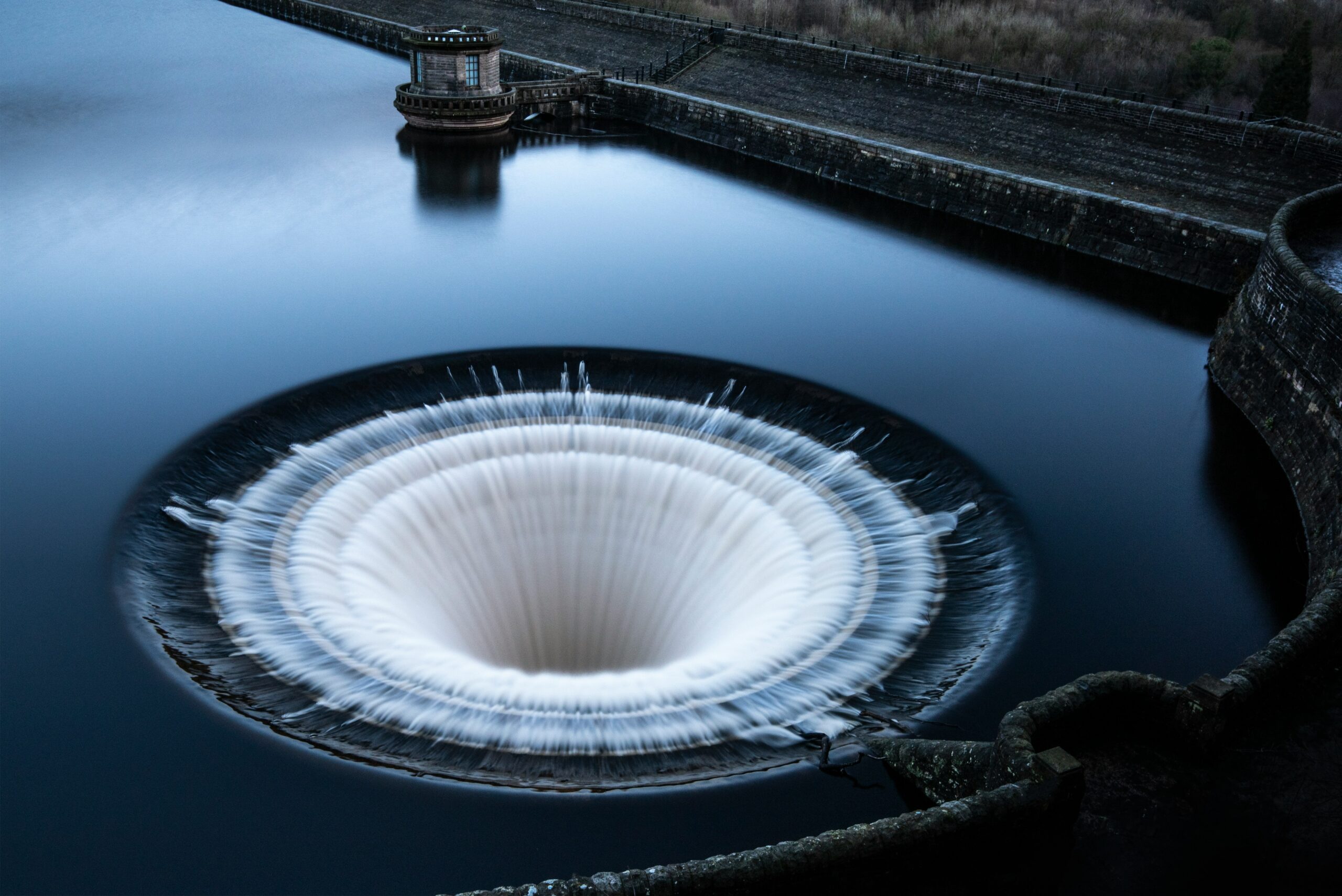
 Photo by Jonathan Bean on Unsplash
While some parts of the UK are set to receive the “first meaningful rain for a long time” in the coming days, it reportedly will not be sufficient reverse widespread drought conditions that continue to strain wildlife, farmers, firefighters and water resources.
According to Environment Agency data from 11 August, five key reservoirs across England and Wales are now “exceptionally low”, with pressures on water supplies are predicted to persist into the autumn.
Wessex Water introduced first household water use restrictions in 50 years
Across England, total reservoir levels have fallen to 66%, down from 69% last week and nearly 14 percentage points lower than expected for this time of year. Of the 32 reservoirs the Environment Agency classifies as strategically important or geographically representative, just four are classed as at normal levels.
Wimbleball reservoir, operated by South West Water, is less than half full, at 46%. The other four that are “exceptionally low” are Clatworthy in Somerset (48%), Hanningfield in Essex (56%), Clywedog in Powys (56%), and the Dove group in Derbyshire (69%).
Wessex Water has introduced restrictions on household water use for the first time in 50 years, affecting 1.4 million people, with the previous hosepipe ban imposed during the famous drought of 1976. Meanwhile, South East Water told customers in Kent to use water only for “essential” purposes, after taps ran dry on Monday for around 8,000 customers.
“Further deterioration” likely
The summer’s fifth climate crisis-driven heatwave will be followed by wetter and cooler weather that is much closer to the usual conditions for the time of the year, according to the Met Office.
However, floods and drought could hit the UK at the same time this week, with heavy rain forecast to fall on hard, parched soil.
In its latest summary published on Thursday, the National Hydrological Monitoring Programme said aridity in July had been “unprecedented” and that “widespread below-normal to exceptionally low” water flows were likely to persist well into the autumn, with “further deterioration” likely.
Alastair Chisholm, the lead for water policy, regulation and governance at the consultancy firm Arup, has warned with three droughts recorded in the past five years, the country was in “new territory”.
New reservoirs won’t be ready for another decade and will only secure 30% of expected water demand by 2055
With droughts and heatwaves becoming more frequent and more extreme due to the escalating climate crisis, the Environment Agency has estimated England’s public water supply could be short by 5bn litres a day by 2055 without urgent action.
The government has responded to the challenge by ordering the building of two major reservoirs, in East Anglia and Lincolnshire, but they will not be ready until 2036 and 2040 respectively.
An additional seven large reservoirs are planned to be built by 2050 – in Oxfordshire, Suffolk, Kent, East Sussex, the West Midlands and two in Somerset – and work is already under way at a further site in Hampshire.
However, even combined these reservoirs will account for only 30-40% of the overall projected demand.
In the absence of this additional storage, water companies continue to explore other drastic approaches to deal with water shortages. Southern Water has reportedly applied to the Environment Agency to continue current levels of abstraction from the River Test, a protected chalk stream that supports a highly sensitive ecological system, even if dry conditions persist and water flow decreases. The campaign group WildFish has said over-abstraction of this river could have drastic effects on wildlife and the long-term ecology of the river.
Water companies are continuing to urge customers to limit their water use.