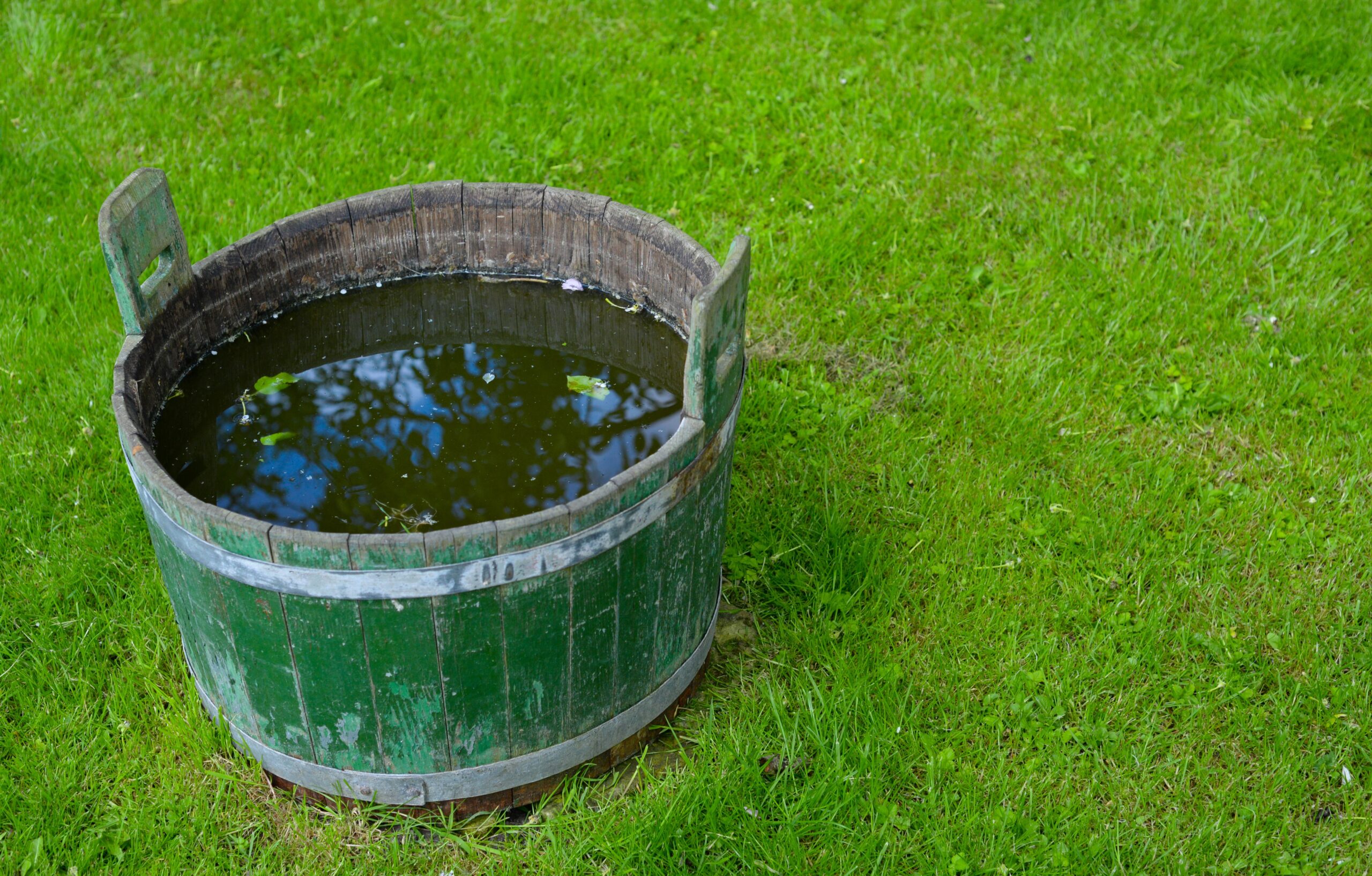
 Image description: A green wooden barrel storing rainwater, surrounded by grass. Image credit Rudy and Peter Skitterians from Pixabay.
England faces a critical water security crisis unless the government fundamentally transforms how it stores, manages, and reuses water resources. A newly published cross-party report from the House of Lords Environment and Climate Change Committee warns that without decisive ministerial action, the country could face a public water supply deficit of 5 billion litres per day by 2055 – equivalent of around 2,000 Olympic swimming pools.
The report’s central finding challenges a common misconception: the problem is not rainfall scarcity but storage and management. While the UK receives adequate rainfall, the cross-party committee stressed that the country must drastically improve how it stores, manages, and reuses water. The warning comes after a severe 2025 drought that was declared a “nationally significant incident” based on widespread environmental damage and agricultural losses. That year saw hosepipe bans affecting nearly 9 million people, canal network closures, and substantial crop yield impacts across farming regions.
The committee identified four priority areas for government action. First, ministers must strengthen drought monitoring and data collection to inform long-term planning. Second, the peers urge campaigns to encourage household water reuse and rainwater harvesting, alongside enhanced water efficiency standards in new homes and SME buildings. Third, the report calls for greater flexibility in abstraction licensing to allow farms, golf courses, and other water-intensive businesses to build local storage reservoirs. For the rural economy, this regulatory change could be the difference between a viable harvest and a crop write-off during dry periods. Finally, peers want emergency planning updated urgently. The government must publish a prioritisation plan for severe drought by autumn 2026 and roll out nature-based solutions including wetland restoration and sustainable urban drainage in both urban and rural settings.
Climate forecasters warn that El Niño conditions are likely to return from mid-2026, raising the probability of hotter, drier summers ahead. Central and Southern England have experienced one of the driest Aprils on record in 2026, with rainfall 23% below average nationally.
For the water sector and those depending on it the House of Lords report signals that adaptation and investment in water storage, reuse infrastructure, and regulatory reform are no longer optional extras. They are essential to England’s water security and economic resilience.