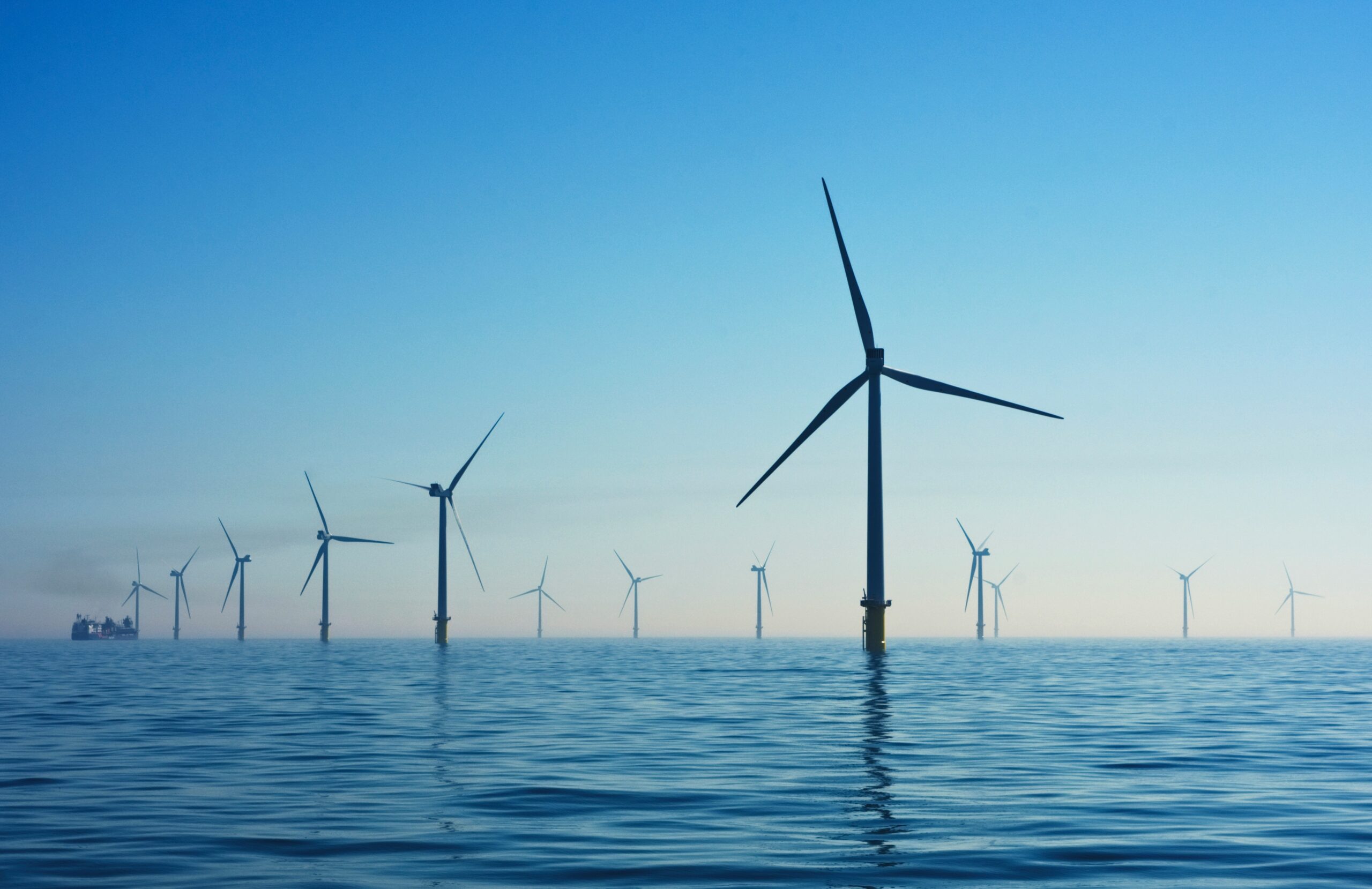
Photo by Nicholas Doherty
The UK has secured a record 8.4 gigawatts of offshore wind capacity in Europe’s largest ever offshore wind auction, with contracts awarded at prices 40% cheaper than building new gas power plants.
The seventh allocation round (AR7) awarded 8.2 GW of bottom-fixed offshore wind and almost 200 MW of floating offshore wind projects, enough clean electricity to power the equivalent of over 12 million homes.
Record-breaking competition
AR7 was one of the most competitive offshore auctions ever held in Europe, with a record 19 projects with a total potential capacity of 24 GW eligible to bid, according to WindEurope.
Strong competition led to average strike prices of £91.20 per megawatt hour in England and Wales and £89.49/MWh in Scotland. The 8.4 GW beat the previous record of 7 GW set in the 2022 auction, whilst the number of successful projects hit a record high at eight, surpassing the previous record of six in 2019.
UK Energy Secretary Ed Miliband said: “With these results, Britain is taking back control of our energy sovereignty. This is a historic win for those who want Britain to stand on our own two feet, controlling our own energy rather than depending on markets controlled by petrostates and dictators. It is a monumental step toward clean power by 2030, and the price secured in this auction is 40% lower than the alternative cost of building and operating a new gas plant.”
Cost comparisons
The cost of building and operating a new gas-fired power station is £147 per megawatt hour, using the LCOE industry metric. By contrast, the results for fixed offshore wind in AR7 averaged £90.91 per megawatt hour, or £65.25 in the commonly used benchmark of 2012 prices, making offshore wind 40% cheaper than the cost of building and operating new gas.
The AR7 prices are also almost 30% lower than building and operating new nuclear plants in the UK at £124/MWh, according to WindEurope. The power generated by the 8.4 GW of new offshore wind farms will save billpayers nearly £1.7 billion per year compared to the alternative cost of gas.
Analysis suggests the outcome will be roughly cost neutral for consumers, as CfD payments would be balanced by lower wholesale costs. In late 2025, Baringa concluded that a strike price of up to £94.50/MWh for up to 8 GW of offshore wind would be cost neutral, implying the AR7 result at £91/MWh is likely in or around the cost-neutral range.
RWE dominates auction
German energy giant RWE was the biggest winner, securing contracts for almost 7 GW of offshore wind projects at a strike price of £91.20/MWh. RWE won CfDs for Norfolk Vanguard East and Norfolk Vanguard West, two Dogger Bank South projects, and the Awel y Môr offshore wind farm, with a combined capacity of 6.9 GW.
SSE secured a CfD for 1.4 GW of capacity from Phase B of its Berwick Bank project at a guaranteed strike price of £89.49/MWh. Martin Pibworth, Chief Executive of SSE, stated: “We are delighted Berwick Bank B has been successful in AR7 and has secured a CfD for 1.4 GW of essential new low-carbon power for the UK at a competitive price for consumers. This milestone enables us to advance the project towards a final investment decision.”
Floating wind projects
Two floating offshore wind projects with a combined capacity of 192.5 MW won contracts, securing a strike price of £216/MWh. The winning floating wind projects include the 100 MW Erebus in the Celtic Sea and the 100 MW Pentland in Scotland.
Blue Gem Wind, a joint venture between Simply Blue Group and TotalEnergies, is developing Erebus. The Pentland floating wind project, developed by Copenhagen Infrastructure Partners, recently secured investment from Great British Energy, National Wealth Fund and Scottish National Investment Bank.
Geographic spread
The projects are located right across the UK and will provide new generation near big demand centres in the south east of England, as well as bringing economic benefits and investment in energy infrastructure to Scotland and Wales.
Berwick Bank in the North Sea represents the first new Scottish project since 2022 and is the largest planned offshore wind project in the world. Two others are at Dogger Bank South, off the coast of Yorkshire, and Norfolk Vanguard, off the East Anglian coast. Awel Y Môr in the Irish Sea is the first Welsh project to win a contract in more than a decade.
Economic impact
The successful results unlock £22 billion in private investment and support 7,000 good, skilled jobs across the UK, from the Scottish Highlands to the Celtic Sea. In total, these new projects will power more than 9.7 million homes and attract over £22 billion in new private investment in the UK’s economy.
Adam Morrison, Industry Co-Chair of the Offshore Wind Industry Council, said: “The results send a clear signal to investors that the UK continues to be a world leader in offshore wind, and today’s announcement will directly trigger investment in factories and jobs across the UK needed to build and operate these projects.”
RenewableUK analysis shows that maximising investment in high-value parts of the UK’s offshore wind supply chain could deliver an extra £25 billion to the economy over the next decade, building on the 150 factories and hundreds of businesses around the country already benefitting from contracts to build and manage offshore wind farms.
Recovery from failed auction
The government inherited the fiasco of the previous government’s failed Auction Round 5 in 2023, in which not a single offshore wind project was secured. The last auction round, AR6, got the industry back on its feet with 5.3 GW secured.
The AR7 auction now marks a turning point with strong competition and a large pipeline of ready-to-build projects. With a budget of £1.79 billion, the UK Government went beyond the initial budget of £1.1 billion, securing extra capacity to boost energy security and economic resilience.
Meeting future demand
These new projects are vital as many of the UK’s old gas and nuclear plants are set to retire in the 2030s, and the country’s electricity demand is expected to surge in the years ahead. Electricity demand is set to increase significantly as existing nuclear and gas capacity retires.
The ground-breaking result puts Britain firmly on track to achieve its clean power mission by 2030, whilst strengthening energy security and reducing reliance on volatile global fossil fuel markets.