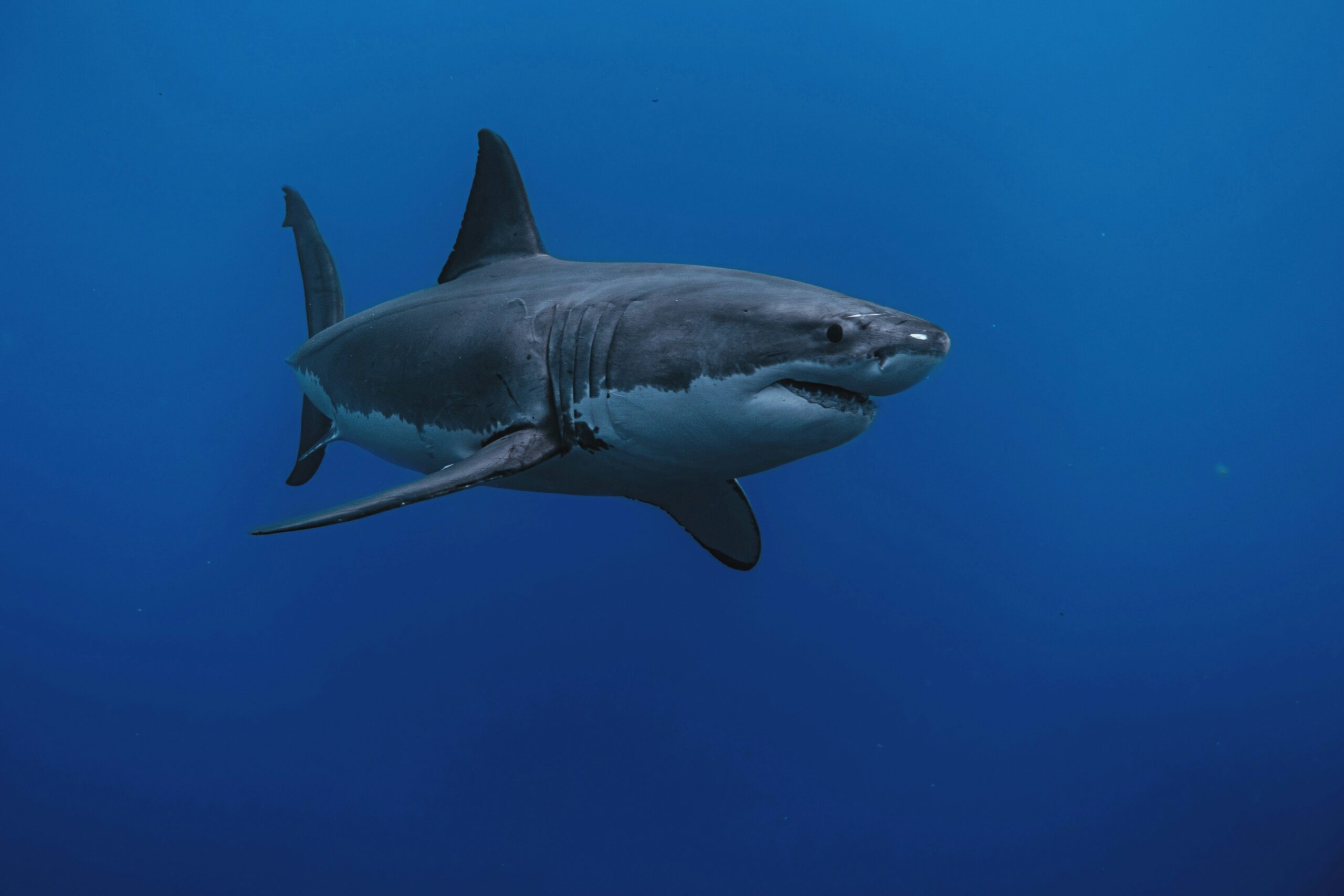
Photo by Gerald Schömbs
Great white sharks in the Mediterranean Sea face extinction within years as illegal fishing and weak enforcement of international protections push the iconic predators toward collapse, according to research by US scientists working with the UK charity Blue Marine Foundation.
The Mediterranean white shark population is now classified as Critically Endangered by the International Union for the Conservation of Nature, with monitoring of fishing ports on North Africa’s Mediterranean coast revealing that at least 40 great white sharks were killed there in 2025 alone.
Failed expedition highlights ecosystem collapse
Lead researcher Dr Francesco Ferretti from Virginia Tech explained that many shark populations, particularly white sharks, have declined dramatically in the Mediterranean in recent decades. “No other stretch of water is fished like the Mediterranean Sea,” he said, speaking to BBC News whilst working on a research vessel off the coast of Sicily in late 2025. “The impact of industrial fishing has been intensifying… and it’s plausible that they will go extinct in the near future.”
In their latest attempt to find and study the predators, Dr Ferretti and his team worked in the Strait of Sicily, an area between Sicily and North Africa identified as a last stronghold for several threatened shark species. One key aim was to fit a satellite tracking tag onto a white shark, something never achieved in the Mediterranean Sea.
The researchers brought more than three tonnes of fish bait, including a shipping container packed with frozen mackerel and tuna scraps, as well as 500 litres of tuna oil to create a “fat slick” that many sharks would be able to smell from hundreds of metres away.
Despite working for two weeks, baiting the ocean, taking samples of seawater to search for shark DNA and using underwater cameras, the researchers did not manage to find any animals to tag. They captured only a brief glimpse of one blue shark on their submarine cameras.
“It’s disheartening,” Dr Ferretti told BBC News. “It just shows how degraded this ecosystem is.”
Protected sharks sold in markets
The BBC News investigation, working with researchers from Blue Marine Foundation, found that protected sharks are caught, landed and offered for sale in countries including Tunisia and Algeria. The BBC independently verified footage posted on social media of a great white being landed in a fishing port in Algeria and another large shark that appears to be a protected short-finned mako being prepared for sale on a trolley in a fish market in Tunisia.
Great whites are one of more than 20 Mediterranean shark species protected under international law, meaning it is illegal to fish for them or to sell them. Currently, 24 threatened species have international legal protection, including mako, angel, threshers and hammerheads.
The EU and 23 nations around the Mediterranean have signed an agreement which states that those species cannot be “retained on board, transhipped, landed, transferred, stored, sold or displayed or offered for sale”. The international agreement states “they must be released unharmed and alive [where] possible”.
However, the rules do not tackle accidental bycatch and enforcement varies from country to country.
Nearby killings during research mission
Whilst the team was searching for surviving sharks, they received reports that a juvenile great white had been caught and killed in a North African fishery just 20 nautical miles from where they were working.
Dr Ferretti estimates more than 40 white sharks have been caught along that coast. “This is a lot for a critically endangered population,” he said.
Poverty and conservation conflict
In poorer communities in North Africa, fishers who catch sharks might face the choice of whether to feed their family or return a threatened species to the ocean.
Sara Almabruk from the Libyan Marine Biology Society says that most of the catches happening in North African waters are accidental, but adds: “Why would they throw sharks back into the sea when they need food for their children? If you support them and train them in more sustainable fishing, they will not catch white sharks – or any sharks.”
Broader Mediterranean shark decline
Almost all species of elasmobranchs, mainly sharks and rays, present in the Balearics are threatened, with a decline of more than 90% in the western Mediterranean compared to the beginning of the 20th century.
In August last year, beachgoers at Can Pere Antoni beach in Palma were left stunned when a massive shark washed up on the beach already dead. The incident reignited debate about sharks in Balearic waters. Experts have unveiled plans to step up protection for sharks and rays around the islands, calling for tighter controls on fishing and measures to protect fragile marine habitats.
Hope for recovery
James Glancy from Blue Marine said his own investigations found white sharks openly sold in Tunisian markets. “It shows that there is wildlife left,” he told BBC News. “And if we can preserve this, there is a chance of recovery.”
Glancy added that if countries around the Mediterranean worked together, “there is hope”. “But,” he added, “we’ve got to act very quickly”.
Conservation experts emphasise that immediate action is needed to prevent the complete loss of great whites from Mediterranean waters. This includes stronger enforcement of fishing regulations, expanded marine protected areas, and international cooperation to combat illegal fishing operations.
Great white sharks play a vital role as apex predators in marine ecosystems, helping maintain the delicate balance of ocean food chains. Their disappearance from the Mediterranean would represent not just a conservation tragedy, but an ecological disaster with far-reaching consequences for the entire marine environment.