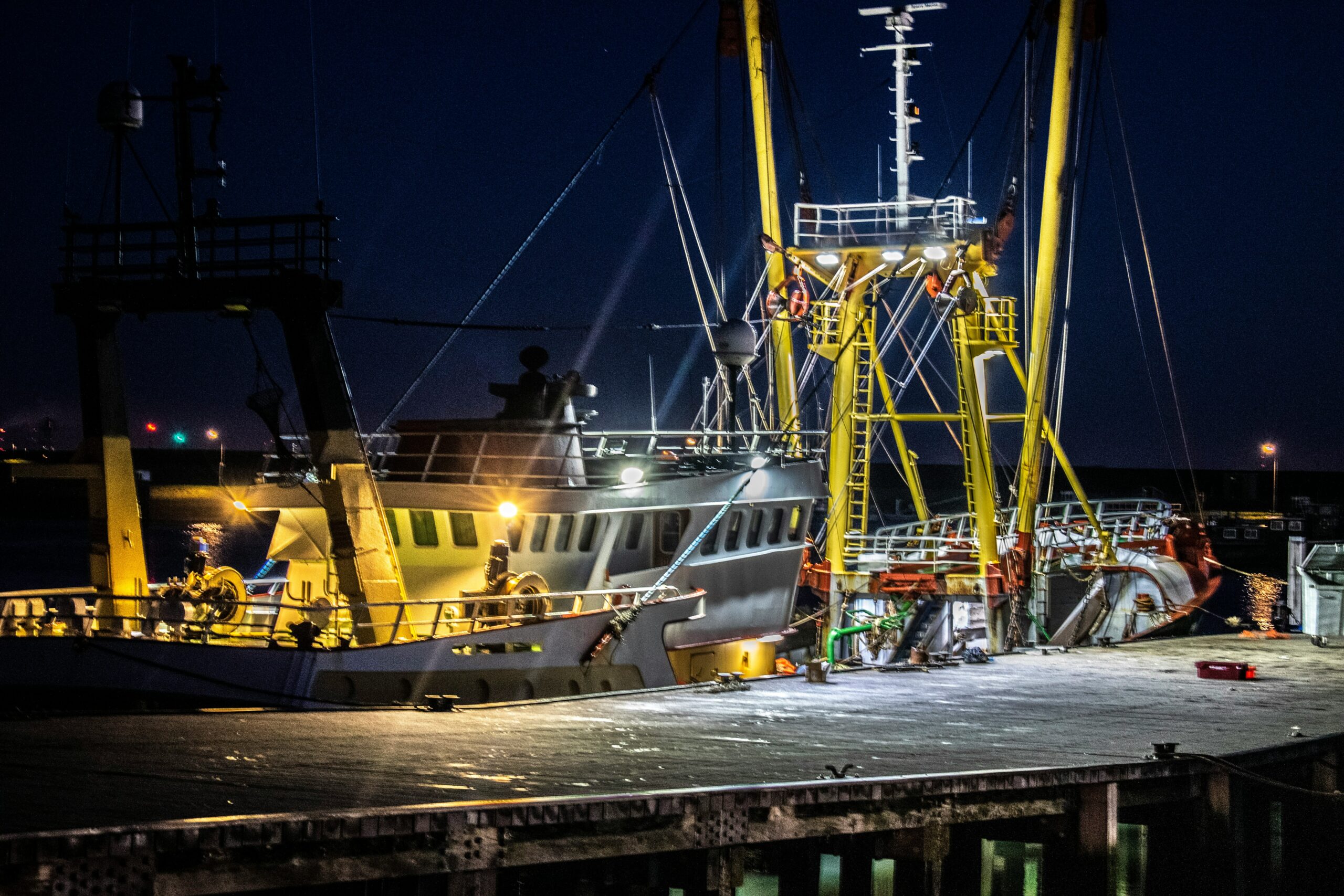
Photo by Paul Einerhand
Hundreds of foreign fishing vessels descend annually on Mile 201, a largely ungoverned strip of high seas just beyond Argentina’s exclusive economic zone, creating what experts describe as one of the world’s largest unregulated squid fisheries with serious implications for marine ecosystems and human rights.
The fleet, which can become so large it is visible from space, has been characterised by the Environmental Justice Foundation as a “floating city” that threatens both Argentina’s $2 billion squid industry and the wider marine ecosystem of the South Atlantic.
Scale of operations
In a monitoring room in Buenos Aires, members of the Argentinian coast guard watch giant industrial fishing ships moving in real time across screens. “Every year, for five or six months, the foreign fleet comes from across the Indian Ocean, from Asian countries, and from the North Atlantic,” Commander Mauricio López of the monitoring department said. “It’s creating a serious environmental problem.”
Analysis by Oceana of fishing activity from January 2018 to April 2021 documented over 800 foreign vessels logging more than 900,000 total hours of apparent fishing along Argentina’s maritime border. The analysis revealed that 69% of this fishing activity was conducted by more than 400 Chinese vessels, with ships from South Korea, Taiwan and Spain making up another 25%.
The total number of fishing vessels at the border of international waters and Argentina’s exclusive economic zone, known as “milla 200” or Mile 201, has increased by nearly a third since 2010, from 400 vessels to approximately 550. By comparison, the Argentine fleet authorized to fish inside the EEZ consists of between 70 and 75 ships.
Environmental concerns
Shortfin squid represents the second-largest squid fishery in the world by volume, with half of the global catch coming from Argentina’s waters. The species has a rapid life cycle, living and spawning for only one year. Because these squid migrate far out to sea to reproduce, overfishing by distant-water fleets can have serious repercussions on populations for years to come.
“You don’t have any place in the world where in a short strip of ocean, you have more than 550 vessels fishing without any regulation,” Diego Schvartzman told CNN. “And the environmental impact is because of this.”
Squid is a vital food source for hake, sperm whales, penguins and elephant seals. Experts warn that continued overfishing in the South Atlantic could deplete squid populations, affecting marine ecosystems and potentially impacting tourism.
Beyond the target species, crews on more than 50% of Chinese vessels and a fifth of Taiwanese vessels have revealed the unreported capture and killing of seals, with culls sometimes numbering in the hundreds.
Dark fleet operations
Oceana documented more than 6,000 gap events where AIS transmissions did not broadcast for more than 24 hours, permitting fishing vessels to hide their locations and mask potentially illegal behaviour. Chinese vessels were responsible for 66% of these incidents, logging more than 600,000 total hours invisible to tracking systems.
CNN analysis found that of approximately 500 instances when fishing vessels had their tracking systems turned off over the past year, over 92% involved Chinese-flagged ships. At night, many vessels turn on bright lights to lure squid to the surface—lights so strong they can be seen from space.
“This connection was particularly evident in April 2020, when approximately 100 squid jiggers, mostly Chinese-flagged, were allegedly caught fishing illegally within Argentina’s EEZ, each with their AIS turned off,” Oceana reported.
Human rights concerns
Workers on vessels describe physical violence inflicted upon them, including hitting or strangulation, wage deductions, debt bondage, and excessive hours of work with little rest. Many vessels turn off their identification systems to avoid detection, putting their crews at risk alongside increasing regulatory hurdles.
Despite these dire conditions, much of the squid caught at Mile 201 ends up in markets in the EU, the UK and North America.
Military response
Argentina’s navy has deployed two aircraft and two corvettes for surveillance operations aimed at strengthening its presence in the maritime zone and deterring foreign vessel intrusions. The P-3C Orion surveillance plane, carrying Defence Minister Luis Alfonso Petri and senior military officials, flew toward a concentration of fishing vessels near the outer edge of the exclusive economic zone.
Encounters between the Argentine coast guard and suspected illegal fishing vessels have escalated to violence. In 2016, Argentina’s coast guard chased and sank the Chinese fishing ship Lu Yan Yuan Yu after it was caught illegally fishing in Argentine waters and reportedly attempted to force a collision with the coast guard vessel.
Economic impact
The shortfin squid fishery generates an average of $597 million annually for South America’s economy and, in particularly favourable years, can generate nearly $2.4 billion. Argentina’s commercial fishing industry produces $2.7 billion in economic impact and constitutes 3.4% of the country’s gross domestic product.
Darío Sócrate, executive director of the Argentine Chamber of Squid Jig Owners, estimates that local fishermen only catch half of what they could have because of foreign fishing activities just beyond Argentina’s maritime frontier.
Dr Marla Valentine, Oceana’s illegal fishing and transparency campaign manager, stated: “Fishing at this scale, under the radar, and without regard for laws and sustainability can have detrimental impacts on entire ecosystems, as well as the people and economies that depend on them. This is just one example of how unregulated distant-water fishing fleets can take advantage of a lack of transparency and enforcement at sea.”