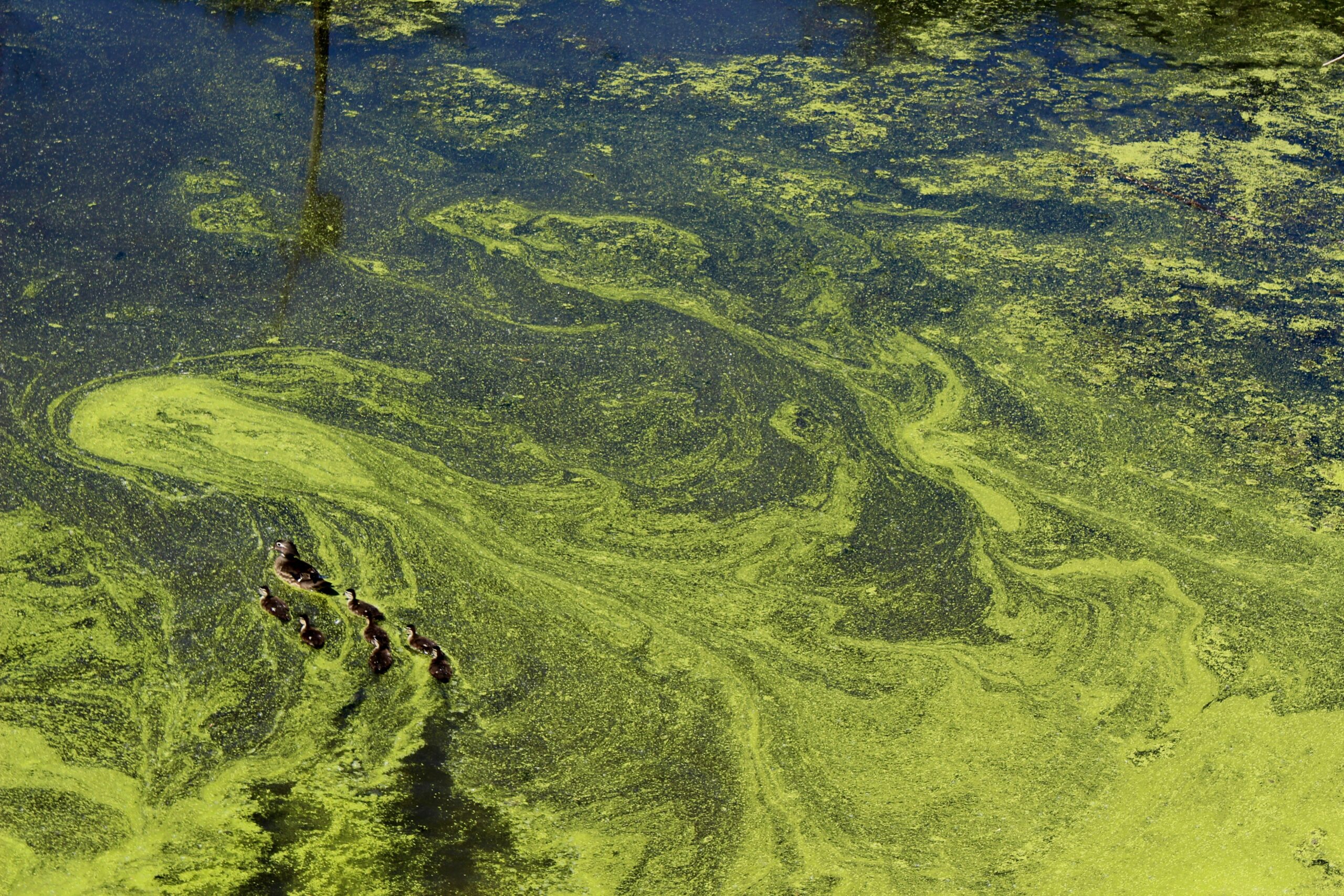
Image description: An algae bloom floating on the water’s surface, with a bird and its chick swimming through. Image by Liz Harrell on Unsplash
The Department of Agriculture, Environment and Rural Affairs (DAERA) has launched the first stage of an online data viewer providing near real-time monitoring of Lough Neagh’s water quality as part of ongoing efforts to tackle blue-green algae blooms. This initial data viewer release will display data from nine monitoring sites in the Lough and its main tributaries.
Three multiparameter probes positioned in the northeast, northwest and southwest of the lough transmit data every 30 minutes on temperature, dissolved oxygen, turbidity, specific conductivity and phycocyanin fluorescence – a key indicator for distinguishing toxic blue-green algae from harmless species. Six additional probes at major tributary inflows measure temperature and dissolved oxygen monthly.
Addressing a water quality crisis
DAERA Minister Andrew Muir described the platform as “an important intervention in providing scientific data to help better understand water quality situation in the Lough. Making this data accessible greatly improves transparency, supports more effective decision making and improves the public’s understanding as we work together to address the water quality crisis at Lough Neagh.”
Lough Neagh, the UK’s largest freshwater lake at over 380 square kilometres, provides drinking water to approximately 40% of Northern Ireland’s population through four water treatment works. However, the lough has experienced severe blue-green algae blooms driven by excess nutrients from agricultural and wastewater systems, exacerbated by climate change impacts and ecological disruption from invasive zebra mussels.
Accessing interactive data
Users can view recent probe data through interactive graphs and download datasets for multi-year analysis. The platform includes GIS datasets, water quality monitoring station information and free satellite imagery enabling visualisation of algal growth patterns and movement.
Development is multi-staged, with NIEA already collecting data for forthcoming enhancements including nutrient levels and algal species identification. These additions will be available in coming months, with further improvements planned through 2026 and 2027.
The viewer was developed under the Lough Neagh Science Platform, a commitment outlined in DAERA’s Lough Neagh Report and Action Plan. The platform supports scientists, researchers and environmental organisations in monitoring water quality, developing predictive models and informing interventions.
Integration of space technology
The data platform complements broader technological interventions. Through the UK Space Agency’s Unlocking Space for Government programme, DAERA received £800,000 funding for Phase 2 of a Small Business Research Initiative developing operational remote-sensing solutions to predict, detect and monitor blue-green algae using satellite technology, drones and AI-enabled forecasting.
Two suppliers – Newcastle University’s ALGAE-Watch project and Plastic-i’s Bloomcast NI – are developing systems combining satellite imagery, drone surveys and environmental data to provide earlier, more accurate information for public health protection and resource targeting. The programme aligns with the Lough Neagh Action Plan and Inter-agency Blue-Green Algae Monitoring Protocol.
While the data platform represents progress in open data provision, following DAERA’s recent bathing waters application launch, officials emphasise all data comes from a constantly changing natural environment and remains non-validated. The public can report suspected algal blooms via the Bloomin’ Algae app or DAERA’s emergency pollution hotline.