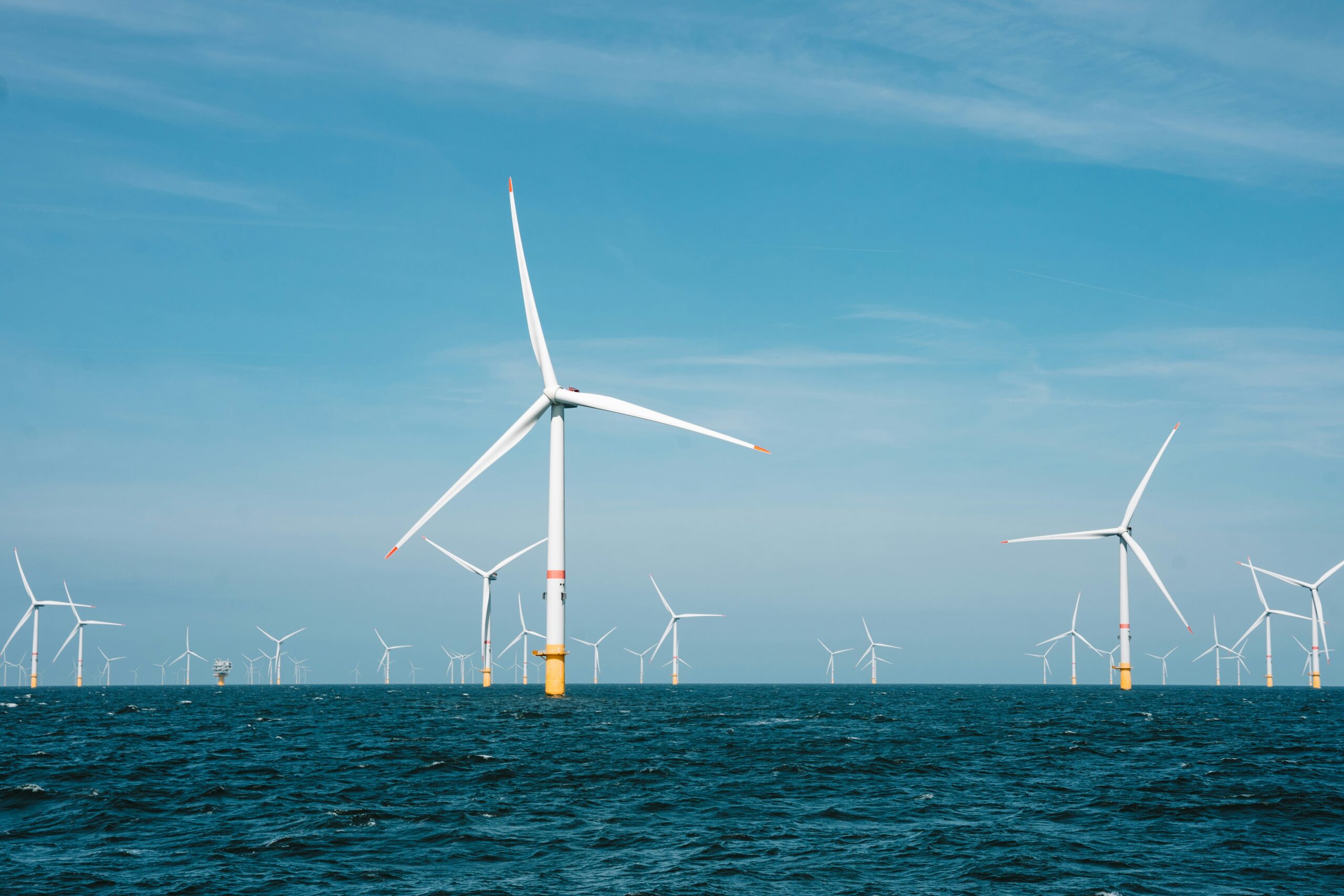
Photo by Jesse de Meulenaere
The UK is marking 25 years since its first offshore wind farm began generating clean power, celebrating a transformation that has seen the sector grow from two pioneering turbines to become the country’s second-largest electricity source.
On 8th December 2000, Blyth Offshore Wind Farm off the Northumberland coast began operating, consisting of two turbines built a kilometre out to sea at an average depth of eight metres, generating enough power for 3,000 homes. The four-megawatt pilot project was described as the first “truly offshore” wind farm in the world, the first to feel the full force of the open sea.
In a single generation, offshore wind has grown to become the UK’s biggest source of clean power, according to industry figures. The sector provided over 34% of all renewable electricity in 2024, RenewableUK reported. Last year, it produced a record 17% of the UK’s electricity overall (48.5 terawatt hours), and the industry now has a generating capacity equivalent to five large nuclear power stations. The UK currently has 2,878 offshore wind turbines (10 floating, 2,868 fixed) with a total generating capacity of 16.1 gigawatts, enough to power more than 16 million homes each year.
Without the development of the offshore wind sector, the country would have imported and burned more than 20 million additional tonnes of gas over the last 25 years, producing over 60 million tonnes of CO₂, according to RenewableUK. New analysis by the Energy and Climate Intelligence Unit finds the growth of offshore wind has reduced the UK’s spending on imported fuels by at least £30 billion to date.
Michael Shanks, Minister for Energy in the Department for Energy Security and Net Zero, said: “Twenty-five years after the first offshore wind turbines began to turn, Britain is once again leading the world in clean homegrown power. Offshore wind is at the heart of our 2030 mission – helping us reduce our dependence on volatile fossil fuel markets, lower bills for good, and support 100,000 jobs by 2030.”
Nearly 2,000 companies around the UK are now part of the wind energy supply chain, including 160 factories, which are forecast to contribute £18.2 billion to the UK economy over the next decade. The offshore wind industry supports around 40,000 jobs across the country, which is set to grow to 94,000 by 2030, the industry body reported. Of the sector’s 40,000 jobs, 7,000 were added in the last two years.
There are more than 7.5GW of offshore wind currently under construction, which will be fully operational in the next two years, as well as a further 22GW consented through to 2033, according to RenewableUK. Modern turbines are far more powerful than those at Blyth. At Moray West offshore wind farm, analysts noted that one turbine generates more than three times the power output of the entire original Blyth installation.
Marking the anniversary, The Crown Estate announced sixteen projects across England, Wales and Scotland are set to share over £13 million through its Supply Chain Accelerator. Projects in Plymouth, Pembrokeshire, Blyth and Orkney are among those to receive development funding to keep the UK at the forefront of the global offshore wind industry. These awards represent the second funding round of The Crown Estate’s Supply Chain Accelerator programme, which aims to accelerate and de-risk the early-stage development of UK supply chain projects that service the offshore wind sector.
The funding, which is nearly triple the amount awarded in The Crown Estate’s initial round in 2024, will help scale up projects in the fixed and floating offshore wind supply chain. The second round was expanded to include UK ports and port-related infrastructure to support the construction, assembly, manufacturing, operations and maintenance, and wet storage of fixed and floating offshore wind.
Julia Rose, Head of Offshore Wind at The Crown Estate, said: “25 years of success highlights the transformative power of collaboration and strategic vision, creating an environment in the UK where investment and innovation have thrived. We now have 45 operational windfarms in UK waters and a pipeline of 95GW. Looking beyond, The Crown Estate has also set out its approach to bring the next 20-30GW of leasing opportunity to market by 2030.”
She continued: “As we look ahead to 2050, our focus will be on providing the forward visibility the market needs, working in partnership with Government and industry to bring forward leasing rounds and deliver the many benefits offshore wind brings – namely economic growth, clean energy and energy security. The UK got the first 25 years right – now it’s about making sure we deliver the next chapter with the same confidence and ambition.”
In a separate but related development, Great British Energy has launched its Energy Engineered in the UK programme, providing up to £300 million in capital grant funding to build UK manufacturing capacity for key components in offshore wind and electricity networks, with a further £700 million earmarked for renewable energy supply chains within this parliament.
Great British Energy CEO Dan McGrail said: “Great British Energy is investing in British industry, we are helping to create jobs, driving innovation, and ensuring clean energy infrastructure is built here in the UK.”
He added: “This programme is about more than funding; it will help overcome the current challenges and ensure the benefits of a world-class supply chain are felt in communities across the country.”
Energy Minister Michael Shanks commented: “We want our clean energy future to be built here in Britain as part of our modern Industrial Strategy. This fund will boost our manufacturing capabilities for offshore wind – supporting jobs and growth in communities across the country.”
RenewableUK’s Deputy CEO Jane Cooper welcomed the announcement: “Last year the offshore wind industry published an Industrial Growth Plan, which set out in detail the new factories and wider network of businesses in the UK which will be critical to deliver the wind farms the country needs, which include facilities manufacturing key components like cables, blades and foundations. It’s fantastic that Great British Energy is aligning with industry to secure those potential investments, providing their £300 million fund alongside private investment from developers of new wind farms in the years ahead.”
RenewableUK’s Head of Supply Chain, Ajai Ahluwalia, highlighted the economic potential: “Our research shows that by focussing on high-value goods and services for our world-class offshore wind sector, we can triple our current manufacturing capacity, create thousands of extra supply chain jobs and boost the nation’s economy by a further £25 billion between now and 2035. The Crown Estate is playing a key role in ensuring that we secure these economic benefits by providing fresh opportunities for communities throughout the UK.”