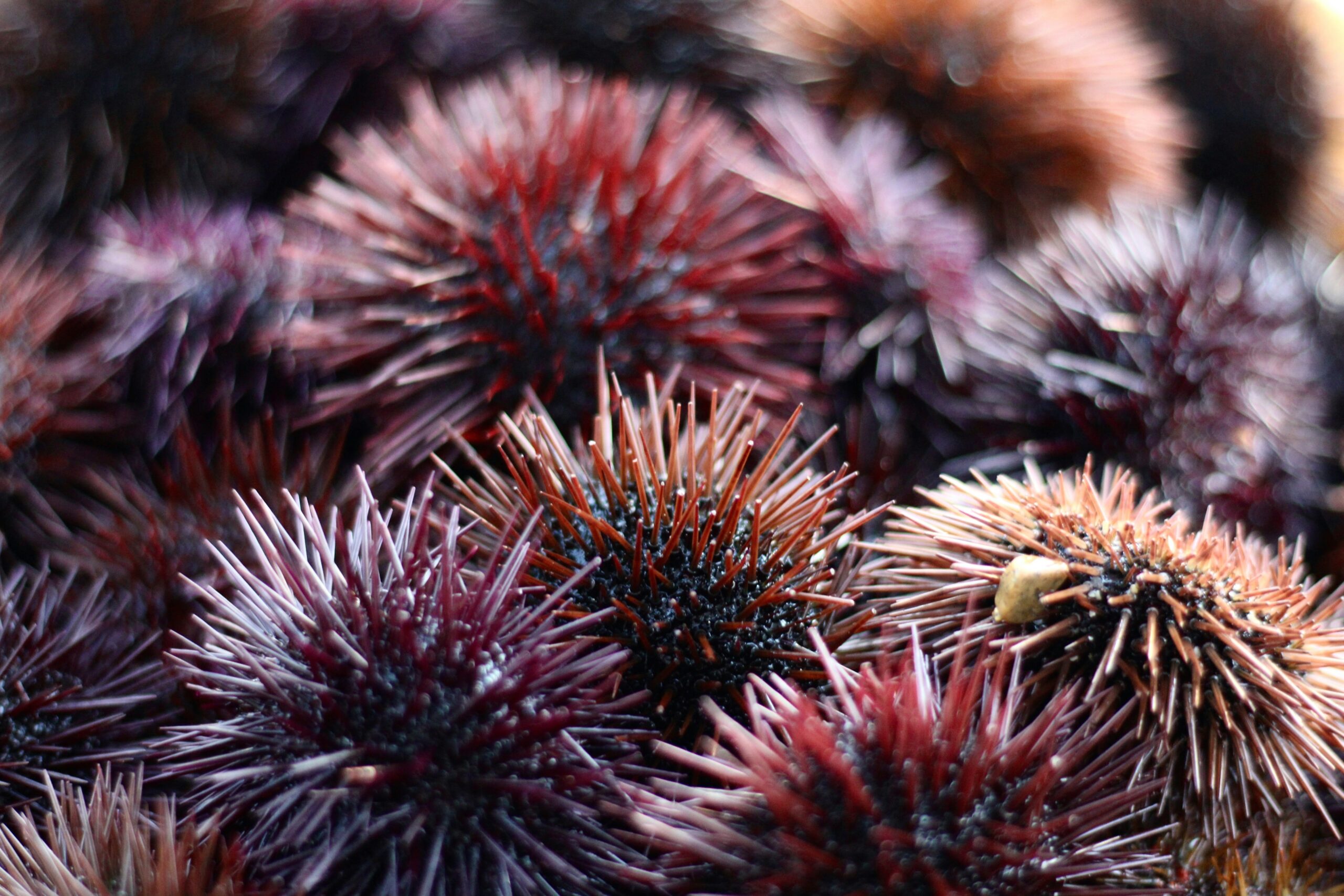
Photo by Sonia Kowsar
A mysterious pandemic is decimating sea urchin populations worldwide, with new research revealing catastrophic declines in the Canary Islands where some populations have plummeted by up to 99.7%. The mass mortality event, which has affected species across multiple ocean basins simultaneously, threatens to fundamentally alter marine ecosystems that depend on these critical grazing species.
A study published in Frontiers in Marine Science reports that since 2021, Diadema africanum urchins in the Canary Island archipelago have almost entirely been killed by an unknown disease. There has been a 99.7% population decrease in Tenerife, and a 90% decrease off the islands of the Madeira archipelago, according to The Guardian. In the same period, mass deaths have been detected in species from the Red Sea, Mediterranean, Caribbean and western Indian Ocean.
Iván Cano, a researcher at the University of La Laguna and author of the study, said: “What we have seen since 2021 is really, really concerning. We are talking about the disappearance of several species in a really short time.”
He explained: “At approximately the same time, other Diadema species have been observed to be dying off in the Caribbean, the Mediterranean, the Red Sea, the Sea of Oman, and the western Indian Ocean.”
Sea urchins are known as “ecosystem engineers”, affecting their surroundings by grazing on algae, breaking down food for other animals, and acting as food for predators. By controlling algal growth they promote the survival of hard coral, itself the habitat for thousands of marine species. Their loss has been felt in Caribbean reefs, where coral cover has halved and algal cover increased by 85%, according to The Guardian.
Cano said: “What fascinated me in the first place about this species is that they change their environment. Like humans, when they are present, they modify their habitat. We don’t know the cascading effect that this could have on other species.”
In the Canary Islands, numbers of D. africanum have been climbing since the mid-1960s, probably driven by a combination of overfishing of its predators and ongoing global warming. At several locations in the archipelago, this population boom was so intense that it led to extensive urchin barrens.
In February 2022, Cano and colleagues noticed that D. africanum had started to die off in large numbers off La Palma and Gomera. Over the rest of that year, the disease moved eastward across the islands. Infected sea urchins became less active, moved in unusual ways, failed to respond to external stimuli, and eventually lost their flesh and spines before dying.
In early 2008, and again in early 2018, a disease killed about 93% of D. africanum off Tenerife and La Palma. After the 2008 event, many urchin populations rebounded relatively quickly. Following the 2022 mortality, however, that kind of recovery did not appear to be happening. Instead, a second wave of mass mortality swept through the Canary Islands during 2023.
To understand how severe these losses were, Cano and colleagues carried out extensive field surveys of D. africanum at 76 sites across the seven main islands between summer 2022 and summer 2025, comparing their counts with historical records. To investigate reproduction, the team set traps to capture drifting larvae in September 2023 and measured newly settled juveniles in January 2024.
Cano said: “Our analyses showed that the current abundance of D. africanum across the Canary Islands is at an all-time low, with several populations nearing local extinction. Moreover, the 2022-2023 mass mortality event affected the entire population of the species across the archipelago.”
The authors concluded that D. africanum is barely reproducing along the eastern coast of Tenerife. Only extremely small numbers of larvae were caught in the traps, and no early juveniles were detected in any of the shallow rocky habitats that were surveyed.
The scientists do not know exactly what has caused this pandemic, but Cano said humans were “probably involved” in the distribution of the disease. Current theories about its transmission include shipping, changes to currents and abnormal wave activity.
Cano said: “We don’t yet know for certain which pathogen is causing these die-offs. Mass mortality events of Diadema elsewhere in the world have been linked to scuticociliate ciliates in the genus Philaster, a kind of single-celled parasitic organisms.”
He added: “We aren’t yet sure how this pandemic will evolve. So far, it seems not to have spread to other populations in Southeast Asia and Australia, which is good news – but we cannot rule out the possibility that the disease will reappear and potentially spread further.”
Molecular diagnostics have detected the same waterborne scuticociliate protozoan in diseased specimens from the Mediterranean Sea, the Red Sea, the Sea of Oman, and Réunion Island, with initial outbreaks predominantly recorded near harbour areas.