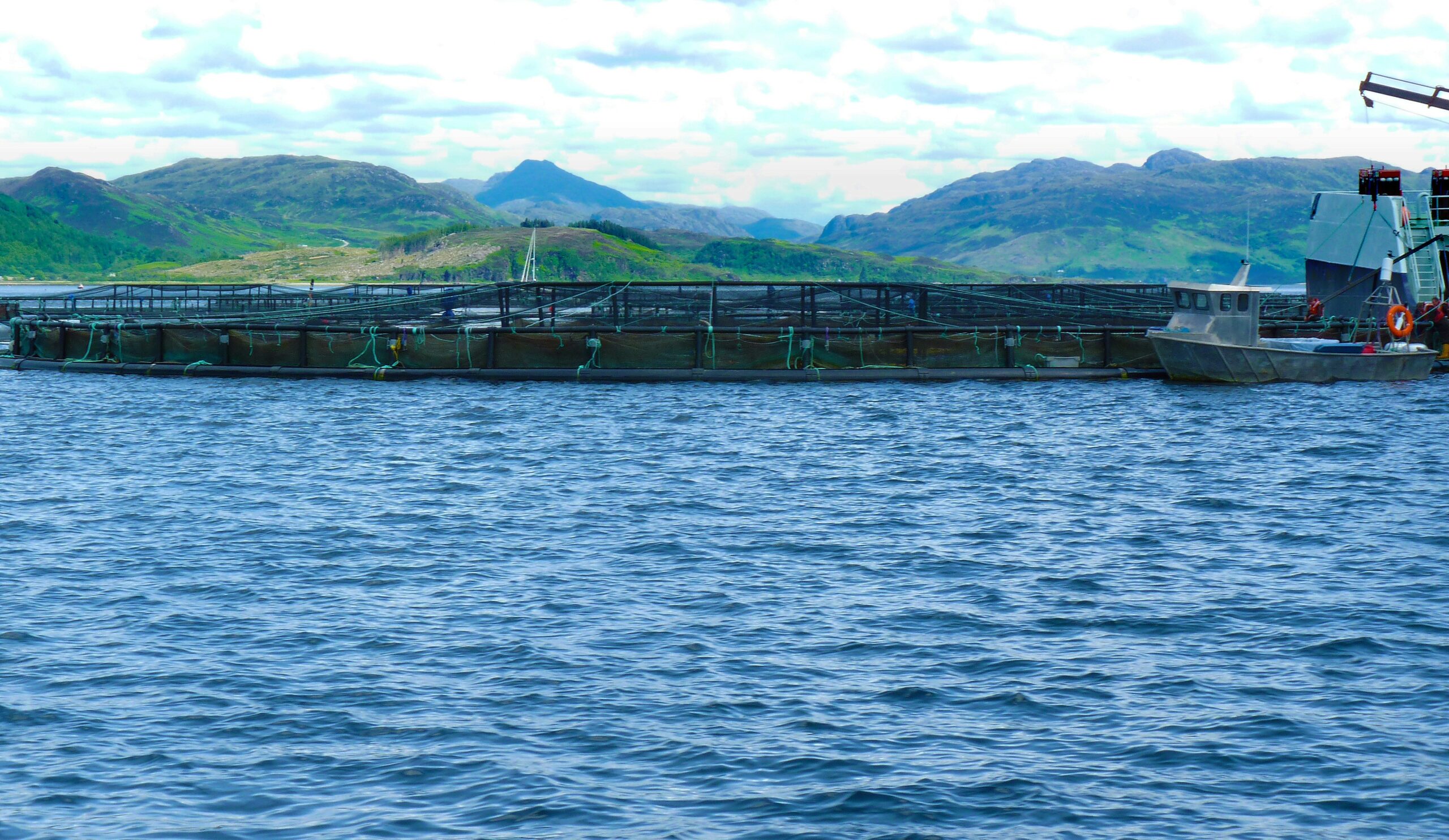
Photo by Craig Thomas
Millions of fish deaths at Scottish salmon farms have been made public after the government’s Animal and Plant Health Agency (APHA) was ordered to release its inspection reports following a ruling by the Information Commissioner’s Office (ICO).
APHA had refused to disclose the reports, arguing that publication would “likely result in significant detriment to the companies, negatively impacting their ability to conduct business, manage their reputation and their ability to protect their business.” The ICO rejected that position, finding no valid grounds for withholding the information. Animal Equality UK, which brought the original freedom of information request, described the decision as a “watershed moment for public transparency.”
What the reports reveal
According to Animal Equality UK, the released documents detail a series of mass mortality events at Scottish farms, none of which resulted in enforcement action by APHA. At an on-land farm called Inchmore, operated by Mowi — Scotland’s largest salmon farming company — more than 100,000 fish suffocated in 2021 after a worker left them unattended and their oxygen supply was cut off. In a separate incident at the same site in the same month, a build-up of hydrogen sulphide killed more than one million fish in ten hours. According to the Guardian, APHA took no enforcement action following either incident.
The Guardian reported that at Applecross, a site operated by Bakkafrost and certified by the RSPCA, 600,000 fish died from hydrogen sulphide build-up in 2022. The same problem recurred months later on a larger scale, killing more than 1.5 million fish. Again, no enforcement action followed.
The Guardian reported that at Maevag Hatchery, a trout farm referred by the Fish Health Inspectorate, APHA found that roughly 70,000 fish had died in 2023, with 7,800 survivors subsequently killed as “economically unviable.” The site had never once reported any deaths. APHA’s response was to email the operator a copy of the Code of Good Practice.
A fourth report the Guardian highlighted concerns Ouseness, a site in Orkney operated by Cooke Aquaculture. Nearly half a million fish were transferred there in February 2022, but stormy seas and fungal infections caused mass mortality almost immediately. Within the first six weeks, 123,000 fish died — but because reporting rules do not require deaths during the first six weeks after transfer to sea to be reported, neither the Fish Health Inspectorate nor APHA were informed at the time. By the time APHA eventually carried out a remote inspection months later, total deaths had exceeded 200,000. There is still no record of a site visit ever having taken place.
New footage adds to pressure on APHA
Alongside the ICO ruling, Animal Equality UK has published footage filmed in March 2026 at the Fiunary farm, operated by Scottish Sea Farms — the primary supplier to Marks & Spencer and a known supplier to Co-op. The video shows salmon suffering from blindness, open wounds, severe sea lice infestations and missing noses.
Between 16 February and 5 April 2026, Fiunary recorded 45,684 salmon deaths. The farm has experienced elevated mortality for seven consecutive weeks. During Scotland’s sensitive period — which runs from 1 February to 30 June, when wild juvenile Atlantic salmon migrate from rivers to sea, and during which farms are required to keep average adult female lice counts below 0.5 per fish — Fiunary recorded 2.73 adult female lice per fish in the week beginning 9 February, nearly five and a half times the permitted threshold.
Animal Equality instructed law firm Advocates for Animals to submit a formal complaint about conditions at Fiunary to APHA in March 2026, and is now demanding that APHA confirms what steps it has taken and releases all inspection reports for the site under the terms of the ICO ruling.
A pattern of weak oversight
The ICO ruling comes against a backdrop of longstanding concerns about the adequacy of regulatory oversight. According to Animal Equality UK, APHA inspected just 21 of Scotland’s 213 active salmon farms between 2023 and 2025, conducted zero unannounced inspections in 2023 or 2025, and just two in 2024. None of the 20 worst-performing sites, which together accounted for more than ten million deaths over that period, were inspected at all.
The Scottish Government’s Rural Affairs and Islands Committee wrote to the Cabinet Secretary in March 2026, criticising the slow pace of reform and noting that key recommendations from its landmark inquiry had not been implemented with the urgency it had called for. Among those recommendations was a call for regulators to be given powers to limit or halt production at sites recording persistently high mortality rates.
Nick Underdown, Scotland Director at WildFish, said: “This is a significant milestone. The Committee has practically confirmed that the regulatory system remains dysfunctional and ineffective. When a parliamentary committee acknowledges ongoing environmental harm, progress stalled in the courts and a lack of effective controls, the logical conclusion is hard to avoid: our planning authorities should not be allowing further expansion of salmon farming.”
The consequences extend beyond farmed fish. Independent research has found that comparative release studies in Norway and Ireland indicate 12 to 44 per cent additional mortality in returning adult salmon in farm-intensive areas attributable to lice exposure. Wild Atlantic salmon populations are currently at an all-time recorded low.
Competing views
An APHA spokesperson told the Guardian the agency was committed to openness and transparency, adding: “We treat all reports of suspected cases of poor welfare at salmon farms seriously and we will not hesitate to take further action if we find evidence of cruelty or neglect.”
A spokesperson for Salmon Scotland, responding on behalf of all producers named in the reports, said: “Claims made by activists are often taken out of context and present a misleading picture of what is happening on farms. Farms operate to world-leading welfare standards, backed by strict regulation, veterinary oversight, regular audits, and inspections.”
Co-op told the Guardian it was aware of the Fiunary footage and was “engaging urgently” with its supplier, adding that it takes “any reports relating to animal welfare extremely seriously.”
Abigail Penny, Executive Director of Animal Equality UK, said: “APHA’s culture of secrecy has to end. The public has every right to know what is happening on these farms and whether regulators are doing their jobs. People are utterly exhausted by the same cycle repeating itself — corporations inflicting suffering on animals, showing little remorse, while the bodies paid by taxpayers to hold them accountable look the other way. This information belongs to the public and should not be buried in bureaucracy to shield global conglomerates from proper scrutiny.”
The ICO’s ruling, while a significant step, still means that future inspection reports will not be published routinely. Members of the public will need to submit individual freedom of information requests to obtain them.