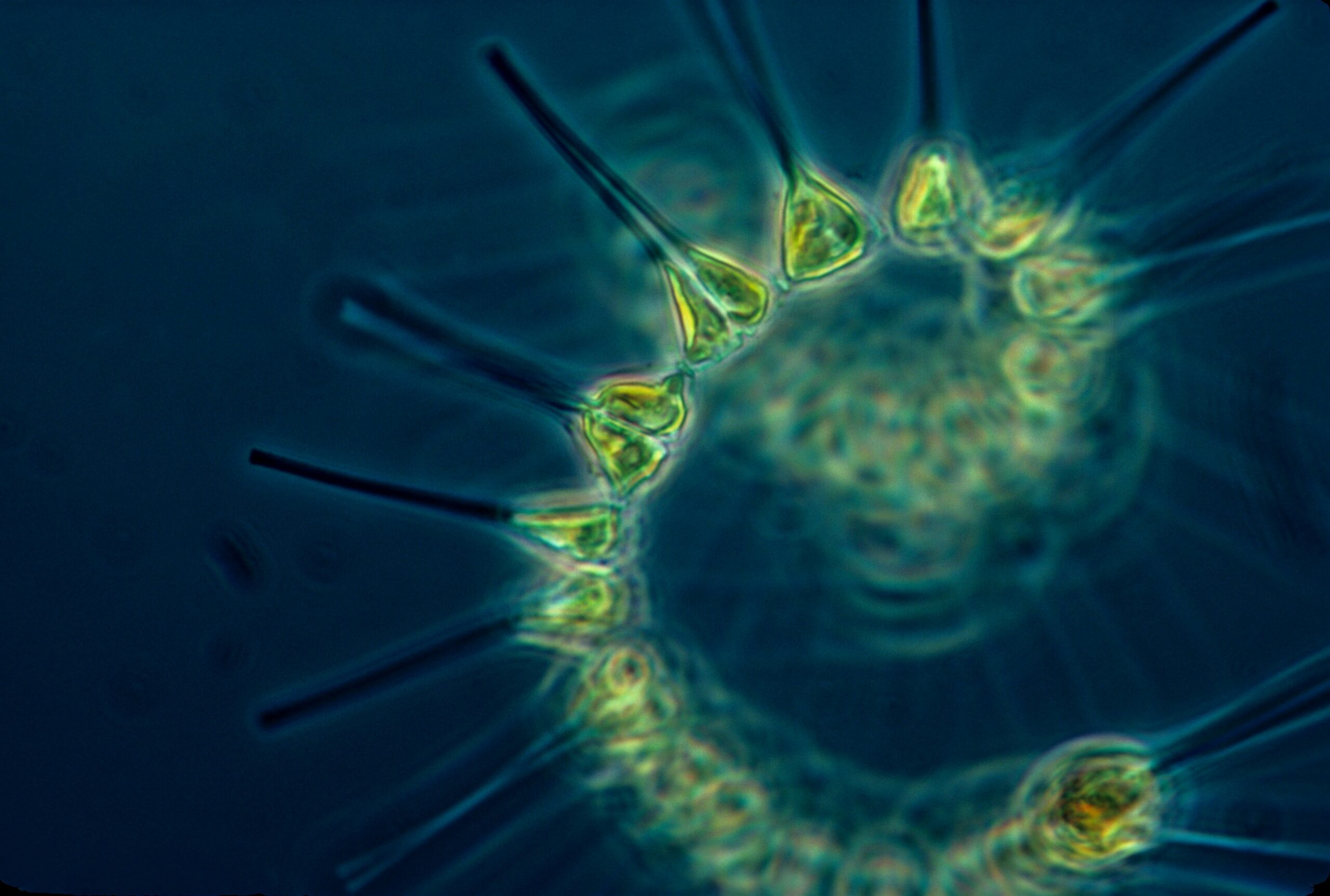
Photo by NOAA
A major new scientific review has found that climate change is already driving large-scale shifts in the plankton communities that underpin UK marine food webs, with knock-on risks for fisheries, seabirds and the ocean’s ability to store carbon.
A landmark rolling review
The study, from the UK’s Marine Climate Change Impacts Partnership (MCCIP), warns that continued warming of UK waters is likely causing major changes to the tiny drifting organisms that are the foundation of marine food webs. The review, Impacts of Climate Change on plankton and pelagic habitats in UK waters around the UK and Ireland, updates a previous MCCIP assessment from 2020 and draws on more than 500 scientific studies published since 2019. It was led by Dr Matthew Holland of the University of Plymouth’s Centre for Marine Biology and Conservation Science, working with 17 co-authors from institutions including the Marine Biological Association (MBA), Plymouth Marine Laboratory (PML), the Environment Agency, Cefas, the Marine Directorate of the Scottish Government and the Scottish Association for Marine Science.
Dr Holland set out the report’s purpose in comments carried by Oceanographic: “Plankton form the foundation of marine food webs, supporting fisheries and playing a fundamental role in carbon cycling, yet they often receive far less attention than more visible parts of the marine environment. By summarising the latest evidence, I hope this report provides policymakers, managers, and the wider public with a better understanding of how climate change is already affecting UK seas, and what future changes could mean for the benefits that our shared marine ecosystem provides to society.”
A key evidence base was the MBA’s Continuous Plankton Recorder (CPR) Survey, one of the world’s longest-running and most geographically extensive marine ecological monitoring programmes, alongside long-term data from PML’s Western Channel Observatory.
Smaller plankton, less efficient food webs
The report’s central finding is that as UK seas warm and become more stratified, larger, more nutritious plankton species are increasingly being replaced by smaller ones better suited to nutrient-poor conditions. Oceanographic reports that long-term monitoring shows declines in both large phyto- and zooplankton in oceanic waters beyond the continental shelf, while smaller plankton and microbial species are increasingly dominating warmer, stratified shelf waters. The problem, the report notes, is one of efficiency: smaller species transfer energy less effectively up the food chain, reducing the food available to the fish, seabirds and marine mammals that depend on them.
David Johns of the MBA, one of the report’s co-authors, explained the mechanism in comments to the MBA: “This new MCCIP report shows that warming seas are driving major changes in plankton communities around the UK and Northeast Atlantic. Spring blooms are occurring earlier, warm-water species are shifting northwards, and smaller plankton and microbial species are increasingly replacing larger, more nutritious plankton. This changes the efficiency with which energy moves through marine food webs and may increase the risk of mismatches between plankton availability and fish spawning.”
The timing of the spring plankton bloom, a critical event that triggers feeding and spawning across the ecosystem, has already advanced in many parts of the North Sea, creating the risk of dangerous mismatches with fish spawning cycles that have evolved over millennia. Fish most likely to be affected include herring, mackerel, sprat and sandeel, an important prey species for seabirds, larger fish and marine mammals, the MBA notes. Warmer water also raises the energy fish larvae need simply to survive, with the report suggesting herring larvae could need up to 35% more food under future warming conditions, with knock-on impacts possible for cod, haddock and whiting.
A weakening climate defence
Beyond fisheries, the report warns changes to plankton could weaken the ocean’s capacity to remove carbon dioxide from the atmosphere, since plankton play a crucial role in transporting carbon to the deep ocean. Johns told the MBA: “The consequences extend beyond changes in distribution and biodiversity. Reduced food-web productivity threatens fisheries, while changes in plankton communities may weaken the ocean’s capacity to remove carbon from the atmosphere.” As waters become more stratified, more energy is expected to become trapped in microbial loops, repeatedly recycled among tiny organisms rather than passed up to fish.
The report also flags marine heatwaves, which have become more frequent, intense and longer-lasting in recent decades, as a growing concern, disrupting plankton life cycles and pushing some species towards their thermal limits. Researchers are additionally watching for the possibility of a substantial weakening of the Atlantic Meridional Overturning Circulation (AMOC), which could significantly reduce plankton growth and further alter the UK’s climate.
Monitoring gaps remain
Despite the UK hosting some of the world’s most comprehensive long-term marine observation programmes, the review identifies significant monitoring gaps, particularly for smaller plankton species and gelatinous organisms such as jellyfish, which are increasing in some regions but remain poorly tracked, along with under-sampled offshore areas. These climate pressures are also being amplified by eutrophication, changing nutrient ratios, coastal darkening, fishing impacts and offshore energy infrastructure, PML notes.
Professor Angus Atkinson MBE, a co-author on the report and Senior Marine Ecologist at PML, said: “The findings in this report demonstrate both the value of long-term monitoring, such as that performed by the PML-led Western Channel Observatory, and the urgency of maintaining marine monitoring programmes around the world. As climate pressures intensify, improving our understanding of plankton dynamics will be fundamental to safeguarding marine ecosystems, supporting sustainable fisheries and informing effective marine policy.”
Professor Abigail McQuatters-Gollop of the University of Plymouth, another co-author, framed the report as part of a longer campaign to raise the profile of an easily overlooked part of the marine environment. “We have been saying for decades that plankton communities are changing as a result of shifts in the global climate and human activities, and more comprehensive evidence is the only way we can bring that to greater attention,” she told Oceanographic. “This report, and the robust scientific evidence it is based on, can hopefully be another piece of the jigsaw that ultimately leads to joined-up action for marine biodiversity management at a regional and global scale.”