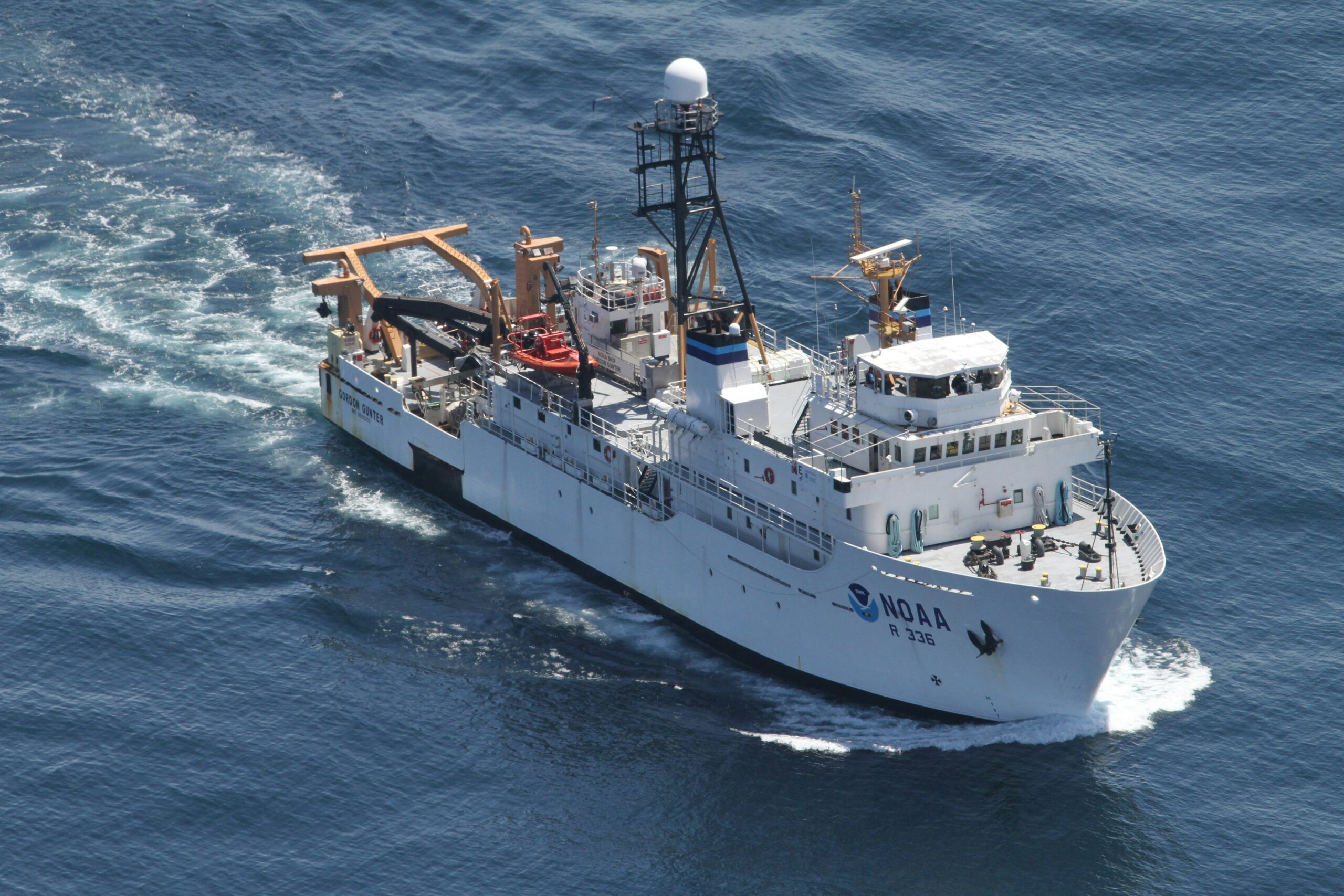
Photo by NOAA
The Trump administration is dismantling a decade-old network of deep-ocean instruments that scientists have relied upon to track climate change, monitor marine heatwaves and study the Atlantic Meridional Overturning Circulation (AMOC). International researchers warn the decision will “severely degrade” weather forecasting and El Niño predictions, with economic consequences they argue far exceed the cost of the network itself.
On 21 May, the National Science Foundation (NSF) announced that recovery of more than 900 in-water instruments had already begun at four of the five currently operating arrays of the Ocean Observatories Initiative (OOI). The arrays being decommissioned span the Gulf of Alaska, the coasts of Oregon and Washington, the waters off New England and North Carolina, and the Irminger Sea between Greenland and Iceland. Only the Regional Cabled Array, which collects data from a tectonic plate off the Pacific Northwest coast, will continue operating for now. All previously collected data will remain accessible through the OOI Data Centre.
The OOI was established in 2016 to provide continuous, real-time data to researchers worldwide, originally planned for up to 30 years of operation. Its $368 million array of instruments in the Pacific and Atlantic collected physical, chemical, geological and biological data used to understand marine food webs, gas exchange between ocean and atmosphere, tectonic plate movement and the long-term impacts of climate change. OOI principal investigator Jim Edson acknowledged what is being lost, saying the network had “delivered the world’s most advanced continuously operating ocean observing systems, supporting science, engineering, education, and workforce development across the ocean sciences community.” He confirmed that as infrastructure is recovered from each array, “the associated real-time data streams and observing capabilities at those locations will come to an end.”
Project 2025’s blueprint
The decision follows policy laid out in the Heritage Foundation’s Project 2025 document, which explicitly targeted the OOI, claiming it was “the source of much of NOAA’s climate alarmism” and recommending that “the preponderance of its climate-change research should be disbanded.” The Trump administration had previously proposed 80% funding cuts to the OOI in both 2025 and 2026; on both occasions Congress restored the funding, but the NSF has now pressed ahead with decommissioning regardless.
NSF head of media affairs Michael England said the agency was not cancelling the programme entirely. “The decision to descope aligns with NSF’s wider strategy of a nimbler approach to prioritize support for evolving scientific priorities and emerging technologies, as well as smart lifecycle management within its research infrastructure portfolio,” he told CNN. He added that the decision was based partly on a 2025 National Academies of Sciences report, though that report recommended restructuring the network, not dismantling it.
Senator Sheldon Whitehouse, a Rhode Island Democrat, was blunt. “Fossil fuel is heating our oceans by the zettajoule, so Trump’s corrupt fossil fuel stooges want to turn off the monitors,” he posted on X.
Flying blind on storms and El Niño
The consequences of losing the OOI extend well beyond ocean research. Research published last month in Nature Climate Change found that removing US observations alone would produce a 163% increase in error in annual ocean heating rate estimates, and that losing US-funded platforms, which span every ocean basin, plugging gaps no other nation currently fills, would be worse than randomly losing 80% of all ocean data worldwide.
Sabrina Speich, an expert in global ocean monitoring at the École Normale Supérieure in Paris and chair of the ocean expert panel of the Global Climate Observing System, co-authored the research. “Ocean heat content is the most robust indicator of climate change we have – not just of what is happening in the ocean, but of the entire climate system,” she warned. “Lose them, and you lose your ability to track not just ocean warming but the climate system as a whole.” Forecasts, she said, “would continue – but they would degrade, sometimes dangerously so. Atmospheric observations alone are not sufficient.” With an intense El Niño forecast for this summer, the world could “lose the ability to see it coming clearly to act in time”, with direct consequences for farmers across the US and South America who rely on El Niño forecasts to plan their planting seasons months in advance.
John Abraham, professor of engineering at the University of St Thomas in Minnesota and co-author of the same research, described the decision as “penny-wise, pound foolish.” The US has suffered more than 400 climate and weather disasters with costs exceeding $1 billion between 1980 and 2024, amounting to $177 billion in 2024 alone. “The US government wants to save less than a billion in sensors, which are the eyes and ears of the ocean,” Abraham said. “We have hundreds of billions in climate costs per year. The cost of the observation system is a fraction of the climate costs from hurricanes and storms that hit the US. This is not about saving money, this is about killing climate science research.”
Rick Spinrad, who led NOAA during the Biden administration, was equally critical. “OOI is proving its value for a range of economic and social benefits: from fisheries management to weather forecasting, to protection from coastal flooding,” he told CNN. “Where’s the analysis of return on investment that shows that eliminating OOI is in the taxpayers’ best interest?”
Samantha Burgess, strategic climate lead at the EU’s Copernicus Climate Change Service, noted that ocean observations are “irreplaceable” because “we can’t see the deep ocean from space.” Without them, she warned, “we are flying blind.”
What is being lost
The Irminger Sea moorings, fixed some 2,800 metres below the surface, have been central to monitoring AMOC, the global current system that scientists fear may be approaching a tipping point. A growing body of research suggests AMOC could be on course to collapse potentially within this century, which would bring accelerated sea level rise along the US East Coast, a deep freeze in European winters and prolonged droughts across parts of Africa. “Ongoing monitoring of the ocean is critical, especially now,” said Stefan Rahmstorf, a physics and oceans professor at Potsdam University who studies the AMOC. “Concern in the oceanography community about major ocean current changes ahead is large,” he told CNN.
Hilary Palevsky, a marine biogeochemist at Boston College who has used OOI data for a decade to study carbon dioxide uptake by the ocean, explained that the Irminger Sea site had shed light on the deep-water convection processes that drive AMOC. “We have gained some really important insights into both how that happens in the Irminger Sea in particular, and how the drivers of that process vary from year to year from the observations that have been gained at this site,” she said.
In the Gulf of Alaska, Ocean Station Papa, one of the longest-running data sets in the North Pacific, is also for the chop. Russ Hopcroft, chair of the oceanography department at the University of Alaska Fairbanks, warned that its removal was particularly ill-timed. “It’s an unfortunate time to have something being pulled out of the water with all these predictions we’re hearing about this super El Niño coming, and this is one of the important sentinel sensors in that system,” he said. His colleague Seth Danielson, who used Papa data to study the 2014–2016 “blob” marine heatwave that decimated fish populations and killed seabirds and marine mammals across the Pacific, was equally direct: “We wouldn’t have been able to know how much heat actually was in the ocean during the time of the blob,” he said. Fisheries managers in the Gulf of Alaska also depend on Papa’s long-term ocean chemistry data when setting catch limits.
The impacts in the Pacific Northwest will be felt more immediately. The Coastal Endurance Array off Oregon and Washington is integrated into wider ocean instrumentation in the region, helping monitor water temperature and oxygen levels. Jan Newton, an oceanography professor at the University of Washington who helps maintain the array, told CNNthat it helps tribal fishermen from the Quinault Indian Nation determine whether there are sufficient Dungeness crab to catch, or whether oxygen levels are low enough to cause crab die-offs or movements to other waters. Its buoys also provide critical weather readings for vessels in the area, alerting captains to dangerous conditions. The array’s 11 instruments are due to be removed by the end of the month, after which Newton said the area will have insufficient data. “To me, this is counterintuitive because we are not funding the things that will help us maintain maritime dominance and shellfish competitiveness,” she said.
Chris Robbins, associate director of scientific initiatives at Ocean Conservancy, warned the wider effects would be far-reaching. The dismantling would “create an irreparable blind spot for our country in predicting earthquakes, fishery health, storm forecasting, coastal flooding and more,” he told CNN. “It just doesn’t make sense.”
International alarm
Helen Findlay, a biological oceanographer at the Plymouth Marine Laboratory who studies ocean acidification, warned that large parts of the global ocean have already crossed into a “zone of risk” for ecosystem change and that none of this work would have been possible without long-term observations. “Sustained ocean observations are how we detect emerging risks in real time,” she said. “Without them, we are effectively choosing to navigate an increasingly volatile ocean with diminishing visibility. If anything, this moment should strengthen, not weaken, our commitment to sustained ocean observation and climate research.”
Craig McLean, who served as NOAA’s acting chief scientist during Trump’s first term, said the move “reflects the further lack of understanding that the current administration has of scientific value and scientific merit. By dismantling such a system, we push the United States back yet again into a rear seat in global scientific leadership,” he told Oceanographic Magazine.
In a partial counterweight to the US pullback, the European Commission this week announced it will invest €92 million in a new ocean monitoring initiative called OceanEye, more than half of which will go to the Global Ocean Observing System. The announcement was long-planned rather than a direct response to the US decision.
Part of a broader rollback
The dismantling of the OOI is the latest in a series of cuts to federal ocean and climate science. Since January 2025, the NSF has lost an estimated 40% of its staff. In April the administration fired all 22 independent board members of the foundation without explanation – just days before the OOI descoping announcement. NOAA’s Mauna Loa Observatory, the US Global Change Research Program and the NOAA Billion Dollar Weather and Climate Disaster dataset have all faced cuts or closure. The administration has also withdrawn from US engagement with IPCC climate assessments, and is simultaneously pushing to expand deep-sea mining and loosen fishing regulations, moves that have separately alarmed ocean scientists.
Removal of the OOI arrays is expected to be complete within approximately 15 months, with work at the Endurance Array off Oregon and Washington already under way.