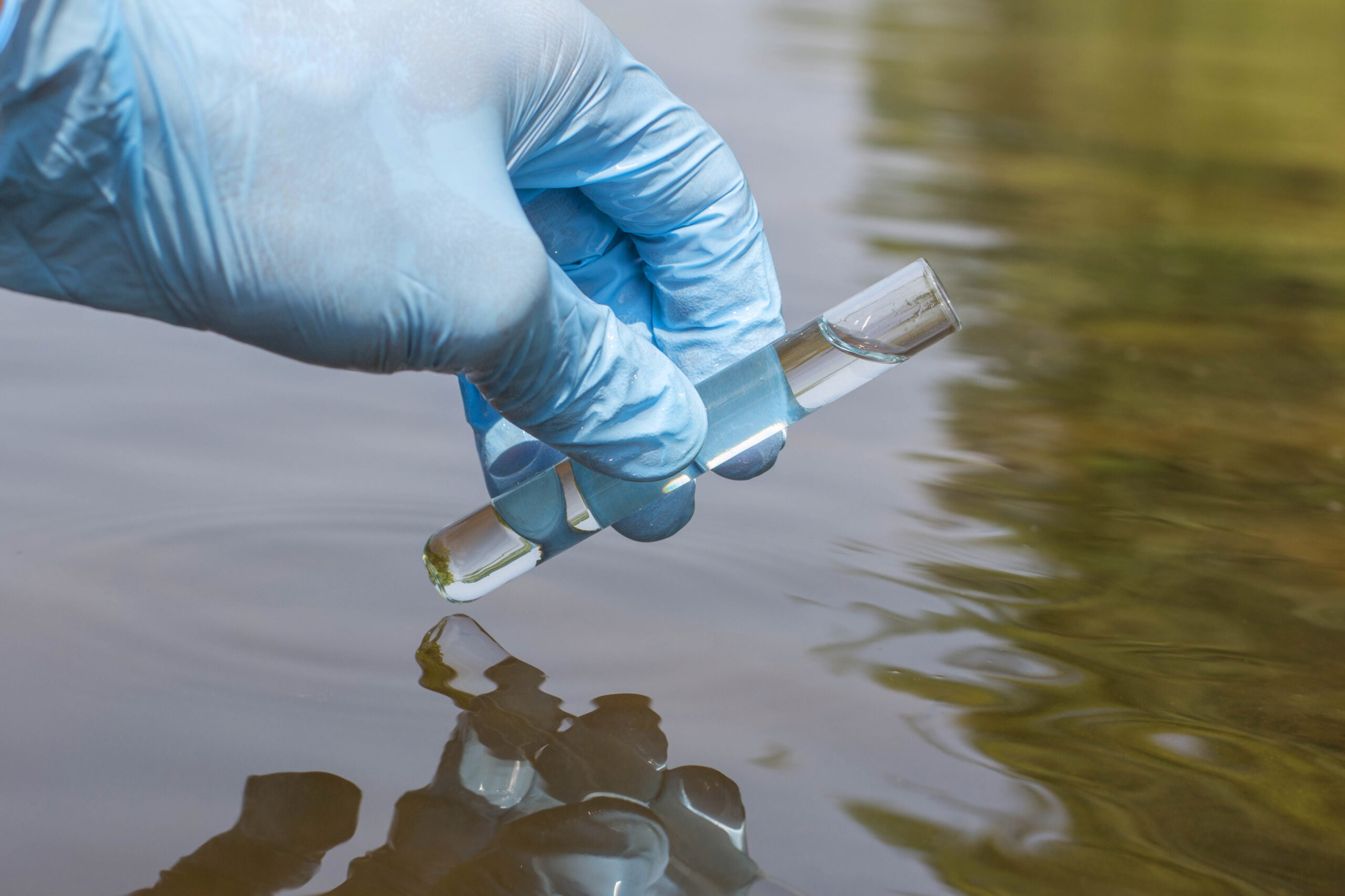
Image description: A hand wearing a blue glove holding a test tube after sampling water from the river for analysis.
The Guardian has exclusively revealed that Thames Water’s pilot tests for its proposed Teddington Direct River Abstraction (TDRA) scheme produced levels of a toxic “forever chemical” at up to 13 times the legal limit, based on an investigation into technical notes in the company’s files for the project. The Guardian reports the data from the pilots is in stark contrast to public comments from Thames Water that their water recycling project in south-west London would not harm the river, its habitats or public health.
Rapid and significant breaches of legal limits
The TDRA scheme is designed to abstract up to 75 million litres of water a day from the Thames at Teddington during periods of drought, replacing it with an equivalent volume of treated sewage from the Mogden treatment plant via a new tunnel into the river. The pilot tests, however, reportedly revealed rapid and significant breaches of legal limits for perfluorooctane sulfonate (PFOS), a particularly toxic type of PFAS chemical. It belongs to a class of chemicals dubbed “forever chemicals” due to its persistence in the environment and links to human health risks including cancer.
PFOS levels reached 6.3 nanograms per litre in the first test and 8.7 nanograms per litre in the second, against a UK legal limit for surface waters of 0.65 nanograms per litre. The Guardian reports that this “rapid breakthrough” above legal thresholds occurred in less than one month of operation. The pilots also showed very high levels of iron in the treated water, which the company’s own technical notes describe as likely to have a “significant detrimental impact” on the river.
Thames Water’s own documents acknowledge the problem
These new reports from the Guardian are particularly significant because the concerns are drawn from Thames Water’s own internal files. The company’s technical notes reportedly describe maintaining compliance with legal limits as “operationally challenging,” requiring carbon filters to be frequently regenerated, reactivated and replaced at “significant additional operational expense.” Critics argue this undermines Thames Water’s public assurances about the scheme. Ian McNuff of campaign group Solar told the Guardian that the test failures were rapid and that the idea of the scheme operating as a reliable asset during drought was “unrealistic against current standards, let alone the higher ones expected around Pfas and pesticides.”
Costs rising as financial pressures mount
The scheme’s finances are also raising concerns. The Guardian reports that the original cost estimate of £350m is now expected to rise to more than £500m, after Thames Water discovered it needs to install additional mechanical pumps within a nature reserve near Teddington. This comes as the company struggles under debts of approximately £20bn and faces the prospect of government-handled administration. The Environment Agency, which rejected an earlier iteration of the scheme in 2019 on environmental grounds, has been given the pilot results and states that the Teddington site will undergo rigorous environmental assessments before any development work can begin.
What the key parties say
Thames Water maintains that the pilot data is not indicative of what would ultimately be released into the river when the project is operational, and that the scheme cannot proceed without an environmental permit from the Environment Agency. The company has also called for a national plan to ban PFAS and remove it from the environment, funded by manufacturers rather than bill payers. The Environment Agency acknowledged that water recycling projects will be critical to securing future water supplies, but stressed that environmental protection and sustainable development must go hand in hand. The Guardian’s findings raise pointed questions about the compatibility of indirect potable reuse schemes with current and tightening PFAS standards.