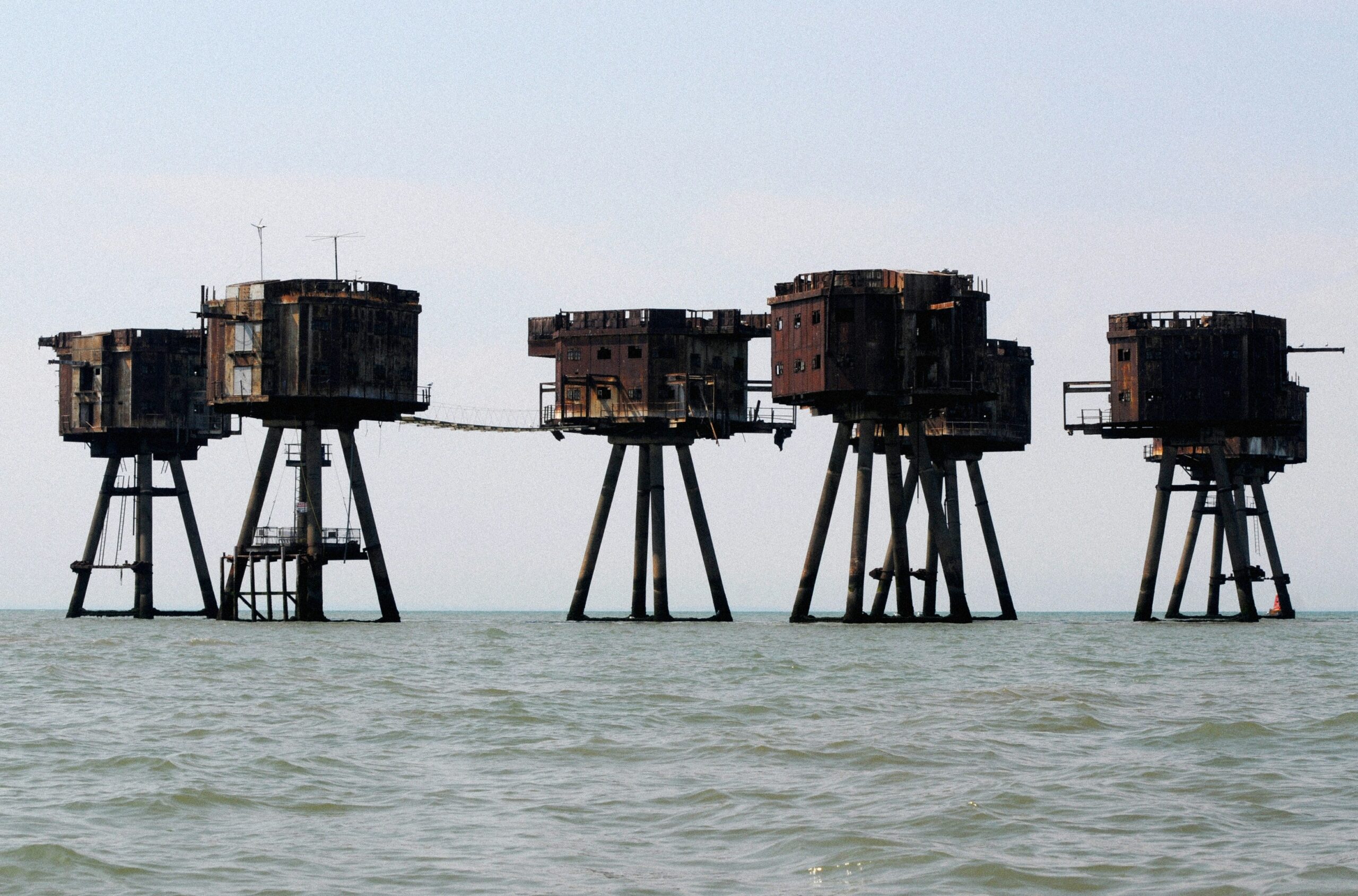
Photo of Maunsell Forts in the Thames Estuary, by James Boreham
UK waters have been gripped by a marine heatwave since February, with the southern half of the country still experiencing category I-III conditions in mid-August and pockets of the Dorset coast reaching category IV, “Extreme,” the most severe classification on the scale. Scientists say the scale and persistence of this summer’s heat, on top of last year’s, mean marine heatwaves are no longer occasional shocks but a recurring feature of British seas.
A record at Thames Estuary
The National Oceanography Centre (NOC) has been tracking the event through rolling updates since late June, drawing on satellite data, research vessels and Cefas’s WaveNet buoy network. Dr Bryony Townhill, principal scientist and deputy director of the international marine climate change centre at Cefas, said the South Knock buoy in the Thames Estuary recorded its highest ever temperature this month, at 21.6C. “We are not yet at the annual peak for sea temperatures, which normally occurs next week,” she said. “It is quite possible that this could be exceeded given the high levels of sunshine and weak winds forecasted over the coming week.”
Other Cefas SmartBuoys have logged similarly stark anomalies against the historical average, including a reading 5.3C above normal at Hastings and anomalies exceeding 4C at Poole Bay and Liverpool Bay. As of 16 August, the Celtic Sea and waters off the south-west coast remained 3-4C warmer than usual, and a small patch of sea off Weymouth remained in category IV conditions. Eloise Matthews, an Applied Climate Scientist at the Met Office, said the heat was likely to persist through the rest of the month, since “August is the month of peak sea surface temperatures around the UK, and the outlook is for marine heatwave conditions to persist around their current levels throughout the month, although this will be dependent on weather conditions.”
A summer of surprises
The temperatures are already reshaping what fishers, divers and swimmers are finding beneath the waves. Kurt Lander, skipper of the Yellowfin charter boat out of Brighton, recently mistook a fluttering shape in the Channel shipping lane for a person waving. “It sounds silly but I thought it was a person in the water waving,” he told the Guardian. Through binoculars, it turned out to be a pair of ocean sunfish lying on their sides and flapping their fins, part of a wider surge in sunfish sightings off British shores this summer that scientists link to the marine heatwave.
Lander’s catches have shifted too. “I used to catch at least a couple of hundred cod a year,” he said; now he lands perhaps one or two a year. In their place, he is bringing in warm-water species such as bass, comber and triggerfish. Dr Zoe Jacobs, a senior researcher at the National Oceanography Centre in Southampton, said colder-water species had largely disappeared off the southern coastline, shifting their range towards Scotland instead, though “temporarily or permanently, we don’t know.”
Off Falmouth, diver Gio Reale has noticed the same pattern from underwater. “Small water temperature changes have such big effects on marine life,” he said. It has been weeks since he last saw his favourite species, the small spotted catshark, which prefers water around 16-17C. “This summer, like every day, the water has been about 20C,” he said, adding that the sharks may have retreated to deeper, cooler water.
Common octopus, meanwhile, have arrived off the south coast in force since early last year, a native but historically rare species whose bloom has already disrupted crab and lobster fishing and is thought to be drawing in more Risso’s dolphins to feed. Warmer waters have also brought occasional Mediterranean visitors further from home, including mauve stinger jellyfish and, in 2025, the first UK record of a Caribbean and Mediterranean species known as the hair curler sea slug. Dr Jacobs cautioned that not every apparent invader is necessarily linked to warming, but said the appearance of species genuinely out of range, rather than simply more jellyfish sightings in a busy summer, was “a different story.”
Seagrass and kelp under strain
Warm water is also hitting the habitats conservationists are working hardest to protect. In north Wales, a rapid spike in temperature destroyed a seagrass restoration project on the Llŷn Peninsula. More than 500,000 seagrass seeds, hand-planted at Traeth Crugan in Bae Tremadog as part of Seagrass Ocean Rescue North Wales, a partnership between Swansea University, Project Seagrass and WWF-UK, were almost entirely lost within months of planting.
Dr Richard Unsworth, Associate Professor at Swansea University and Lead Scientist at Project Seagrass, said there had been every reason to expect success: “Over 500,000 seeds were planted into this bay. The seeds were really healthy. Everything was going in a really positive direction.” When the team returned to monitor the site, almost nothing remained. Dr Oliver Thomas, Senior Scientist at Project Seagrass, recalled: “We came down to the beach and sort of planned this big monitoring program, and then we found nothing, nothing at all. It was just bare sand.” Investigation traced the cause to a rapid marine heatwave in which temperatures rose by around 3.5C in less than a week, which Dr Thomas called “unprecedented” in marine terms for such a short spell. The team has since identified an alternative planting site near Holyhead considered more resilient to temperature extremes.
The UK has already lost around 92% of its seagrass meadows since the 1930s, and kelp forests have suffered similarly steep declines, in Sussex by more than 96%, according to the Blue Marine Foundation. Chris Williams, founder of the volunteer-run Hastings Kelp Project, told the Guardian that kelp loss was easy to overlook precisely because it happens out of sight: “You don’t see a degrading kelp forest from the land like you might see a woodland burning down or dying off because of the temperatures.” Even his controlled laboratory tanks have struggled to stay within kelp’s preferred range of 8-12C this summer. “Because of the heatwave, our chillers in the lab haven’t been able to keep the tanks below 12C,” he said.
A recurring pressure on fisheries
Dr Jacobs warned that the full impact on fisheries may not be clear for a couple of years, since even where adult fish survive elevated temperatures, eggs and juveniles may not. Warmer waters can also trigger harmful algal blooms; authorities in the Bay of Biscay have already closed beaches this summer to protect swimmers, and Dr Jacobs said the UK is “just not ready” should similar closures become necessary here. Looking further ahead, she said cod and mackerel fisheries in southern waters could ultimately give way to warmer-water species such as triggerfish, even as Scotland benefits from cod shifting north.
What concerns her most is the pattern of repetition. “I’m starting to call it our new normal because we seem to be getting hit by them in successive years,” she said. As background ocean temperatures continue to rise, she added, “the extreme is just going to be more extreme.”
A wider European and global pattern
The UK’s experience mirrors conditions further south. Copernicus Marine Service data for 13 August shows marine heatwave conditions persisting across the western Mediterranean and parts of the north-eastern Atlantic, with anomalies of up to 6C above the long-term average in the Gulf of Lion off southern France and readings above 5C in Atlantic waters off the Iberian Peninsula.
Writing for The Conversation, Sina Pinter and Nicole Jones of the University of Western Australia note that sea surface temperatures surged during the 2026 European summer by up to 5C above average in places, threatening ecosystems across the Mediterranean, North Sea and Baltic Sea, and warn that climate change means such events are becoming more frequent, more severe and longer-lasting as the ocean’s baseline temperature rises.
The European picture sits within a wider global trend. Average sea surface temperature outside the Arctic and Antarctic reached 20.96C in July, surpassing the previous July record set in 2023 by 0.07C, according to the EU’s Copernicus Climate Change Service. Samantha Burgess, Copernicus’ deputy director, said the all-time record from March 2024 will almost certainly be broken this year, adding: “It’s just a case of when.” Much of the anomalous heat is linked to a developing El Niño event in the Pacific, though scientists stress this is not the whole story, with wide areas of the northern Pacific, Atlantic and Mediterranean running hotter than the 1990-2020 average.