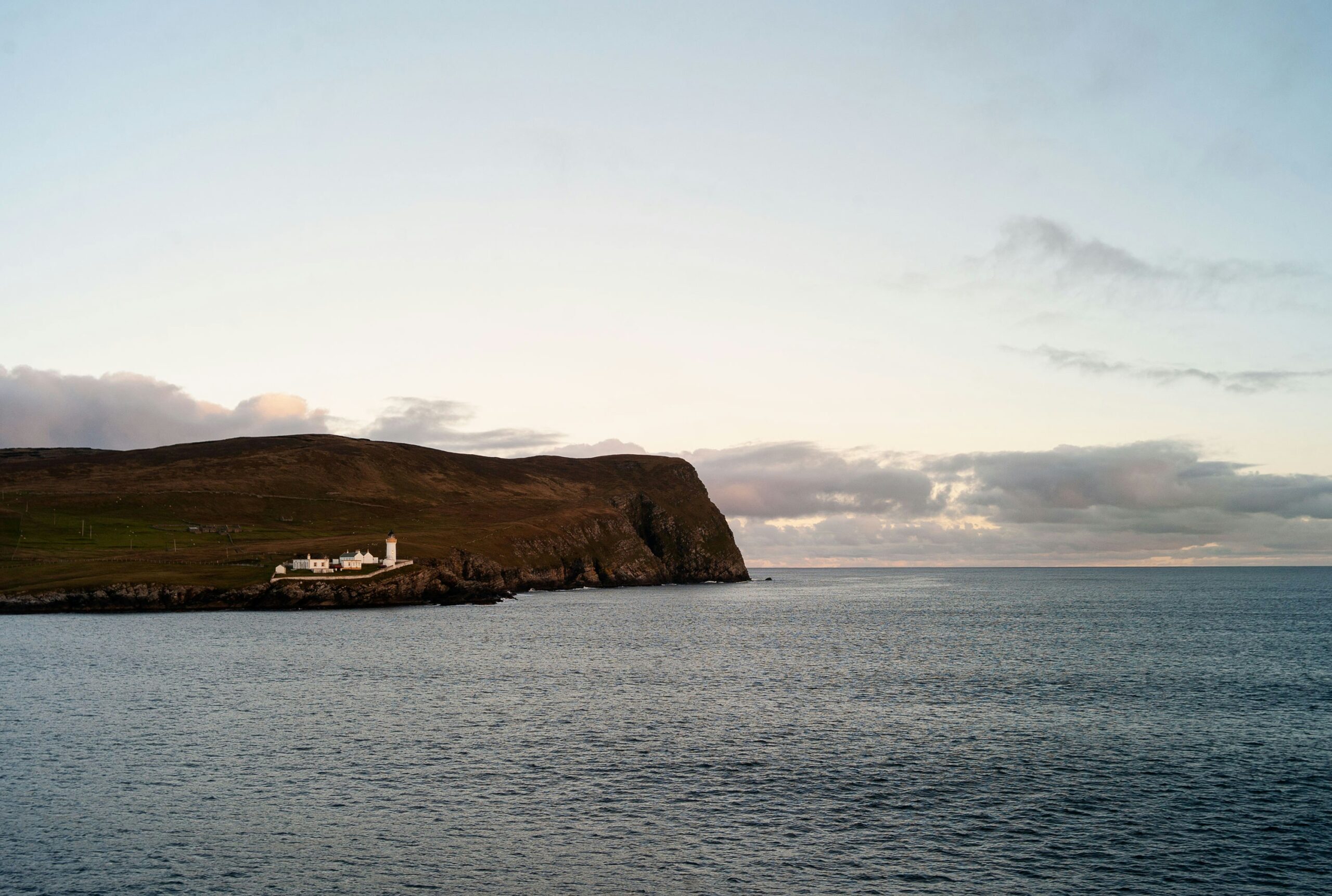
Photo by Hamish Duncan
Landings at Lerwick, Scotland’s second busiest fishing port, fell 31% in the first half of 2026 compared with the same period last year, a decline the Shetland Fishermen’s Association (SFA) has blamed largely on this year’s steep cuts to cod and saithe quotas. Marine Management Organisation figures show landings across Scotland as a whole fell 22% over the same period.
A 44% cut, and what lies behind it
SFA executive officer Daniel Lawson said the reduction reflected “the most obvious reason for less fish being landed in Shetland,” pointing to “a 44 per cent reduction in quotas for Northern Shelf cod and a 25 per cent reduction for Northern Shelf saithe” this year, though he also acknowledged weather disruption and lost fishing time to maintenance had contributed. When the cuts were first announced in December, Lawson estimated the cod reduction alone would cost the Shetland economy £16m this year. “Numbers in government spreadsheets have real-life consequences,” he said at the time. “For a population of only 23,000 people, that economic impact will be felt strongest in communities such as Shetland.”
The 44% cut, agreed in trilateral negotiations between the UK, EU and Norway, followed advice from the International Council for the Exploration of the Sea (ICES) that catches of Northern Shelf cod should ideally be reduced to zero in 2026. ICES warned that the stock’s Southern substock is so depleted that any catch risked driving it below critical biomass limits, and that because the Northwestern, Southern and Viking substocks mix and are caught together, even limited fishing of the healthier substocks could endanger the weakest. The final agreement set a total allowable catch of 14,034 tonnes, thousands of tonnes above the zero-catch recommendation, with the North Sea allocation at 11,164 tonnes and Norway receiving 1,898 tonnes.
Lawson disputed the scientific basis for even this reduced figure, describing it as resting on “irresponsible assumptions and unsupported guesswork,” and argued fishing crews’ own observations at sea were not being reflected. “Fishermen whose livelihoods depend on it deserve serious analysis of data, not arbitrary computer modelling,” he said.
A starkly different view from conservation groups
Conservation organisations have argued the opposite: that the agreed quota remains dangerously high. Alec Taylor, Director of Policy and Research at Oceana UK, said the outcome amounted to a missed opportunity to protect a collapsing stock. “Our government went into annual catch negotiations knowing that drastic measures were necessary to safeguard ocean ecosystems – they have come out of them with a catch limit for North Sea cod thousands of tonnes above scientific advice,” he said. “It is not an exaggeration to say that this could be the death knell for British cod and the coastal livelihoods it supports.” Phil Taylor, director of Open Seas, called for the government to align future decisions more closely with scientific advice and set “a legally binding deadline to end overfishing, once and for all.”
Elspeth Macdonald, chief executive of the Scottish Fishermen’s Federation, occupied a middle position, acknowledging the industry had feared far worse. “With ICES having recommended a zero total allowable catch for Northern shelf cod, the Scottish whitefish fleet had been contemplating having to tie up for much of the year,” she said, adding that she was “relieved negotiators found a way forward in setting a TAC and agreeing a series of measures to protect the stock.” She noted the SFF had separately raised concerns about “problems with how [ICES] scientific advice is formulated.”
Government rationale
The Scottish government said the 2026 total allowable catches were set following negotiations between the UK, EU and Norway, based on both scientific advice and socioeconomic factors. According to a Marine Scotland blog post, the specific reductions for Northern Shelf cod aimed to reduce fishing pressure, increase spawning stock biomass, and deliver improvements to existing management, reflecting the Fmsy catch scenario for the two northern substocks and headline advice for the southern substock. As part of the package, the three parties also agreed to update elements of their real-time closure schemes and extend spawning closures.
Real-time closures add a further squeeze
Industry frustration has also centred on how the reduced quota is being enforced day to day. A 21-day real-time closure (RTC) came into force in the North Sea east of Fair Isle in July, triggered when a pair team’s catch exceeded the threshold of 80 cod caught per hour — almost identical in location and timing to a closure imposed in July 2025. Mike Park, chief executive of the Scottish White Fish Producers’ Association, said the industry accepted the principle behind such closures but disputed the threshold itself. “We understand the reasoning for them, but we do challenge the thresholds and the fact that there is less available sea than before,” he told Fishing News. “Where pair trawlers are involved, which is the case with this closure, it amounts to only 40 fish (of all sizes) for each vessel – which it could be argued defeats the purpose if indeed it is dense congregations of cod we are trying to protect.”
Lawson said cod uptake within the Shetland producer organisation was running at around 60%, “right on target for a full-year fishery,” and argued the closures as currently enforced were not “necessary, fair or proportionate.” He proposed changing the trigger from a flat count of 80 cod per hour, regardless of size, to a count based specifically on fish below the 35cm minimum conservation reference size, arguing this would “retain RTCs as a tool in the interest of protecting the cod stock, whilst also allowing legitimate and sustainable cod fishing to continue.” He also questioned inconsistencies between how Norway, Denmark and the UK apply their respective triggering criteria.
A mixed picture across ports
The MMO figures point to significant variation beneath the headline Lerwick decline. Scalloway’s landings rose 16% year-on-year over the same period, with June landings alone up 112% on June 2025, a shift Lawson attributed to weather patterns affecting which port vessels found most convenient. Shetland ports also commanded the best prices in Scotland in June, with average landings values of £3,232 per tonne in Lerwick and £3,161 in Scalloway, compared with £1,668 in Peterhead. Despite the year-on-year fall, Lerwick’s landings were still worth £27m in the first half of 2026, retaining its position as Scotland’s second busiest port. Total landings value across Scotland for the same period came to £207m, with three of nine ports or districts recording an increase and six a significant decrease.