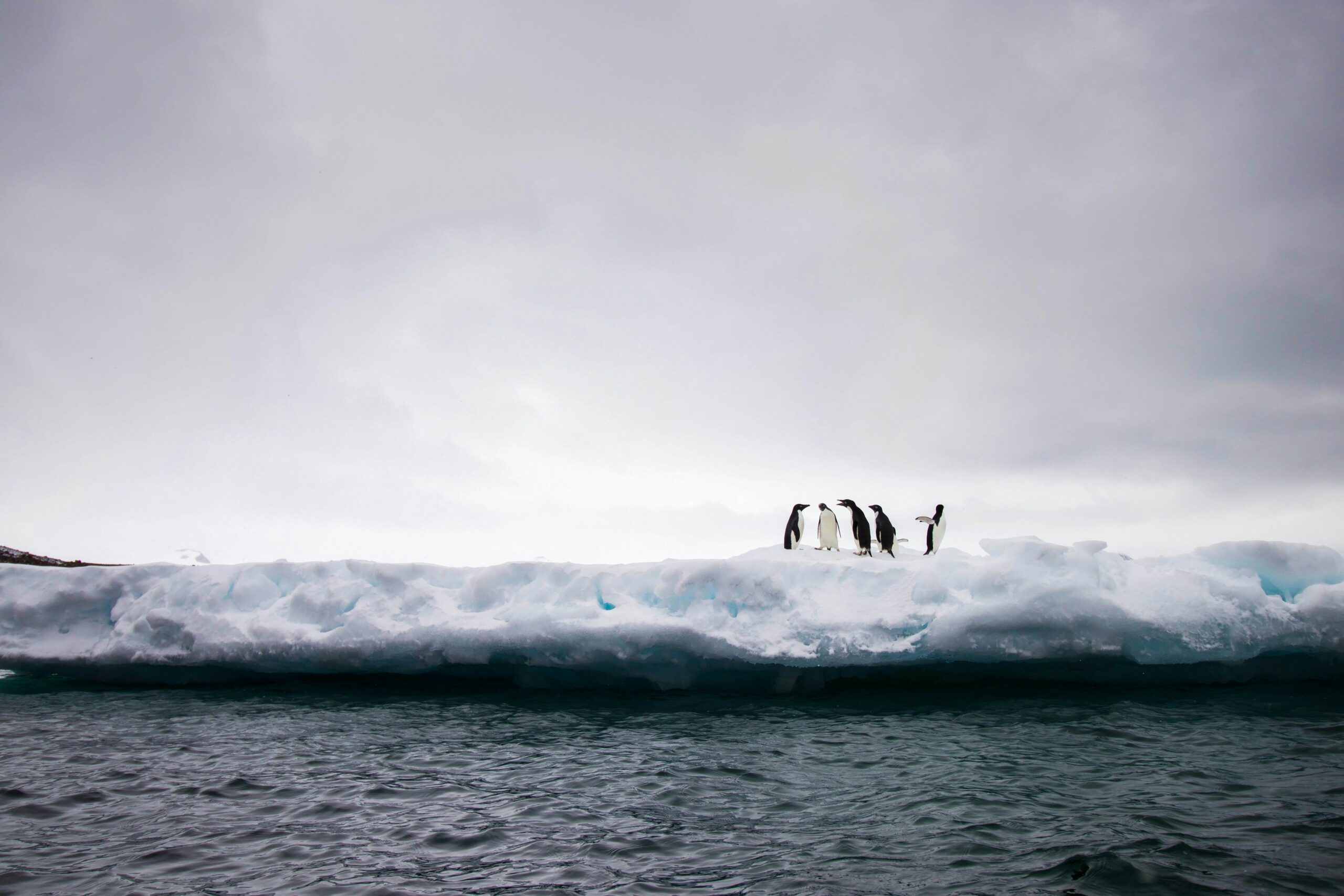
Photo by Dylan Shaw
A vast area of winter sea ice has failed to form off West Antarctica’s Bellingshausen Sea, with scientists warning the region may now be entering a permanently reduced state with consequences for penguins, krill and some of the continent’s most significant glaciers. The gap was first reported in detail by The Guardian in mid-June, and satellite data tracked by ABC News days later showed the area still had not recovered.
How much ice is missing
Scientists told the Guardian the Bellingshausen Sea was missing around 650,000 square kilometres of sea ice compared with the 1991-2020 average for that time of year, an area roughly the size of France and almost ten times the size of Tasmania. Across the continent as a whole, total Antarctic sea ice extent stood at 11.4 million square kilometres on 10 June, against a long-term average of 12.6 million square kilometres for that date. By 14 June, satellite imagery analysed by the University of Colorado Boulder’s National Snow and Ice Data Center showed a further area of around 150,000 square miles, roughly the size of Montana, still missing from what would typically already be frozen at this point in the Southern Hemisphere winter.
A record-breaking heatwave
The ice loss coincided with an extreme temperature spike on the Antarctic Peninsula. Argentina’s national weather service recorded a peak of 15.4°C at its Esperanza base on 5 and 6 June, smashing the station’s previous June record of 13.3°C, set in 1998, against typical daily maximums of around -6°C. From January through April, sea surface temperatures in the Bellingshausen Sea ran 1 to 3°C above average, according to NOAA data, with air temperatures forecast to run as much as 10°C above average through the following weekend. Ellen Buckley, assistant professor at the University of Illinois Urbana-Champaign’s Department of Earth Science and Environmental Change, said the likely cause was a low-pressure anomaly north of the Bellingshausen Sea pulling in warm air from higher latitudes and preventing ice formation. Peter Neff, a glaciologist at the University of Minnesota, said the missing ice surface was itself part of the problem, since without reflective white ice to keep the region cold, the heatwave was able to intensify further.
Why it matters for Thwaites and sea level rise
Just to the west of the Bellingshausen Sea sit the Pine Island and Thwaites glaciers, West Antarctica’s two largest contributors to ice loss and sea level rise. Phil Reid, who monitors Antarctic conditions at Australia’s Bureau of Meteorology, said the floating ice shelves in front of these glaciers could break up faster without protective sea ice in place for extended periods, in turn speeding up ice loss from the glaciers themselves. A 2025 study by the International Thwaites Glacier Collaboration, a joint US-UK research partnership, found that a full collapse of the West Antarctic Ice Sheet could ultimately contribute more than three metres of global sea level rise.
Penguins, krill and a changing ecosystem
Will Hobbs, an Antarctic sea ice expert at the University of Tasmania with the Australian Antarctic Program Partnership, described the loss of ice as “depressing,” noting this was the third time in four years the region had seen very low sea ice. He said the Bellingshausen Sea was important habitat for krill, which would normally shelter and graze on algae beneath the ice in winter. Peter Fretwell, a scientist at the British Antarctic Survey who has tracked the decline of the region’s emperor penguins, said the current loss of sea ice was “a serious problem for penguins, especially emperors,” explaining that sea ice now forms too late and breaks up too early, “leading to reduced breeding success and longer trips to moulting grounds.” He added that Adélie penguin numbers were falling too, and that crabeater seals were being forced to migrate further in summer to find stable ice. The Bellingshausen Sea coastline was the site of a catastrophic emperor penguin breeding failure in late 2022, which contributed to the species being moved up two categories to “endangered” on the IUCN Red List earlier this year.
A new normal?
Neff said Antarctic sea ice had entered a “new, much reduced state” since 2015, in which less and less ice refreezes each winter as air and sea temperatures rise, calling the question of why the freeze-thaw cycle has changed in the last decade a “huge area of research” right now. Hobbs was more blunt about the Bellingshausen Sea specifically: “I don’t think we will see sea ice there any more. It’s done.” Rose Malanga, a PhD student at the University of Illinois Urbana-Champaign who carried out fieldwork in Antarctica earlier this year, said it was possible this June’s sea ice level in the region could surpass last year’s record low, with Buckley noting that June 2025 and June 2026 have both ranked among the lowest sea ice levels on record for the region.