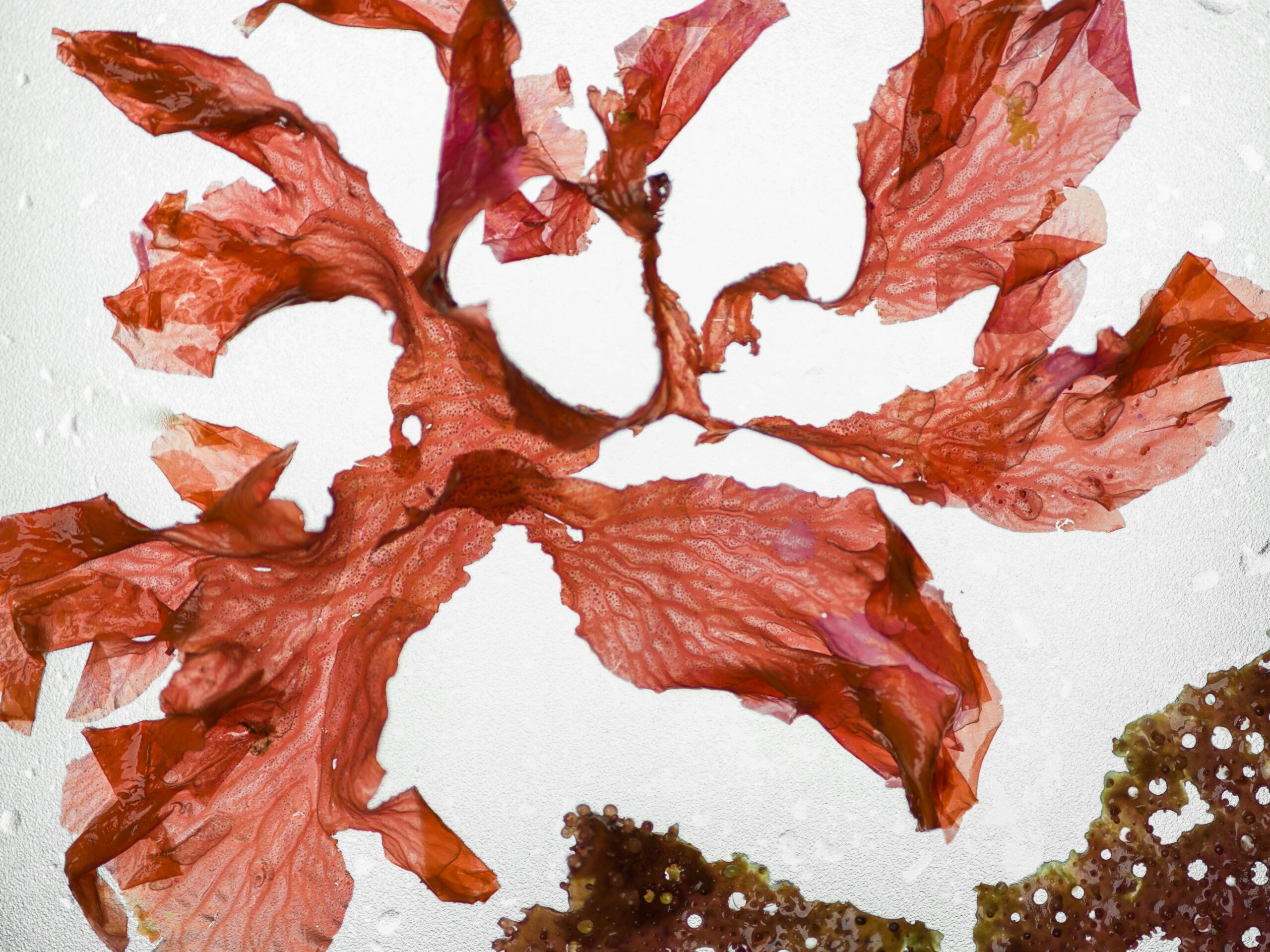
Photo by Kier in Sight Archives
Researchers at the Scottish Association for Marine Science (SAMS) in Oban have developed a land-based tank method for cultivating Palmaria palmata — the red seaweed commonly known as dulse — that dramatically reduces early-stage mortality and enables year-round production of a species that has historically proved extremely difficult to farm.
In controlled tank trials, the team recorded biomass doubling every week, describing the results as “phenomenal”. Dulse is among the most commercially attractive seaweed species available, valued at roughly 40 times more per tonne than kelp and with applications spanning food, animal feed, cosmetics, dyes and pharmaceuticals. Despite that potential, previous cultivation attempts have consistently foundered at the hatchery stage, where mortality rates of 60 to 70% have been the norm, typically driven by disease and a complex, poorly understood reproductive cycle.
The key breakthrough was achieved by SAMS microbiologist Dr Frederik De Boever, who tackled the problem by rebalancing the seaweed’s microbiome — introducing natural grazers and adopting probiotic methods to suppress disease. The approach has brought hatchery mortality rates down to around 10%. Dr De Boever said: “The growth is phenomenal. We’re growing the seaweed from the spore stage to germlings, which increases resilience, compared with vegetatively cut thalli from established adult seaweeds. The spore to germling mortality rate is usually high but in the lab we have more control over that crucial life stage.”
The species presents particular challenges for farmers. Palmaria palmata has a short reproductive window, and males and females reach sexual maturity at different times, making lifecycle management difficult to control. Wild stocks along the Atlantic coast are limited, and the global industry has therefore remained heavily dependent on wild harvesting, which cannot meet growing demand. The new SAMS method gives growers far greater environmental control than open-sea farming, while producing a more pristine biomass with lower levels of iodine and metal accumulation.
Dr Puja Kumari, who leads the FABRICS cultivation project at SAMS, emphasised the wider significance of the work for the sector: “When discussing seaweed cultivation, a lot of focus is often on large kelps that generate lots of biomass, but more research effort is required to help expand and diversify the cultivation of red seaweeds in the region. Red seaweed cultivation is important for the seaweed aquaculture industry because it contributes to half the net worth of world seaweed production.” She continued: “There is therefore an urgent need to diversify seaweed cultivation practices to include important UK and European red seaweeds to help address the uncertainty in the red seaweed global market supply, as well as address sustainability and net zero targets.”
The urgency of that diversification is underlined by conditions in global markets. The red seaweed industry currently relies heavily on a small number of cultivated species, most of them grown in Asia, where crops face mounting pressure from climate change and disease. A domestic UK and European supply chain for cultivated dulse would help insulate buyers from that volatility while reducing the environmental footprint of supply.
The research is being conducted under the FABRICS project, funded by UKRI-BBSRC, and involves commercial partners including W.L. Gore & Associates. SAMS, a partner of the University of the Highlands and Islands (UHI), is the UK’s oldest independent marine science organisation and operates two experimental seaweed farms near Oban, in addition to a seaweed nursery that supplies seeded line to commercial cultivators across the UK.