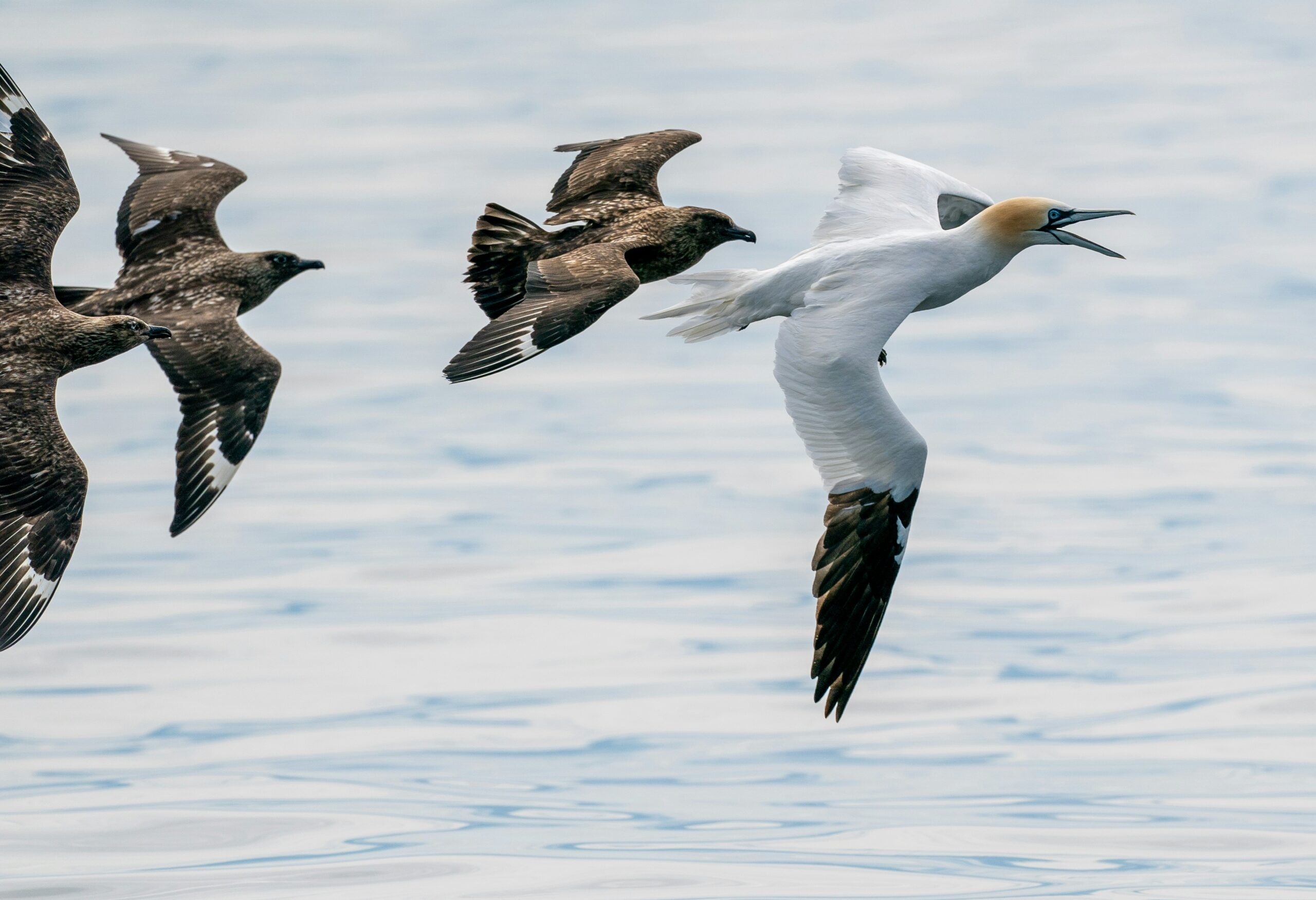
Photo by Bob Brewer
Scotland’s seabirds remain in long-term decline, with average numbers now around half what they were in the 1980s, according to new statistics published by NatureScot on 13 August.
A steep long-term fall
The Scottish Biodiversity Indicator for Seabirds, which draws on data from the UK Seabird Monitoring Programme, assessed 19 of the 24 seabird species that breed around Scotland’s coasts between 1986 and 2024. Of the 14 species with sufficient data to assess abundance, 13 have declined since 1986 and eight of those declines are statistically significant. No species has shown a significant long-term increase.
Arctic skua has fared worst, down 93% since 1986, followed by little tern (down 75%) and common tern (down 73%). Over the shorter term, from 2015 to 2024, Arctic skua, common tern and little tern again recorded the steepest falls, down 73%, 63% and 44% respectively, while kittiwake, razorbill and herring gull were the only species to show short-term increases, of 33%, 15% and 14%.
Breeding success has followed a similar downward trajectory since 1986. Of the 16 species with productivity data, eight produced fewer chicks per pair in 2024 than their recent three-year average, with the steepest falls in Arctic skua, shag and little tern. There were pockets of better news: puffin, guillemot and black-headed gull breeding success has stabilised over the past three years, and great black-backed gull and gannet both had a stronger than average breeding season in 2024, though the report notes gannet’s short-term improvement sits against a backdrop of long-term losses driven by avian flu.
Sandeels, disease and climate change
The report identifies shortages of prey, particularly sandeels, as one of the central pressures on Scotland’s seabirds, alongside invasive non-native species and climate change, which it describes as an overarching threat running through food supply, habitat and direct mortality risks alike. High Pathogenicity Avian Influenza (HPAI) has compounded these pressures since an outbreak that peaked in 2022, with more than 100,000 seabird and waterbird carcasses reported UK-wide over a two-year period, and great skua and common tern populations recorded falling by 77% and 40% respectively across the UK during the outbreak.
Bex Outram, NatureScot Marine Ornithologist, said the scale of Scotland’s seabird colonies makes the declines a matter of international significance. “Scotland is home to more than 60 percent of the UK’s seabird population. Our seabird colonies are world-renowned, contributing significantly to wildlife tourism, worth an estimated £127 million to Scotland’s economy each year. But many of our seabirds are under threat. Climate change, food shortages, invasive species and other human pressures are contributing to their decline. Disease outbreaks like avian flu and extreme weather events have also had devastating impacts.”
Conservation action under way
Outram pointed to the Scottish Seabird Conservation Action Plan, published by the Scottish Government in August 2025, as the main vehicle for turning the data around. “Work is underway to help secure the future for Scotland’s seabirds,” she said. “Efforts are focused on three key areas: safeguarding food supplies, restoring habitats and maximising seabird survival. These efforts will take time to have an impact, which is why long-term monitoring coupled with advances in technology to improve our understanding of seabirds is vital.”
The plan sets out a 2045 vision for Scotland’s seabird colonies to be “thriving and showing improved resilience to climate change,” with abundance and breeding success increasing against the benchmark set by the UK-wide Seabirds Count census of 2015-2021, and covers 50 priority actions across 24 species. Steps already under way include biosecurity plans covering 27 of Scotland’s 29 seabird islands, the eradication of non-native predators from Canna, Ailsa Craig and the Shiant Isles, and the closure of sandeel fishing in all Scottish waters to protect a key prey species for birds such as kittiwake and Arctic skua. Priority actions still to be delivered include developing bycatch-reduction measures for the long-line fishing fleet, restoring seagrass and kelp habitats that support the forage fish seabirds rely on, and repeating the national seabird census.
Among the projects already funded, the Scottish Marine Environmental Enhancement Fund has supported the purchase of 40 bespoke GPS tags and ten base stations to track northern fulmar on St Kilda and Fair Isle, intended to help the National Trust for Scotland better understand the pressures driving the species’ decline. The fund is currently supporting 23 seabird projects in total.
How the data is collected
The abundance and productivity figures behind the NatureScot indicator are drawn from the UK-wide Seabird Monitoring Programme (SMP), which is jointly funded by the British Trust for Ornithology (BTO) and the Joint Nature Conservation Committee, in association with the RSPB, and supported by NatureScot and its counterpart agencies in England, Wales and Northern Ireland. Volunteer and professional surveyors visit coastal and inland colonies annually to count breeding numbers and, where possible, chicks, with 222 colonies included in the 2024 Scottish count and 36 monitored for breeding success. The scheme also underpins the periodic UK and Ireland-wide seabird census, Seabirds Count, most recently completed in 2023 and used as the benchmark against which the Scottish Government’s 2045 recovery vision will be measured.