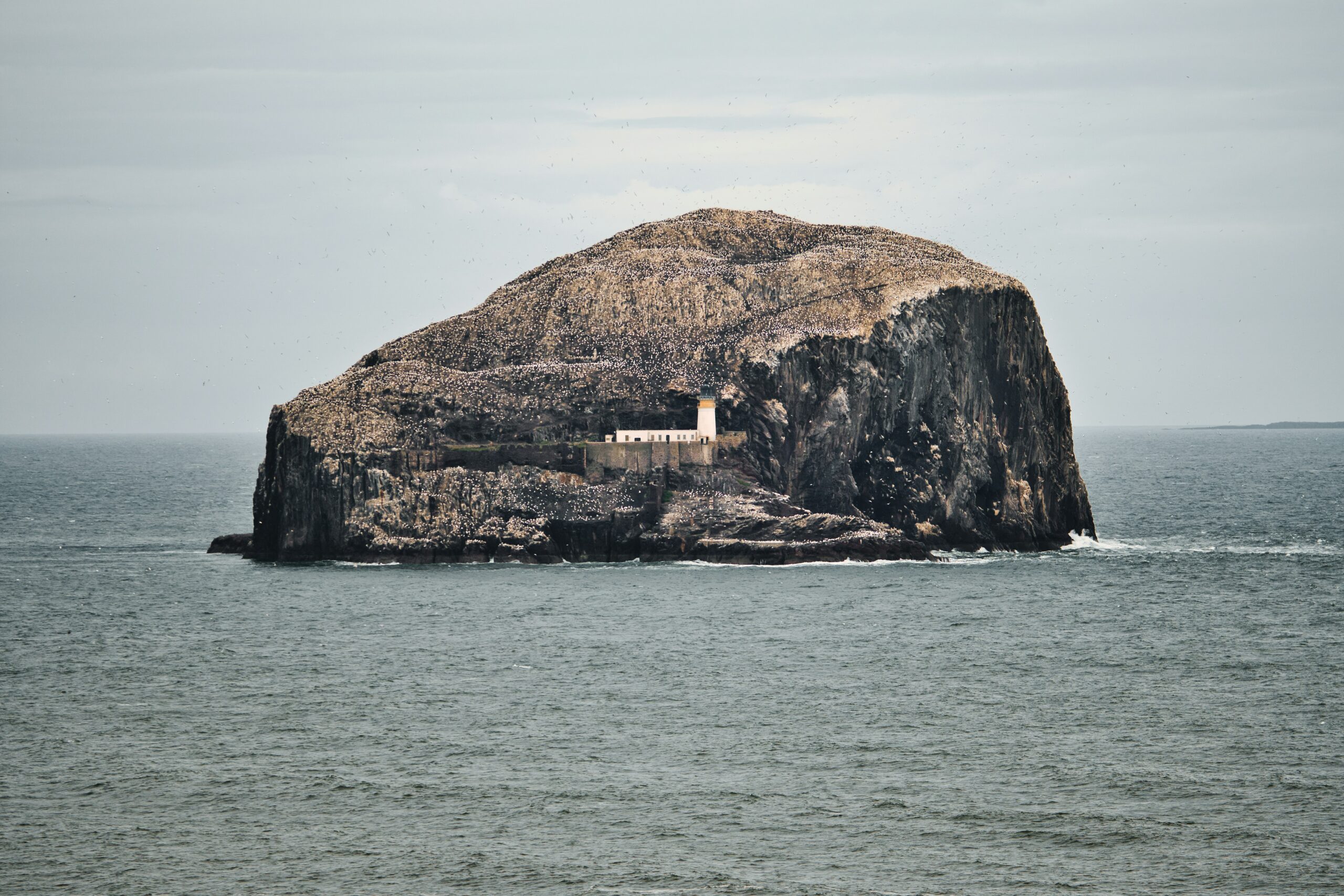
Photo by Kevin Krüger
Bass Rock and its neighbouring island of Craigleith in the Firth of Forth have been acquired by RSPB Scotland, marking the first time in more than three centuries that these celebrated seabird sanctuaries have been held in charitable ownership. The purchase, supported by £586,000 from the National Heritage Memorial Fund, brings to an end more than 320 years of private stewardship by the Hamilton-Dalrymple family.
A colony under pressure
Bass Rock, a 106-metre volcanic outcrop three miles off the coast of North Berwick, is home to around 100,000 breeding northern gannets, making it one of the largest gannet colonies in the world. The island has been a Site of Special Scientific Interest for almost 75 years, and its distinctively white appearance, the result of guano coating the dark volcanic rock beneath, is one of the most recognisable wildlife spectacles on the British coastline. Craigleith, the smaller island lying to the west, supports around 10,000 puffins, a population that has quadrupled over recent decades thanks to community-led efforts to remove invasive tree mallow.
The acquisition comes at a critical moment for Scotland’s seabirds. More than 70% of species are in decline, facing mounting pressure from climate change, food scarcity, invasive species and human activity. Bass Rock was hit hard by the 2022 outbreak of highly pathogenic avian influenza, which NatureScot estimated killed a minimum of 11,175 gannets. The most recent survey found numbers had rebounded to only around two thirds of their pre-outbreak peak of 150,000.
A family decision
Sir Hew Dalrymple, whose ancestor of the same name purchased Bass Rock in 1706, said the decision to sell had been driven by the scale of the threats now bearing down on the birds. “The Dalrymple family have been fortunate to have been custodians of the Bass for over 300 years,” he told the East Lothian Courier. “During my lifetime, the gannet population has quadrupled. However, it is clear the seabird colonies of the Forth now face unprecedented challenges, most notably from wind turbines, pollution, overfishing and disease. I believe that RSPB Scotland is the organisation best equipped to take up this challenge on their behalf, so I am delighted to pass on to them stewardship of Craigleith and the Bass.”
Speaking during a visit to the rock, Sir Hew elaborated on his reasoning to The Scotsman: “I thought an organisation like the RSPB would be better equipped to protect the islands and their wildlife than a private individual. In this day, an individual doesn’t have the same sort of traction as an organisation like the RSPB who can access funds.”
The proposed Berwick Bank offshore wind farm looms large among those concerns. The RSPB has said that the Scottish Government’s own assessment predicts the development — one of the largest offshore wind projects in the world, with around 300 turbines planned in the outer Firth of Forth — would kill 2,808 guillemots, 814 kittiwakes, 260 gannets, 154 razorbills and 65 puffins in its first year alone. Developer SSE disputes those figures, arguing seabird densities in the area are “not exceptional.”
A new chapter
RSPB Scotland will manage the islands in close partnership with the North Berwick-based Scottish Seabird Centre, which has led conservation and research activity on and around the islands for years and will continue to run its wildlife boat trips and SOS Puffin programme.
Anne McCall, director of RSPB Scotland, said the charity was “thrilled” to be taking on stewardship of the islands. “With the pressures facing Scotland’s seabirds intensifying, we have a responsibility to act,” she said. “This partnership gives us the opportunity to drive forward seabird recovery at this crucial time. Collaboration is essential to protect wildlife and these incredible places they call home.”
David Anderson, the RSPB’s new Bass Rock site manager, emphasised the islands’ potential as a platform for communicating broader conservation challenges. “Having the opportunity to have Bass Rock provides an opportunity to talk about how important these species are and the threats they are facing, from climate change to developments that are being put in the wrong place, food supply and also biosecurity,” he told The Scotsman. “One of the key aspects of this project is that we are doing it alongside the Scottish Seabird Centre which has links with the local community.”
Harry Huyton, chief executive of the Scottish Seabird Centre, described the islands as “among the world’s most awe-inspiring natural wonders” and said their entry into the RSPB network marked a historic day for Scottish nature.
Funding and future plans
In addition to the £586,000 from the National Heritage Memorial Fund, the project has received £372,000 in development funding from the National Lottery Heritage Fund, with the potential for a further £589,000 from lottery proceeds. Simon Thurley, chairman of both funds, described the purchase as a once-in-a-generation opportunity. “For the Memorial Fund, this is a once in a lifetime opportunity to secure the islands for the public and ensure that, with RSPB Scotland and the Scottish Seabird Centre at the helm, their role as seabird sanctuaries is protected for the future,” he said. “For the Heritage Fund, this project is a fantastic example of our vision for supporting nature’s recovery and enabling people to connect positively with the world around them.”
Paul McLennan, East Lothian Coast and Lammermuirs MSP, also welcomed the news, telling the East Lothian Courier that the islands’ “importance for seabird populations and our wider marine environment cannot be overstated.”
Planned conservation and visitor initiatives include a new immersive 360-degree viewing theatre at the Scottish Seabird Centre, allowing visitors to watch the colonies in real time without disturbing nesting birds, alongside coordinated monitoring across both islands, school workshops, and a community heritage project drawing on memories and artistic depictions of the islands. A ten-year management plan is expected to be developed over the coming year.