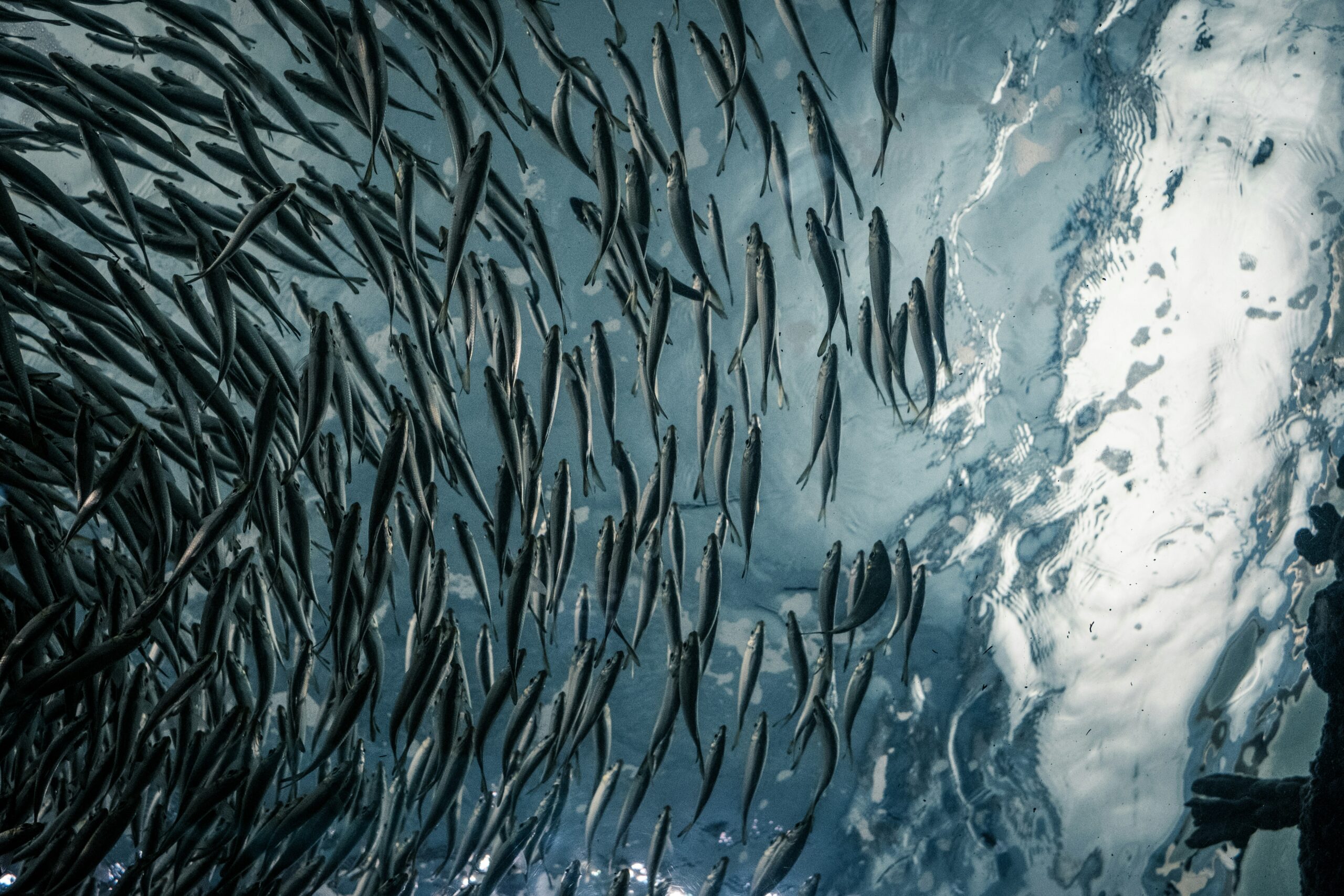
Photo by Lance Anderson
A new study has identified the specific genetic mutations that allowed the Atlantic herring to colonise the Baltic Sea thousands of years ago, findings that shed new light on evolution in action, and that their lead author says provide a compelling argument for much more restrictive industrial fishing of the species.
The research, led by Professor Leif Andersson of Uppsala University and published in the Proceedings of the National Academy of Sciences, sequenced the whole genomes of large numbers of both Atlantic and Baltic herring. It found that genetic changes in just four genes, all expressed in sperm, eggs and early embryos, were critical to the Baltic herring’s successful adaptation to the low-salinity environment of a sea that has existed for only around 8,000 years.
Evolution in four genes
The Baltic Sea presents an extreme challenge for a marine fish: salinity as low as 2–3‰, compared with 34–35‰ in the open ocean. In species with external fertilisation, sperm, eggs and embryos are directly exposed to the surrounding water and must adapt to local conditions. The four key mutations identified each solve a specific problem this creates.
One alters a sperm-specific anion channel, likely necessary to maintain sperm function in brackish water. Two others, one in a major egg envelope protein, another in an enzyme that creates crosslinks between these proteins, work together to produce a reinforced egg casing that prevents swelling when exposed to low salinity. The fourth addresses a resulting paradox: because the reinforced envelope makes hatching harder, natural selection has given Baltic herring 20 extra copies of a gene that degrades the egg envelope, ensuring larvae can still emerge successfully.
“This study is a textbook example of how strong natural selection results in genetic changes in multiple genes that together ensure successful reproduction in a new environment,” said Andersson. “What is notable is that we have been able to revealed specific genes and mutations, and can explain the biological mechanisms as to why these changes have been crucial for adaptation to the brackish Baltic Sea.”
Strikingly, all herring spawning in the Baltic Sea – regardless of geographic region within the sea – carry all four genetic changes, confirming the adaptations are universal and deeply embedded. Andersson noted that the striking genetic distance now revealed between Baltic and Atlantic herring provides an argument to reclassify the Baltic herring as a distinct species, not merely a subspecies, as classified by Linnaeus.
A keystone species under pressure
The study carries a direct conservation message. The Baltic herring is a keystone species, linking plankton to the fish, birds and marine mammals that feed upon it, and underpinning Baltic fisheries for millennia. “The Baltic herring is a unique fish adapted to the low salinity of the Baltic Sea of crucial importance for the ecosystem and contributes significantly to food security in the area,” Andersson said. “This is a very strong argument for much more restrictive industrial fishing of this important species.”
Those words land against a backdrop of deepening crisis. Central Baltic herring populations have been below minimum safe biological levels for most of the past three decades. The western Baltic herring stock remains below the critical threshold marking a high risk of collapse, with ICES having advised zero catch every year since 2019. The Bothnian herring stock has reached one of its lowest levels on record. Of the four Baltic herring populations, only the Gulf of Riga stock remains healthy.
EU fisheries ministers agreed catch limits for 2026 in October 2025, increasing central Baltic herring catches by 15% and sprat by 45% in line with some ICES advice, while cutting Bothnian herring by 40% and maintaining a three-month spawning closure. Western Baltic herring catch limits remained unchanged, with no directed fisheries permitted. Environmental NGOs including WWF and FishSec welcomed the precautionary stance of the Commission’s original proposal but have repeatedly warned that political agreements consistently exceed scientific recommendations, driving stocks further into decline.
Andersson invoked the species’ historical importance to make his case – the study is accompanied by wartime photographs of queues at Stockholm fish markets, illustrating how Baltic herring sustained surrounding nations when international food trade collapsed. “For the human population around the Baltic Sea, the rich herring fisheries have been a vital part of the food supply for thousands of years,” he said. “The Baltic herring is a species that is highly deserving of protection, not least for food security in times of crisis.”