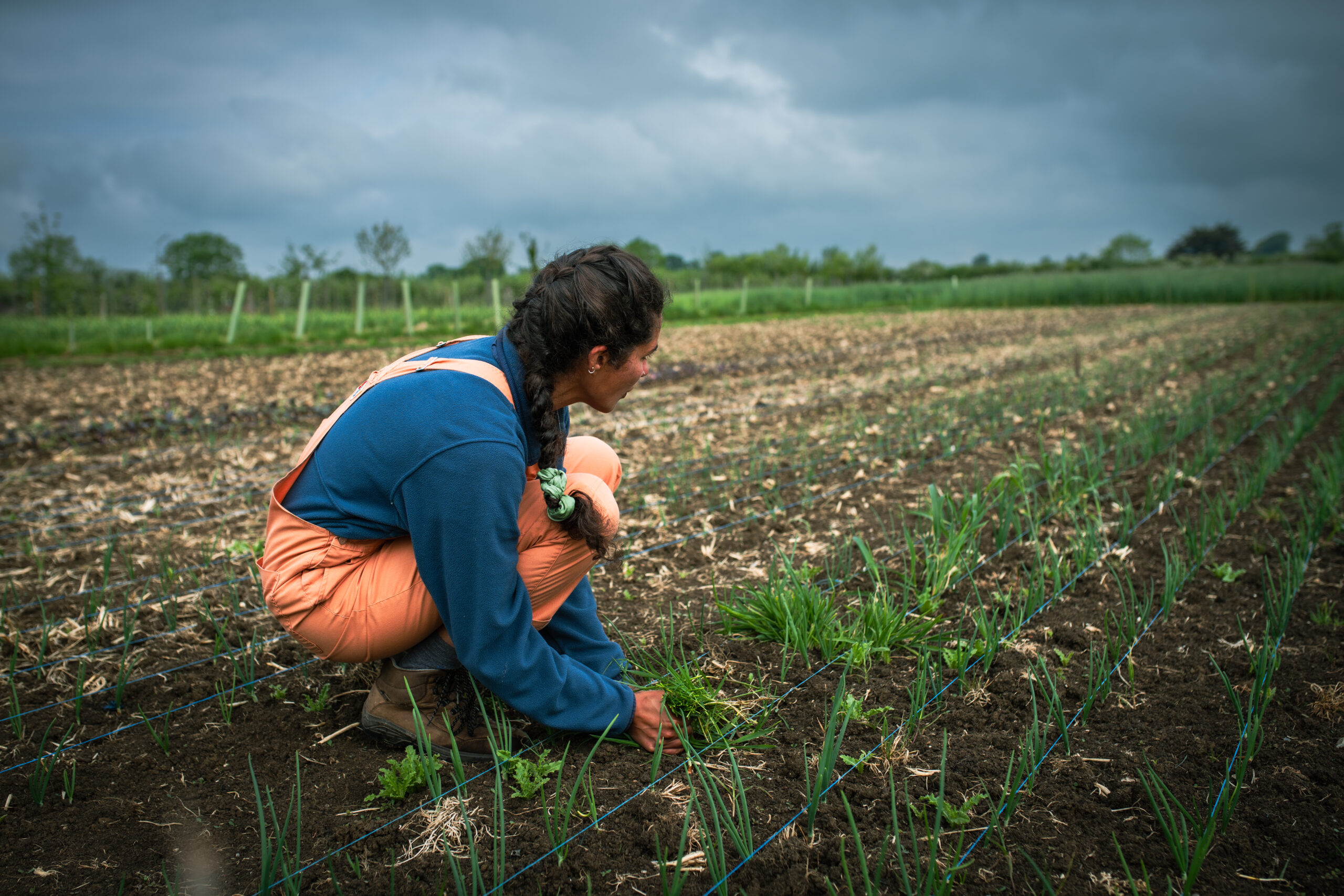
Image description: A farmer wearing a blue shirt and orange dungarees squats next to a line of sprouting crops. Image credit: Sivalingam and Molly Vasanthakumar,Woodland Farm
National Drought Group to meet weekly as drought conditions persist
The National Drought Group has moved to weekly meetings as drought conditions continue to intensify, despite the recent rainfall and cooler temperatures.
The government says this marks a step change in their response to the continued threat posed by wildfires and drought, following the COBR meeting chaired by Prime Minister Andy Burnham.
The group, which brings together senior decision-makers from government departments, regulators, water companies, and key environmental, agricultural, and public stakeholder groups, met on 20 August to assess the latest conditions and coordinate action across sectors.
Almost three-quarters (71.3%) of England is in drought, and it will be later this year before we see meaningful signs of recovery. Nine water companies in England have now imposed restrictions on water use, impacting 29 million customers: Affinity Water, Anglian Water, Cambridge Water, Essex & Suffolk Water, Southern Water, South East Water, Thames Water, South West Water and Wessex Water. At the same time, farmers are reporting their earliest harvest in 20 years, with yields affected by heat stress and dry conditions. Livestock are also suffering heat stress, while poor grass growth has reduced forage availability.
The government recently announced £65million package to help farmers, alongside increased flood funding and nine new reservoirs. The government also says they will be investing at least £10.5 billion by March 2036 to construct new flood and coastal erosion schemes and repair existing defences.
Government highlights risk of flash flooding as rain hits dried soils
Officials have warned that recent rainfall will not significantly improve depleted water resources. Instead the Rural Communities Minister, Jenny Riddell-Carpenter, has warned worsening drought conditions are now being accompanied by the risk of flash flooding:
“These have been some of the driest conditions in decades, and l have seen the impact it is having on communities, and I know the real pressure on farmers and the environment.
We have acted in lock-step with fire services, local authorities and across government to provide support and protect people and nature.
Drought conditions are worsening and yet we now face the risk of flash flooding. As extreme weather becomes more frequent, this government is working to adapt to our changing climate – including through our work with the National Drought Group and building nine new reservoirs to secure future supplies.”
Heavy rainfall can run off hard, compacted ground rather than soaking into the soil, meaning flooding can occur while wider drought conditions persist.
Environment Agency chief executive Philip Duffy, who chaired the National Drought Group, said: “This current rainfall isn’t enough to change the overall drought picture, and it is possible to have simultaneous drought and flood as heavy rain falls on compacted soils.”
He said the agency was monitoring flood risks while continuing to work with agriculture, industry and government on the drought response.
You can find a detailed update on the current water situation via the government announcement: https://www.gov.uk/government/news/coordinated-drought-response-intensifies-amid-extreme-weather