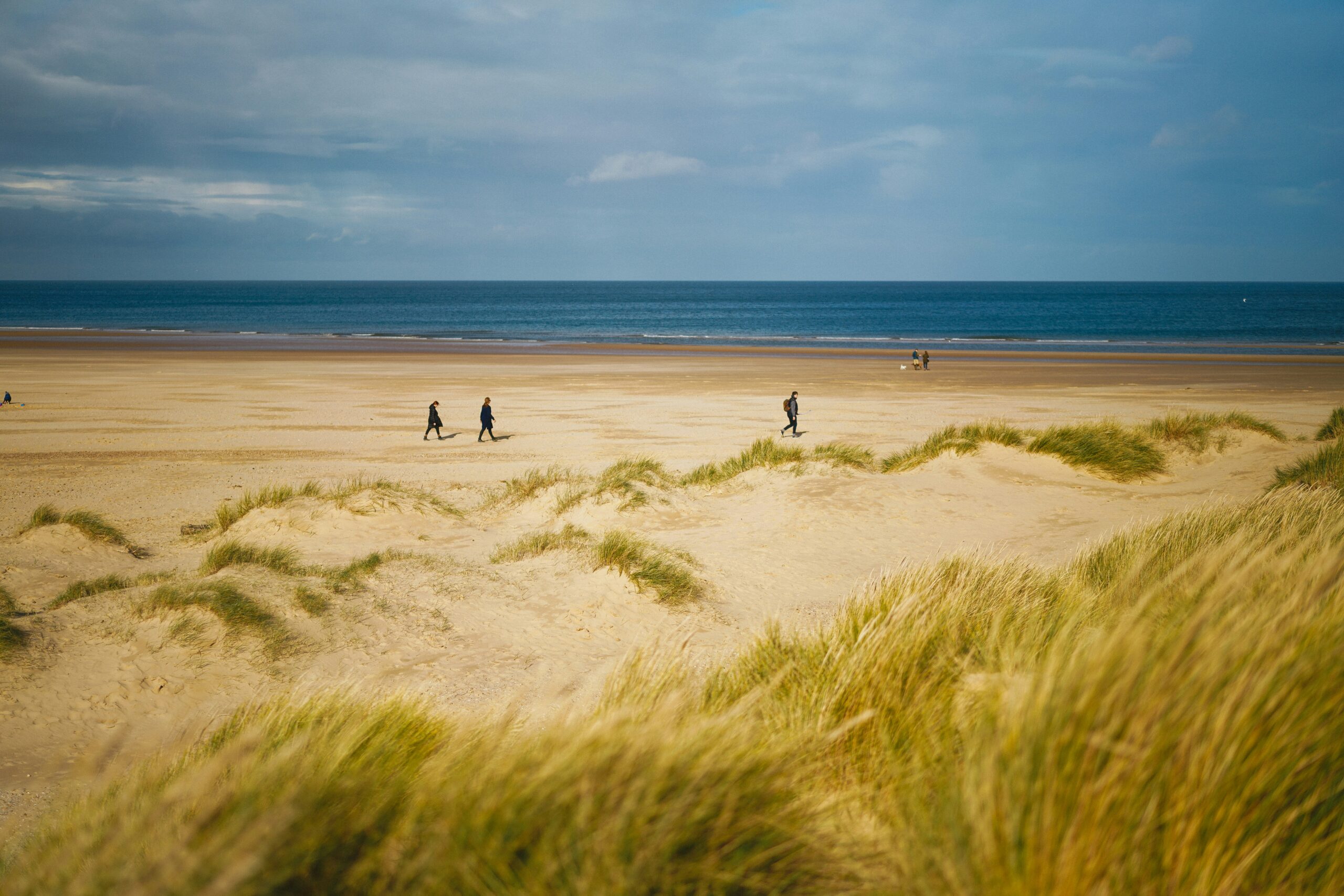
Photo by Phil Hearing
Two whales that washed up and died on the north Norfolk coast between Mundesley and Trimingham on Monday 4 August remain unidentified more than a week later, after experts from the Cetacean Strandings Investigation Programme (CSIP) said the animals looked unlike any known example of their initially suspected species.
A stranding that didn’t fit the pattern
The two whales, a juvenile male and a juvenile female both around 3.4 metres in length, were first thought by CSIP specialists to be Sowerby’s beaked whales, a poorly documented deep-diving species occasionally recorded around the UK. North Norfolk District Council officers worked alongside whale experts to recover the animals the following day, after which the CSIP team from the Zoological Society of London carried out necropsies at an off-site location. A CSIP spokesperson said: “They appeared unlike any Sowerby’s the CSIP team has previously dealt with and may represent a more unusual beaked whale species for the UK. Further investigation during the necropsies failed to confirm species — skeletal material has been collected to allow morphometric analysis, and genetic investigation will also be conducted in an effort to definitively confirm species identification.”
While the whales appeared to be in generally good nutritional condition, both had empty stomachs. Experts said this was consistent with “live strandings of out of habitat animals,” a diagnosis CSIP has recorded in previous cases involving beaked whales and other deep-diving species that stray outside their normal range. Decomposition had already begun by the time experts examined the carcasses, attributed to the recent warm weather. “We’ll post more information as and when we learn more,” the CSIP spokesperson said.
British Divers Marine Life Rescue (BDMLR), which sent a team of marine medics to the scene, said the whales had already died before their team arrived. A spokesperson said: “Both whales appeared to have been in good body condition, with large amounts of superficial grazing and injuries consistent with being stranded and washing in on the tide, though uncertainty surrounded their species identification.”
Recovery and public safety
In the immediate aftermath of the discovery, an NNDC spokesperson had appealed for patience and public caution: “We aim to clear the beach as soon as possible, but have to work around the tides and ensure that important information is collected before the remains are disposed of. While work to clear the beach continues, members of the public are asked to avoid disturbing the whales and to keep a distance from activity around them.”
CSIP, based at the Zoological Society of London, has coordinated the investigation of whale, dolphin and porpoise strandings around the UK since 1990, and has recorded data on more than 17,000 cetacean strandings over its history, helping build one of the world’s largest datasets on the causes of marine mammal mortality in UK waters.
Why beaked whales are hard to identify
Beaked whales as a family are resident in the North Atlantic and North Sea but remain elusive and poorly understood. Although they occasionally strand on beaches, they are rarely seen alive at sea, capable of extended dives in pursuit of prey such as squid and Atlantic cod. Sowerby’s beaked whale itself was the first member of the beaked whale family to be scientifically described, after a specimen stranded in Scotland in 1800.
This is not an isolated event for the region. A Sowerby’s beaked whale was previously found stranded at Snettisham in August last year, a minke whale was found at Hemsby beach last month, and a sperm whale stranded at Sheringham in 2021. The Hemsby minke whale illustrates the practical challenge such strandings pose: it had to be hauled off the beach using a trailer by the council, four days after it first washed ashore.