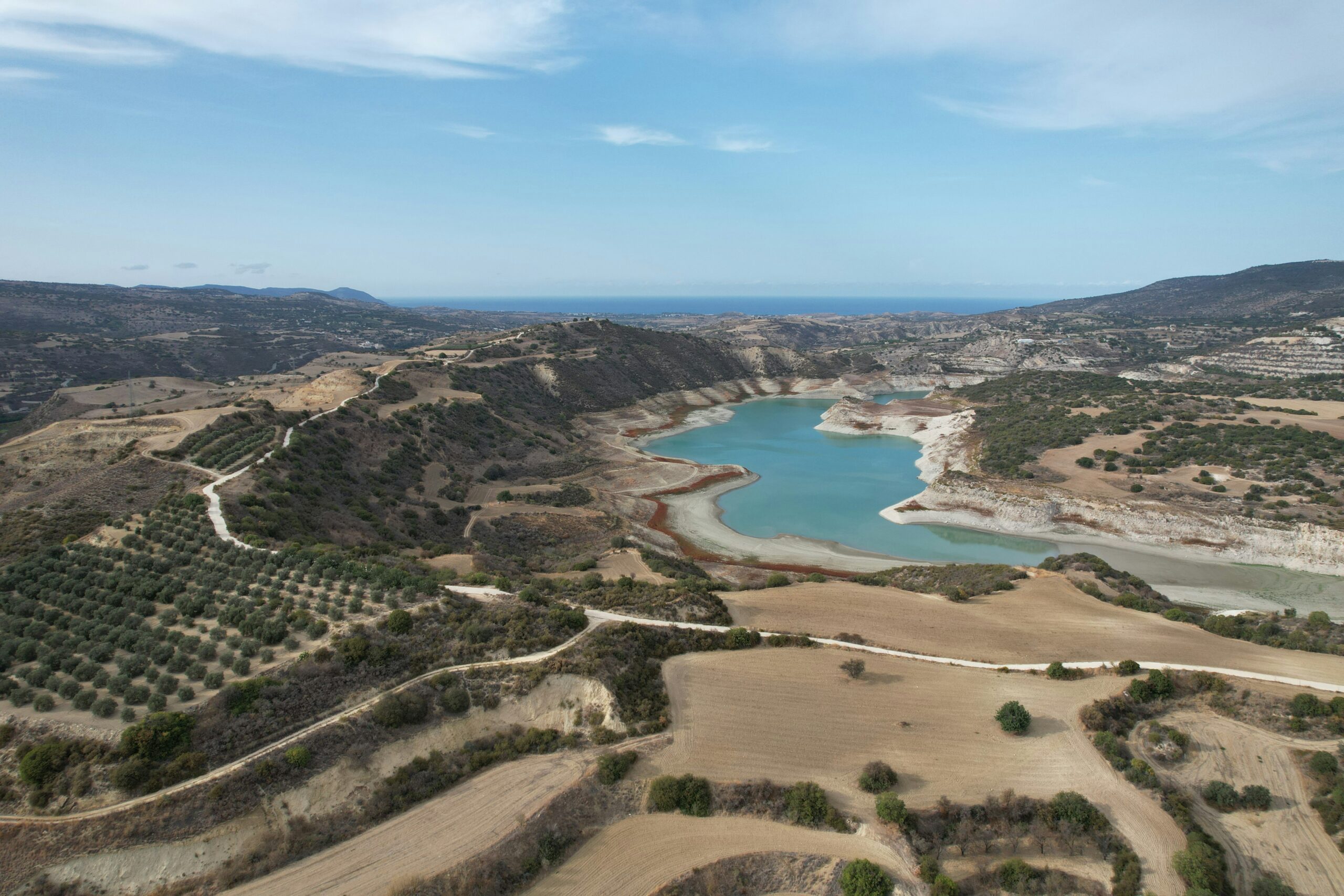
 Image description: Evretou Dam, Paphos Cyprus as it was on a drought at October 2025. Photo by Athina Vrikki on Unsplash
Water ministers and senior officials from the 43 member states of the Union for the Mediterranean (UfM) have agreed priorities for regional cooperation to 2030. They met in Rome on 28 September, the first UfM ministerial meeting on water since 2017. Italian foreign minister Antonio Tajani hosted the meeting. It was co-chaired by Jessika Roswall, European Commissioner for Environment, Water Resilience and a Competitive Circular Economy, and Raed Abu Saoud, Jordan’s Minister of Water and Irrigation. According to the European Commission, delegations endorsed a second ministerial declaration on water, which sets out priorities for meeting the water-related Sustainable Development Goals between 2026 and 2030.
The scale of the problem
The UfM Secretariat says water stress already affects every country on the southern and eastern shores of the Mediterranean. In Southern Europe, 70 per cent of the population lives in areas that experience water stress in summer. Across the region, more than 180 million people are classed as water poor. The Secretariat puts this down to climate change, environmental degradation and demographic pressures. Roswall described the Mediterranean as “one of the most vulnerable regions in the world to water scarcity”.
Ministers agreed to focus regional work on five areas: water governance, the water-energy-food-ecosystems (WEFE) nexus, finance and investment, digitalisation, and water and climate. They also endorsed three supporting frameworks, first approved by the UfM Regional Platform on Water in Barcelona in November 2025:
- a WEFE nexus strategy covering the full source-to-sea continuum
- recommendations on water finance, covering tariffs, climate finance, development banks and the private sector
- a framework for digitalising the sector, including a regional capacity-building project on artificial intelligence
A pipeline for projects
The Rome Initiative on Water is the region’s contribution to the UN Water Conference in Abu Dhabi in December. Its aim is to turn national goals into project pipelines that can attract finance, mainly for Southern and Eastern Mediterranean countries, which often struggle to get technical support and funding. The UfM Secretariat says access to water supply and sanitation has improved, but many countries have not yet made those systems financially sustainable. It says the initiative will follow the model of its Blue Mediterranean Partnership, linking and coordinating existing efforts rather than starting new ones.
Water and regional politics
Abu Saoud used his statement to address the region’s conflicts. He said water resources “must not be weaponized as a political tool or hijacked by one single country”, and that the region should put cooperation ahead of conflict.