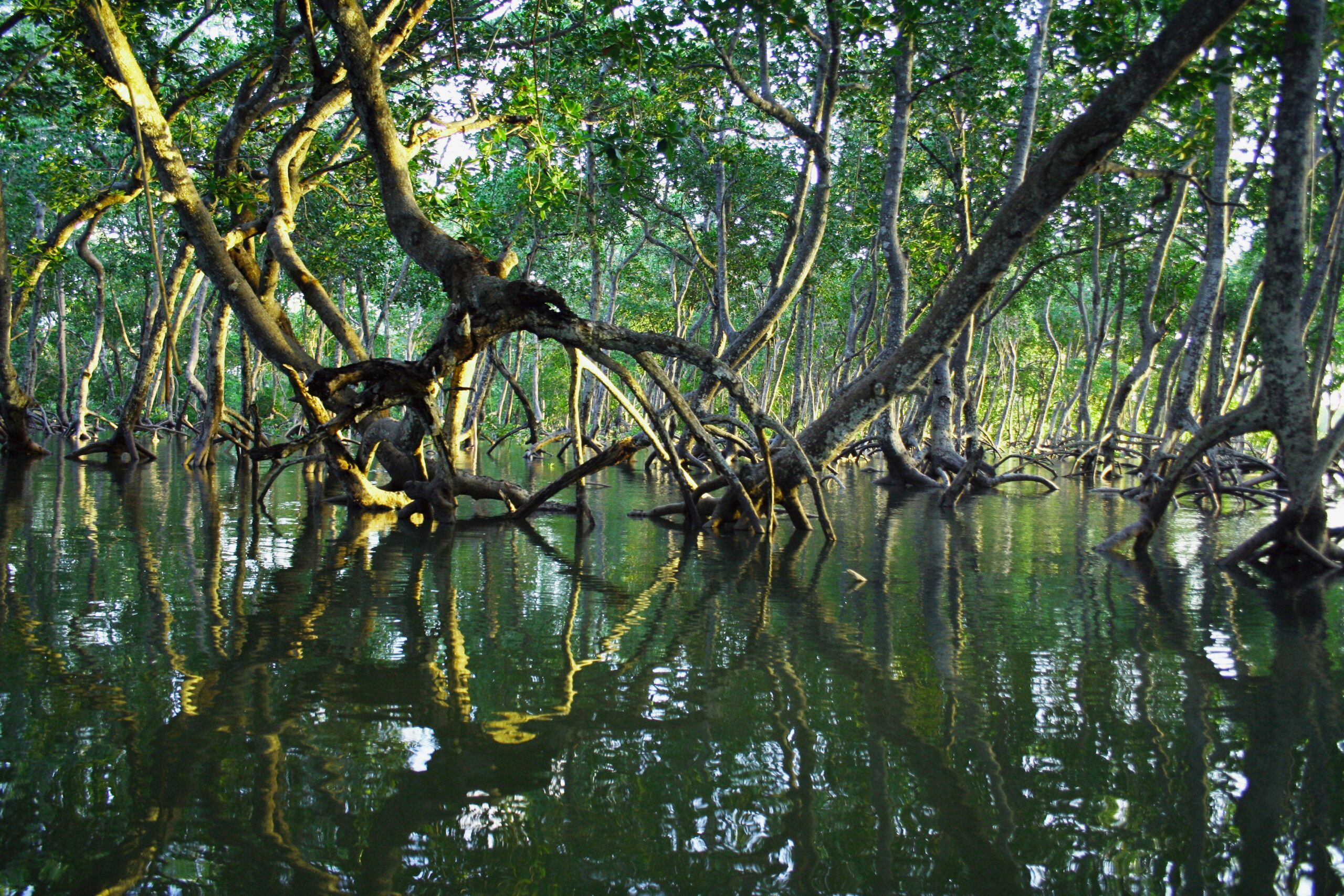
Photo by Timothy K
Two studies published this week paint a complex picture of the world’s mangrove forests: globally they are growing for the first time in decades, but rising seas risk pushing them past a tipping point that could turn some of the ocean’s most valuable carbon stores into net emitters.
A rare conservation success story
The first study, published in the journal Science and based on four decades of satellite data, found that mangrove forests worldwide are no longer in net decline. Led by researchers at Tulane University in New Orleans, the analysis shows that after decades of loss driven by deforestation and coastal development, nearly 2,900 square kilometres between the 1980s and 2010, gains have outpaced losses over the past 16 years. By 2023, the overall net loss across the entire four-decade period amounted to only around 1%, far smaller than previously estimated.
“After decades of loss, we’re finally seeing a global turning point for mangroves,” said Zhen Zhang, a postdoctoral scholar at Tulane’s School of Science and Engineering and lead author of the study. “This highlights their strong resilience and their potential as a powerful nature-based solution for climate mitigation and coastal protection.”
Daniel Friess, Cochran Family Professor of Earth and Environmental Sciences at Tulane and director of The Mangrove Lab, described the findings as a genuine shift in trajectory. “What we’re seeing now is a real shift. Mangroves are now showing a net increase globally, and the rate of degradation is slowing. While some mangroves are still being lost, this could make them a rare conservation success story and an important source of optimism for climate action.”
The recovery is being driven by a combination of restoration programmes and natural processes. In many regions, mangroves are recolonising abandoned aquaculture ponds and expanding onto newly formed coastal mudflats, particularly in river deltas where fresh sediment creates ideal growing conditions. Along the US Gulf Coast, warming temperatures are allowing mangroves to push into higher latitudes that were previously too cold, with Louisiana recording an overall increase over the past four decades. Beyond area, the study found that many existing mangrove forests are also becoming denser: closed-canopy forests, which store more carbon and provide stronger coastal protection, have expanded globally, while rates of degradation have dropped significantly since the 1980s.
Why mangroves matter
Though they cover less than 1% of Earth’s surface, mangrove forests store roughly 15% of all ocean carbon, mostly locked into their dense, root-rich soils. They also protect coastlines from storm surge and flooding, support fisheries and provide habitat for a wide range of marine species. Zhang emphasised the dual value of halting forest loss. “When mangroves are cleared, large amounts of long-stored carbon are released into the atmosphere. But when deforestation stops, mangroves can continue to accumulate carbon naturally over time, so there’s a major climate benefit in both avoiding emissions now and allowing future carbon storage.”
He also highlighted a dependency that is easily overlooked. “Much of mangrove expansion happens on newly formed mudflats, which depend on a steady supply of river sediment. Maintaining that sediment flow is critical for creating the conditions mangroves need to establish and spread.”
The sea level threat
The optimism of the Tulane study is, however, tempered by a second paper published simultaneously in the journal Earth’s Future. Researchers at the universities of Exeter and Plymouth developed a new model incorporating water flow, sediment movement, erosion and carbon dynamics across mangrove ecosystems, then tested it against a range of sea level rise scenarios. The results were clear: the higher the rate of rise, the more severe the impact on carbon storage across the forest as a whole.
Barend van Maanen, a coastal researcher at the University of Exeter and co-author of the study, warned that the scale and pace of sea level rise could push these forests beyond their adaptive capacity. “Sea level rise and increased inundation can push the forests beyond their limits, and they won’t be able to tolerate this.” At a landscape scale, the model found, rising seas reduce total carbon sequestration through both mangrove loss and soil erosion – and in some locations rising sea levels could even flip mangrove areas from carbon sinks to carbon emitters.
Co-author Arya Iwantoro, a senior research consultant in coastal modelling at the University of Plymouth, stressed that local observations could be misleading. “The key message is that local increases in carbon accumulation do not necessarily mean that the whole mangrove ecosystem will store more carbon in the long term. Even within one mangrove ecosystem, different areas can respond differently depending on their position in the landscape, especially their proximity to channels and sediment sources.”
The model also drew on a well-understood biological reality. As Andre Rovai, a mangrove scientist at the Smithsonian Environmental Research Center who was not involved in the paper, put it: “It’s like a vase in your house: if you keep putting a lot of water on it, you’re going to drown the plant, right? The roots are going to rot.” The mangrove forests, he added, “don’t have time to adjust to that.” He praised the study overall, saying the authors did “an outstanding job” simulating real-world conditions and that they had “beautifully put together” a “pretty complicated puzzle.”
Separately, modelling published in Earth’s Future and summarised by Eos/AGU confirmed the same underlying tension: at a local scale, some sea level rise may actually increase mangrove growth and carbon accumulation due to enhanced water supply, but at landscape scale the net effect is negative, with erosion and habitat loss outweighing local gains.
What needs to happen
The two studies together point to an urgent management challenge. Many mangrove forests are currently hemmed in between the ocean and coastal infrastructure – roads, hotels, seawalls – leaving them no room to retreat landward as sea levels rise. Van Maanen argued that this needs to change. “We need to think very carefully about how we can create opportunities for mangroves to actually retreat landward and migrate into other suitable areas. But also we need to try and limit sea level rise the most we can. The less sea level rise, the better.”
On the positive side, the Tulane findings suggest that protecting existing forests and allowing natural regeneration remains the single most effective intervention. As Zhang concluded: “As countries invest in nature-based solutions to climate change, mangroves stand out as a rare example of an ecosystem where global trends are beginning to move in the right direction.”