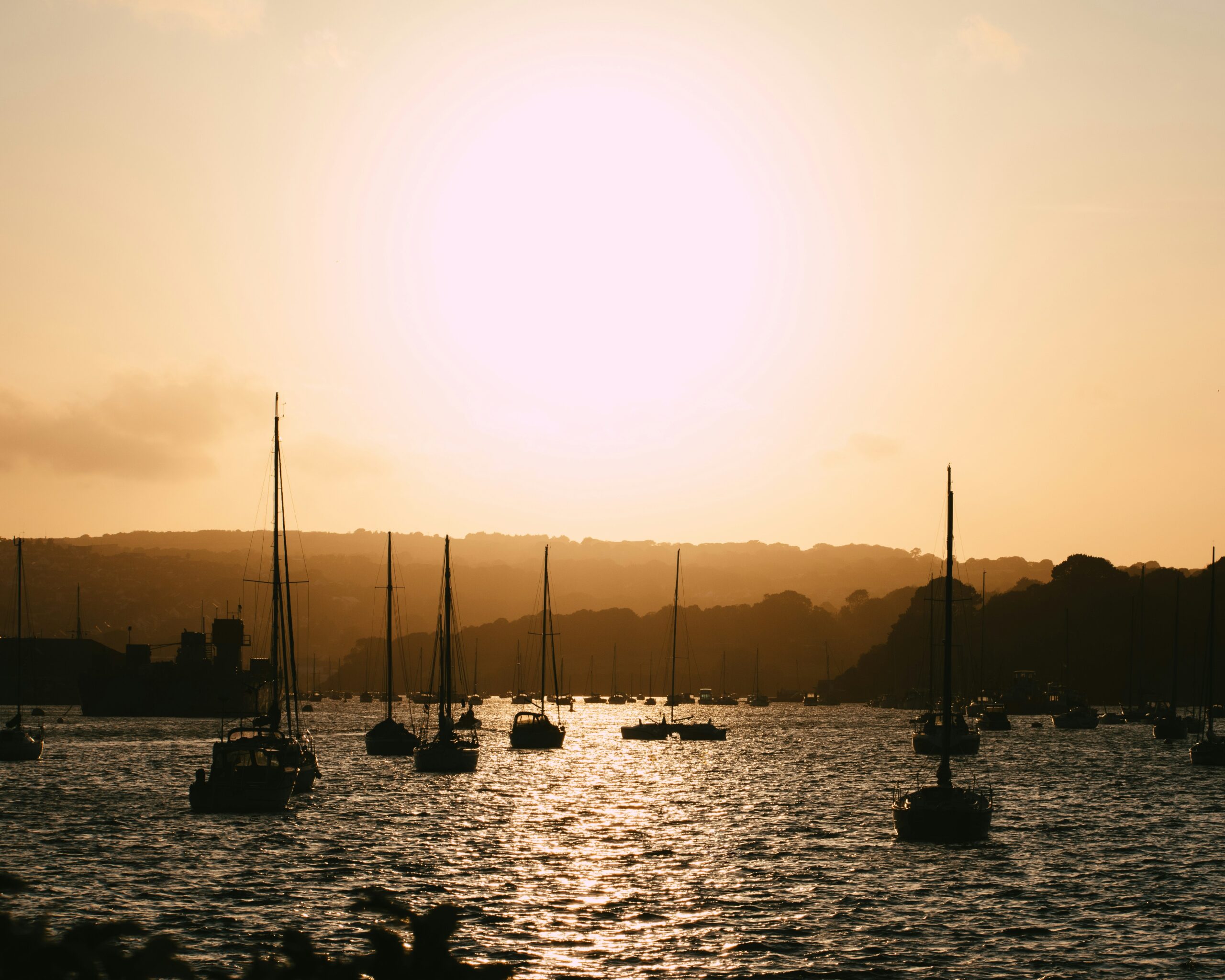
Photo by Joseph Reeder
More than 400 residents packed The Cornish Bank in Falmouth on the evening of 17 August for a public meeting on the proposed £150 million dredging and redevelopment of Falmouth Docks, with the venue full to capacity and a large crowd gathering in the street outside to follow the debate through speakers, Cornwall Live reports. The meeting came a few days after Cornwall Wildlife Trust (CWT) raised fresh concerns about the scheme, which would bring new wharves, an area to build floating offshore wind structures, and enhanced berth capacity for cruise ships and cargo vessels.
A community anxious for answers
The panel, hosted by campaign group Stop the Dredge, brought together Drystan Jones, director of port development at dock owner Balaena, alongside Dan Barrios-O’Neill of CWT, local fishermen Paddy Vinnicombe and Jason Pascoe, artist and climate campaigner Francesca Williams, and Bella Bunce of Stop the Dredge.
Dr Barrios-O’Neill told the meeting that the material earmarked for dredging, nearly a million cubic metres in total, contains some of the most toxic sediment in the UK, with elevated levels of mercury, lead and Tributyltin (TBT), a compound used in old anti-fouling paints that is highly damaging to marine life. He argued that it was the combined effect of these contaminants, not just individual substances, that needed laboratory testing, and noted that three-quarters of the sample cores taken in the harbour exceed safe limits for disposal at sea. Inadequate sampling, he said, meant it would not be clear which loads were most contaminated, raising the risk of highly toxic material being dumped just outside the Fal and Helford Special Area of Conservation. “There can’t even be a 1% chance that this goes wrong,” he said, adding that CWT is “not opposed to this development in principle, but we have some serious concerns in practice.” CWT has submitted a Holding Objection to the MMO calling for further research before the proposals can be fully assessed.
Oyster fisherman Paddy Vinnicombe, whose family has fished the estuary for six generations, warned of the risk to what he called the last natural oyster fishery in the country. “The oyster fishery needs to be in a Goldilocks’ zone,” he said. “If they are going to go ahead with this dredge, then they need to make sure that it’s tightly sealed. A five percent error could kill off the last natural oyster fishery in the country. It’s been here for hundreds of years and it’s just starting to take off again. If this happens, we won’t be able to carry the torch forward.”
Fisherman Jason Pascoe questioned the developer’s understanding of local tides and winds, arguing that plumes of contaminated sediment would drift through fishing waters for days, and pointed to a 2001 dumping operation involving a much smaller quantity of spoil in the same area that he said wiped out fish stocks there for five years. He asked why the plans did not include silt curtains to contain the spread.
Support for a working port
Speaking for Balaena, Mr Jones said dredging was essential if Falmouth was to prosper as a working port and provide good local jobs, both from cruise ship visits and from the growing floating offshore wind sector. He said the plan had been developed in consultation with Natural England and the MMO, and that dredging would take place on ebb tides to minimise the risk of sediment spreading into the estuary. “We are on exactly the same page, we do not want any damage to happen,” he said. “These are issues for the regulators to enforce and us to comply with.”
Unions push for approval
GMB, one of the UK’s largest trade unions with more than 500,000 members, has urged Cornwall Council to back the proposals ahead of a meeting scheduled for 24 August, when councillors are due to consider the land-based element of the application. The union stressed that the dredging decision itself rests with the MMO, not the council, which is only responsible for planning permission on the land-based works.
Matt Roberts, GMB National Officer, framed the redevelopment in terms of national as well as local significance. “This is far more than a development project, it is an investment in Cornwall’s future and in Britain’s future,” he said. “Falmouth has the opportunity to become one of Britain’s important maritime centres for the renewable energy revolution as well as being a hub of strong domestic ship repair and engineering. This is vital if we are serious about our future national and energy security.” He added that the union wanted “today’s workforce to know that there is a future for them in Falmouth,” and for young people in Cornwall to be able to “build rewarding careers here without having to leave the county to find opportunities.”
The MP’s position
Jayne Kirkham, MP for Truro and Falmouth, attended the meeting and later issued a formal statement addressing concerns raised about the developer’s environmental modelling. She said she had raised concerns about “issues raised about tidal flow models and measurements in the report, and the screening of the dredged area,” and confirmed that Balaena’s £1.3 million environmental assessment uses tidal data that sometimes differs from Admiralty charts, and that regulators have asked for further sediment testing.
Ms Kirkham was clear that the decision does not rest with her. “I am not the decision-maker on Falmouth Docks,” she said. “We have regulators that we set up to judge whether marine development can be done safely. They make the decisions on these cases, not politicians. The MMO turned down the last Falmouth dredge application nearly 20 years ago because it affected the bay and would impact the marine environment. This time the MMO are lead regulators and will be coordinating the regulators’ responses with Natural England and the Environment Agency. Closer collaboration should prevent delays and reduce unnecessary costs, without slippage of environmental standards.”
She also confirmed that restoring a disused rail freight line into the docks was being explored alongside the redevelopment, which she said could take around 100 lorries off the road for each train used. Speaking before the meeting, she had told Cornwall Live that “the development of Falmouth docks could be a key pillar in unlocking Cornwall’s massive renewables potential,” pointing to floating offshore wind and critical minerals as central to the UK’s shift away from fossil fuels, while stressing that any development “must be done in an environmentally safe way with all stakeholders’ voices being heard.”
What happens next
The government named the MMO as lead environmental regulator for the scheme in October 2025, working alongside Natural England and the Environment Agency to streamline the consent process. The public consultation on the marine licence closed in September 2025 and the MMO is reviewing responses, while Cornwall Council’s Strategic Planning Committee is due to consider the land-based element of the application on 24 August. Up to 643,000 cubic metres of sediment could be removed as part of “pocket dredging” around the berths, much of it earmarked for disposal at sea.