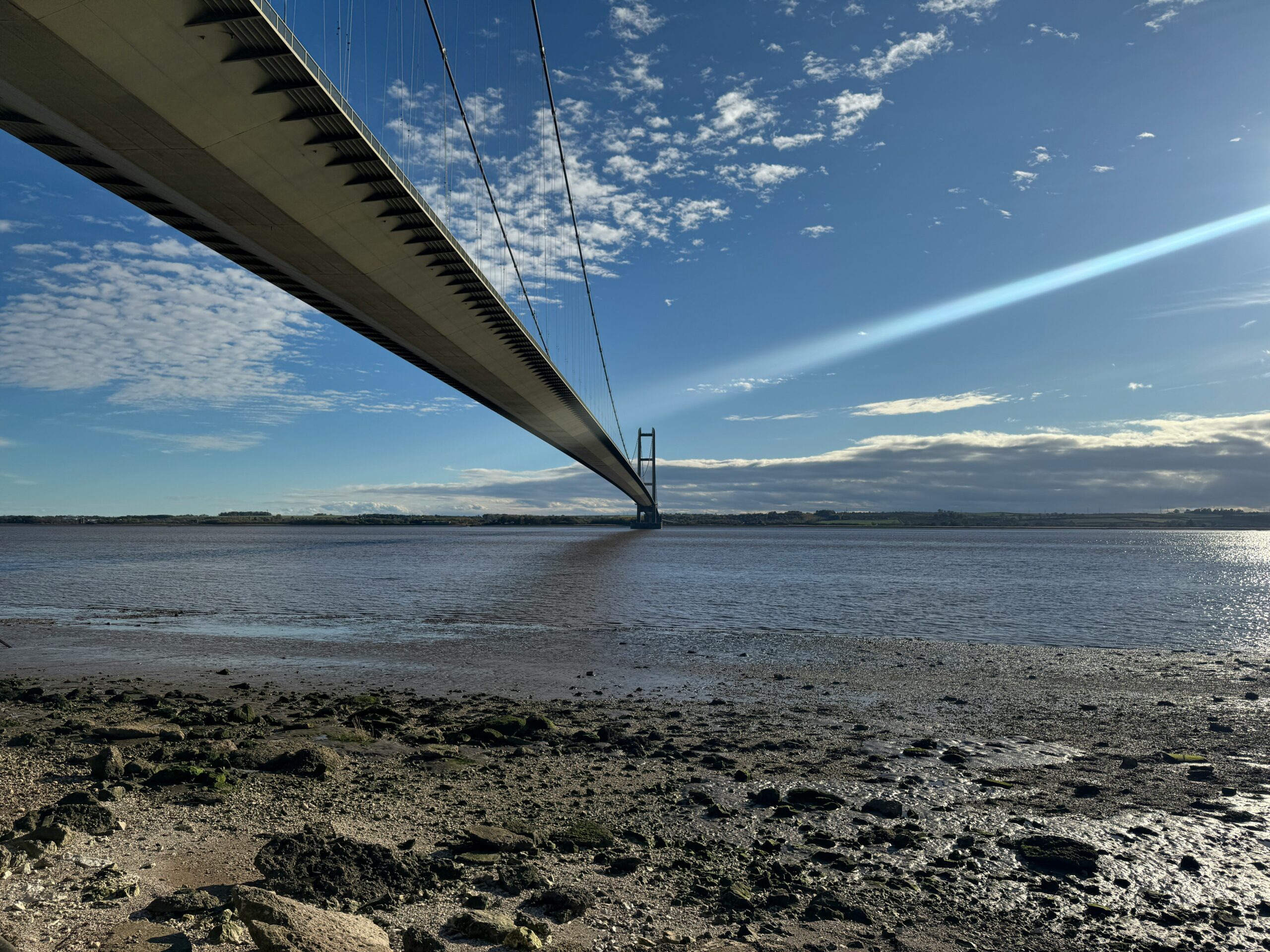
Photo credit: Steve Payne
More than half a million people, nationally important infrastructure and the UK’s largest port complex face increasing tidal flood risk across the Humber unless a long-term, estuary-wide approach to adaptation is delivered. Understanding Tidal Risk, published on 7 July, is the shared evidence base of the Humber 2100+ partnership, which brings together the Environment Agency, 11 local authorities, Natural England and internal drainage boards.
What is at risk
Around 500,000 people live in areas currently at risk of tidal flooding, including Hull, Grimsby and Goole, with exposure extending inland along the tidal rivers to Doncaster, Selby and Gainsborough. The estuary also hosts power stations, oil refineries, the UK’s largest port complex and more than 120,000 hectares of high grade agricultural land. Its habitats carry international conservation designations.
Sea levels around the UK have already risen by around 17cm since 1900. UK climate projections suggest the Humber could see increases of roughly 10 to 15cm per decade, potentially exceeding a metre by the end of the century. Rare surge events are not the only concern. Routine high tides will bring more water into the estuary every day, exposing more land to regular flooding and steadily increasing pressure on defences.
Why higher walls will not solve it
The partnership modelled a scenario it calls hold the line+, raising defences across the entire study area. The evidence shows this would trap more water within the estuary, create a funnelling effect with limited space for water to disperse, and increase risk beyond the study boundary. It would also raise residual risk, since higher defences hold back greater volumes and the consequences of a breach grow accordingly.
There is a physical constraint too. For every metre of additional embankment height, roughly six metres of extra width is needed to maintain stability, and in many places that space is taken by homes, businesses, infrastructure or sensitive habitats. Even maintaining existing defences, most of which were not built to modern standards, could require more than £1 billion of investment by 2046.
Costs and consequences
Economic damage is projected to rise sharply from the 2070s onwards, even if current defences are maintained, running into billions of pounds without a change of approach. Densely populated areas would see the greatest losses, though rural areas with high quality farmland face severe consequences too. The partnership points to wider effects on transport, emergency services, hospitals, schools and power networks, on physical and mental health in repeatedly flooded communities, and on food production.
Since 2008, more than £350 million has been invested in tidal flood risk management around the Humber, improving protection for around 70,000 properties. The partnership argues that no single solution will now suffice. Future measures are likely to combine raising and maintaining defences with flood storage, changes to land use, nature-based approaches, and the possible use of large-scale infrastructure such as a tidal barrier, planned adaptively so that early decisions do not foreclose later options.