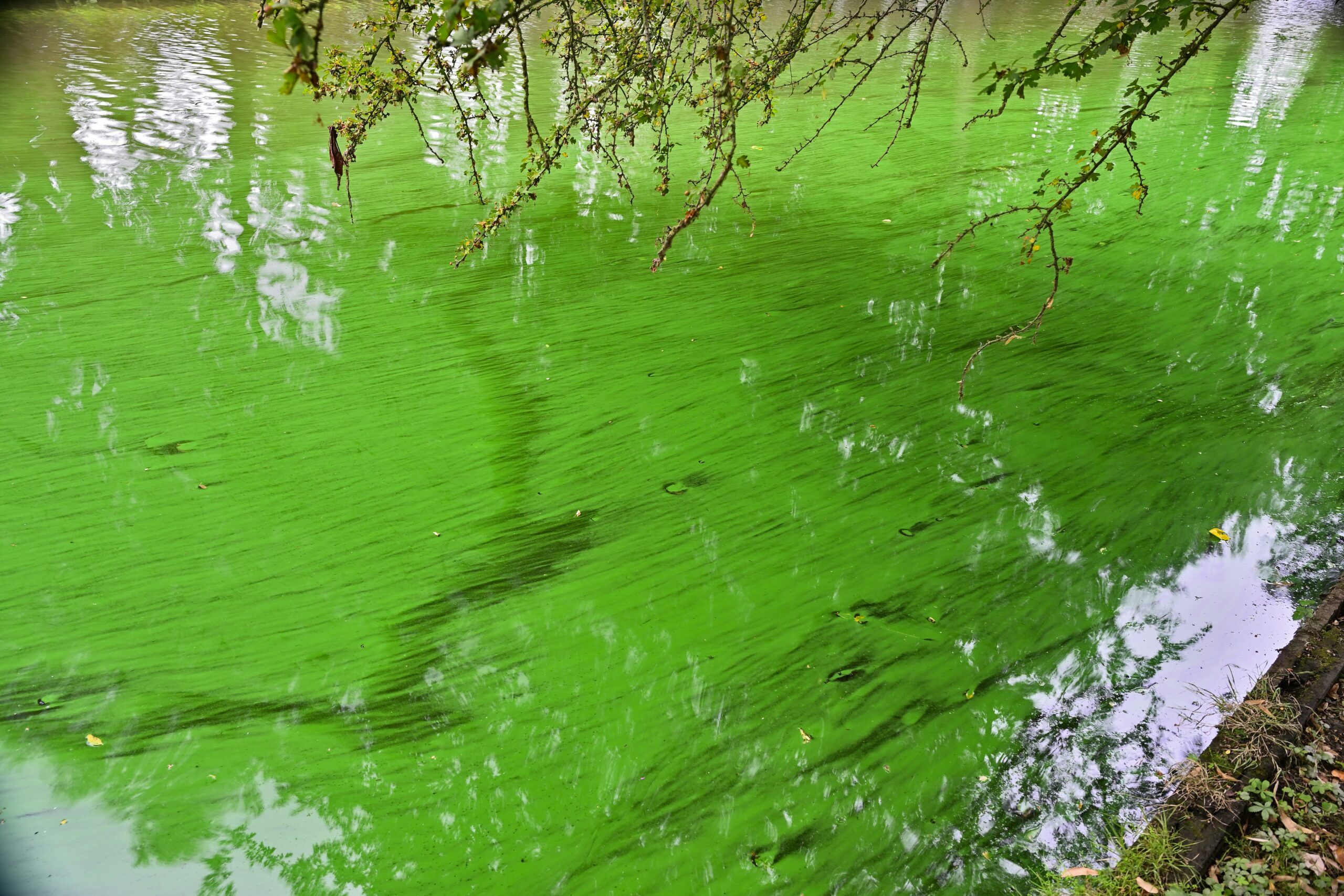
 Image description: Blue-green algae (Cyanobacteria) in the canal network in Bruges, Belgium Image credit: P Mantha on Unsplash
Blue-green algae blooms causing mass disruption
Successive heatwaves across the UK this summer have triggered a wave of blue-green algae blooms in rivers, lakes and coastal waters, causing widespread disruption to swimmers and raising deeper concerns about the long-term health of some of the country’s most ecologically significant aquatic habitats. According to the Guardian, British Triathlon has confirmed that four events have already been cancelled this year due to algae blooms – most recently the swimming leg of Ironman Leeds on 16 August, which had drawn around 2,000 competitors. The cancellations have thrown a spotlight on a problem that, while not new, is being significantly amplified by the warm, slow-moving water conditions that characterise this summer’s prolonged dry spells.
London’s newest bathing site affected within its first season
Particularly striking is the impact on the Thames at Ham and Kingston, designated earlier this year as the first official bathing water site on the River Thames in London. The Environment Agency detected a potentially toxic blue-green algae bloom in the stretch between Sunbury Lock and Teddington Lock on 17 August, with warning signage placed in the area and updated guidance issued on 20 August following further sampling. The EA is continuing to monitor the situation and has advised the public to avoid contact with the affected water. As the site is in its first year of designation, no overall water quality classification is yet available, making this an unfortunate start for what had been celebrated as a landmark moment for river swimming in the capital.
The conditions driving blooms
Blue-green algae, or cyanobacteria, thrive in warm, slow-moving water where nutrient levels are elevated, multiplying rapidly when conditions are favourable. The Guardian notes that while blooms are not unusual at this time of year, the frequency and intensity of this summer’s heatwaves have made conditions particularly conducive to their spread. The underlying nutrient enrichment that fuels blooms, driven by agricultural runoff, sewage discharges and urban drainage, means that rising temperatures are increasingly acting as a trigger for pollution problems that are underlined by poor water quality.
Ancient habitats under threat in Cornwall
The third dimension to this week’s reporting on algal-related issues comes from Cornwall, where the Guardian reports that blooms fuelled by agricultural runoff and sewage from the River Fal catchment are smothering maerl beds in Falmouth’s Carrick Roads harbour, some of which are believed to be up to 4,000 years old. Divers found a “worrying deterioration” in the beds last year, with algae blocking the sunlight that the fragile, coral-like seaweed depends on. The maerl beds, alongside seagrass meadows in the same area, are among the most biodiverse and carbon-rich marine habitats in England, and serve as nurseries for commercially valuable species including scallops and crab.
In response, Cornwall Council has launched the Fal Rivers to Reef initiative, working with farmers and landowners across 22,000 hectares of farmland and woodland to reduce pollution, restore nature and build climate resilience from the river’s source at Goss Moor to the Falmouth estuary. The scheme is backed by Defra catchment data identifying rural farm pollution and water industry waste as the reasons the Lower River Fal has failed to achieve good ecological status. A separate but parallel Forest for Cornwall programme, which secured an £8.7m in Defra funding this month, is working to plant 8,000 hectares of new trees across the county.
A system under pressure
A summer of heatwaves is making the consequences of water pollution more visible, more disruptive and more urgent. Addressing nutrient loading at a catchment scale should no longer be considered a long-term ambition but an immediate operational and environmental necessity.