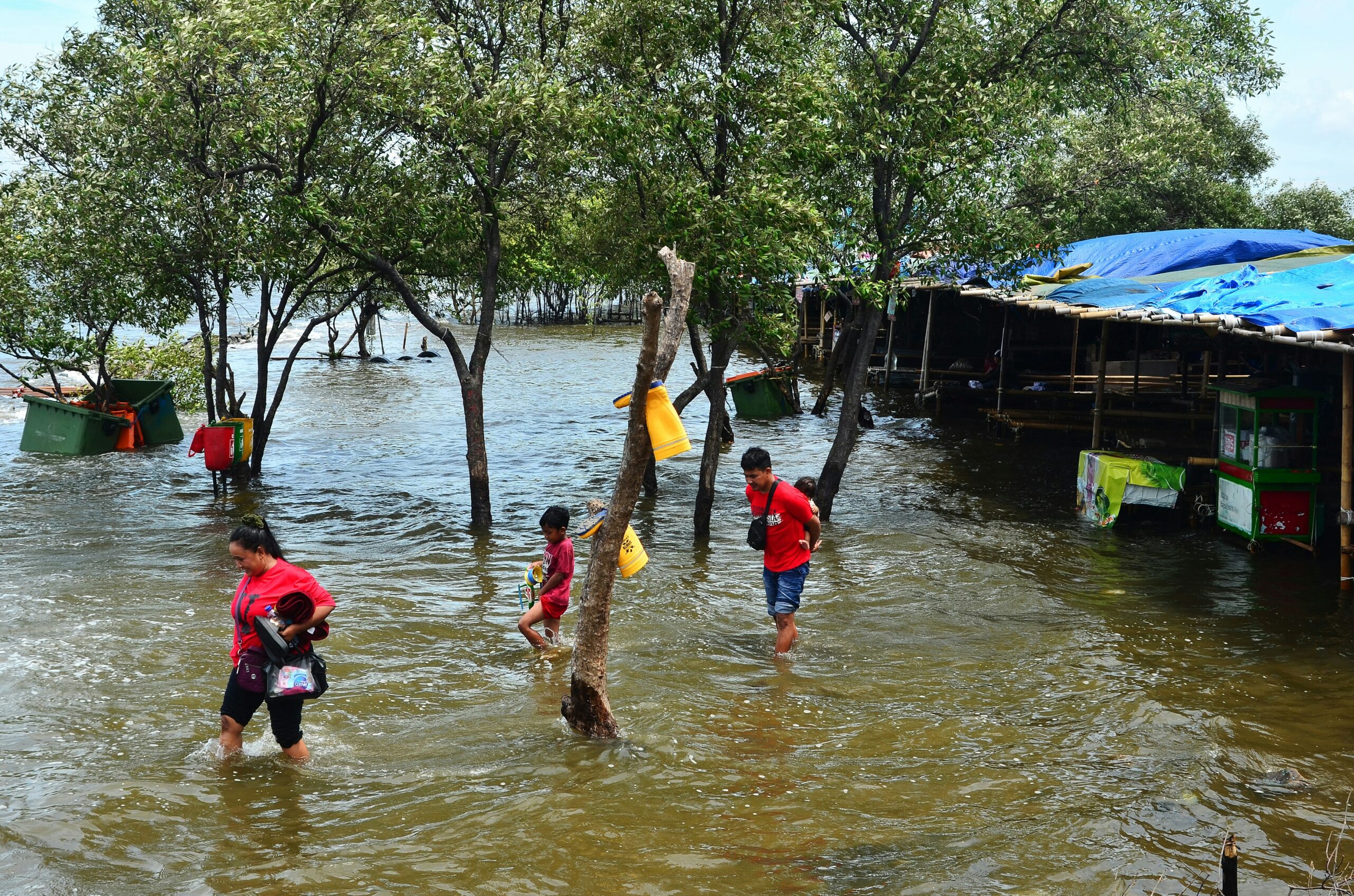
Photo by Iqro Rinaldi
Coastal sea levels around the world are significantly higher than assumed in most scientific risk assessments, a finding that could place tens of millions more people in the path of flooding than previously understood.
The study, published in Nature, reviewed 385 peer-reviewed papers on sea level rise and coastal hazards published between 2009 and 2025. It found that around 90% of them underestimated baseline coastal water heights by an average of 30 centimetres – roughly one foot – with some regions of Southeast Asia and the Pacific seeing discrepancies of up to one metre.
The root cause, according to PBS News, is a mismatch between the way sea and land altitudes are measured. Study co-author Philip Minderhoud, a hydrogeology professor at Wageningen University & Research in the Netherlands, attributed the error to a “methodological blind spot” between the different ways those two things are calculated.
Implications for future projections
The corrected baseline changes the picture of future risk substantially. Research cited by the Guardian indicates that with a one-metre rise in relative sea level, 37% more coastal areas would fall below sea level than currently assumed, affecting up to 132 million people. “If sea level is higher for your particular island or coastal city than was previously assumed, the impacts from sea level rise will happen sooner than projected before,” Minderhoud told the Guardian.
Lead author Katharina Seeger of the University of Padua said: “Our calculations show that measured coastal sea levels in many places on Earth are higher than is often assumed in coastal impact studies.”
The findings have drawn attention from scientists beyond the research team. Michael Mann of the University of Pennsylvania, who was not involved in the study, told USA Today that the entire research community appeared to have overlooked the key distinction drawn by the paper, and that it “does look as if” sea level rise in many key regions may have been underestimated “by a substantial margin.” Matt Palmer, an associate professor at the University of Bristol, said the study showed that “the impacts of sea-level rise under climate change have been systematically underestimated.”
IPCC assessments affected
The errors are not confined to individual studies. The Nature paper found that 46 studies included in the most recent IPCC Sixth Assessment Report also contained incorrect or absent sea-level referencing. Correctly adjusted figures suggest that between 966 million and 1.07 billion people, 12–14% of the global population, currently live in low-elevation coastal zones, compared with the 896 million figure cited in the IPCC report.
The problem is most acute in the Global South. CBS News reported that underestimates are far more common in Southeast Asia, the Pacific, Latin America, Africa, the Middle East and the Caribbean than in Europe or along Atlantic coasts.
A wider data gap
The sea level findings coincide with a separate UNESCO report warning that models differ by 10–20% in their estimates of how much carbon the ocean absorbs – raising further questions about the reliability of the global climate projections on which coastal planning depends. PBS reported that together, the two studies suggest governments may be planning for coastal and climate risks with an incomplete picture of how the ocean is changing.
For communities already living with those risks, the stakes are immediate. Thompson Natuoivi, a climate advocate for Save the Children Vanuatu, put it plainly: “Sea level rise is not just changing our coastline, it’s changing our lives. We are not talking about the future — we’re talking about the right now.”