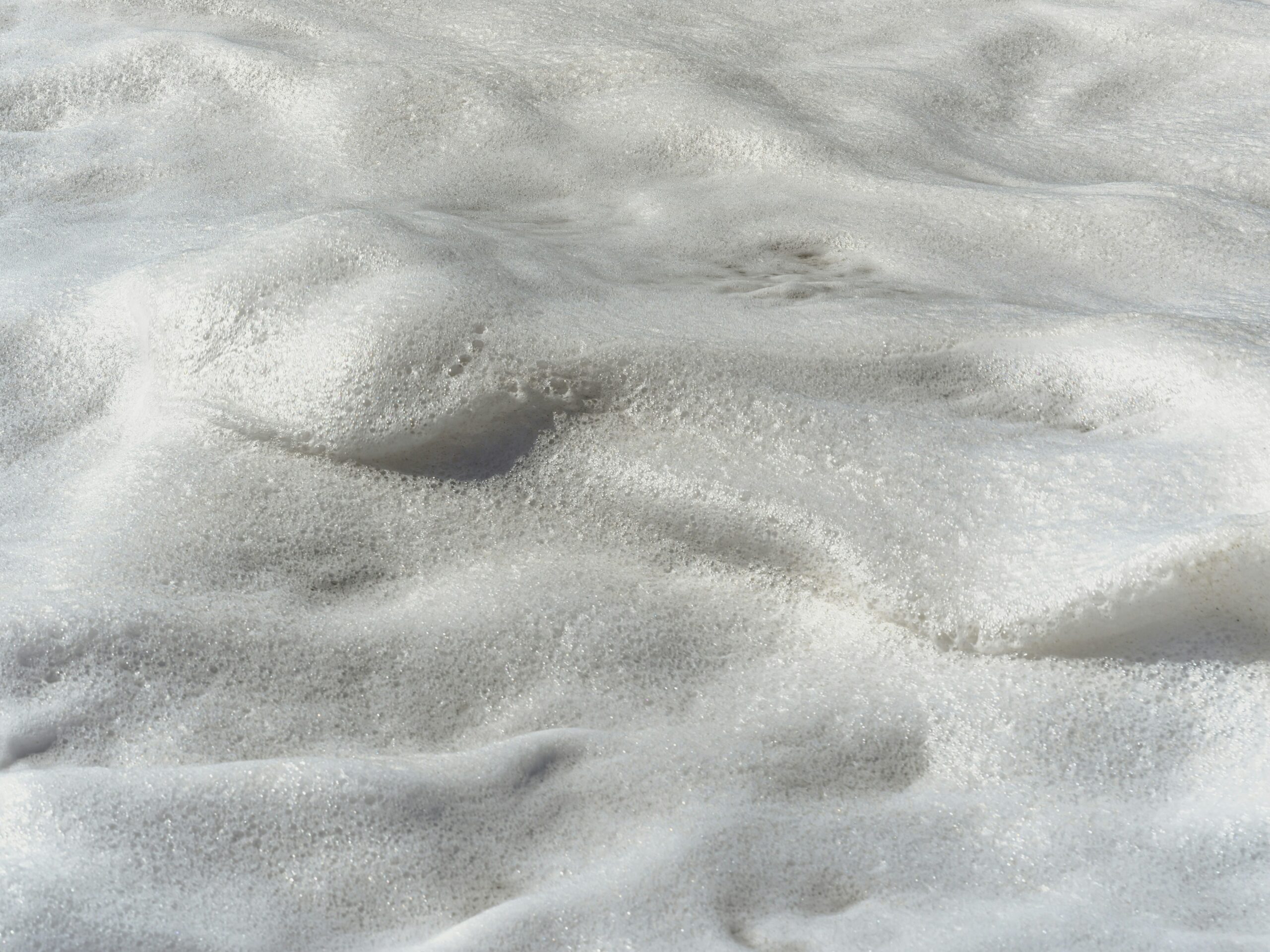
Image description: Close up shot of silvery seafoam in sunlight. Photo by Kier in Sight Archives on Unsplash
A remote island, an unexpected finding
Britain’s most remote inhabited island, known for knitting and rare birds, has the highest recorded levels of toxic per- and poly-fluoroalkyl substances (PFAS) in any public drinking water supply in Scotland. The finding, reported by the Guardian on 2 June 2026, is striking precisely because Fair Isle has no obvious industrial sources of the chemicals. Journalist Daniel Shailer obtained readings for the individual PFAS compounds detected on the island, along with documents relating to the airstrip and community fire station. Concentrations of PFAS at Fair Isle’s water treatment works had first been identified through 2023 sampling by Scottish Water, with the highest combined PFAS sum recorded at Fair Isle reaching 23.1 ng/l, the highest in Scotland and well ahead of Benbecula (9.4 ng/l) and Lerwick’s Sandy Loch (4.9 ng/l). It remains below the 100 ng/l threshold at which Scottish Water is required to take emergency action.
A new theory: seafoam and seaspray
According to the Guardian’s reporting, around half a dozen scientists based in Stockholm, Texas, Liverpool and Aberdeen reviewed the data and reportedly agreed that Fair Isle’s “forever-chemical fingerprint” matched a mix consistent with PFAS arriving in seaspray and foam. EnviroLink, which carried follow-up coverage, described the proposed pathway: when Atlantic storms churn the ocean, pale yellow foam drifts across the island’s fields. The theory is an early scientific hypothesis rather than a fully established mechanism, but several independent researchers told the Guardian the data fits this pathway.
Health and policy context
PFAS are a group of thousands of synthetic chemicals widely used in non-stick coatings, waterproof clothing and firefighting foams. The Royal Society of Chemistry has previously stated that exposure to some PFAS has been linked to a range of health conditions including certain cancers, thyroid disease and liver damage. Scottish Water previously told Shetland News that it could not definitively say why Fair Isle’s results were so high compared with the rest of Scotland, and that it remained engaged with regulatory work on PFAS. If the seafoam pathway is confirmed by further research, it could have implications for many other coastal communities across the UK.