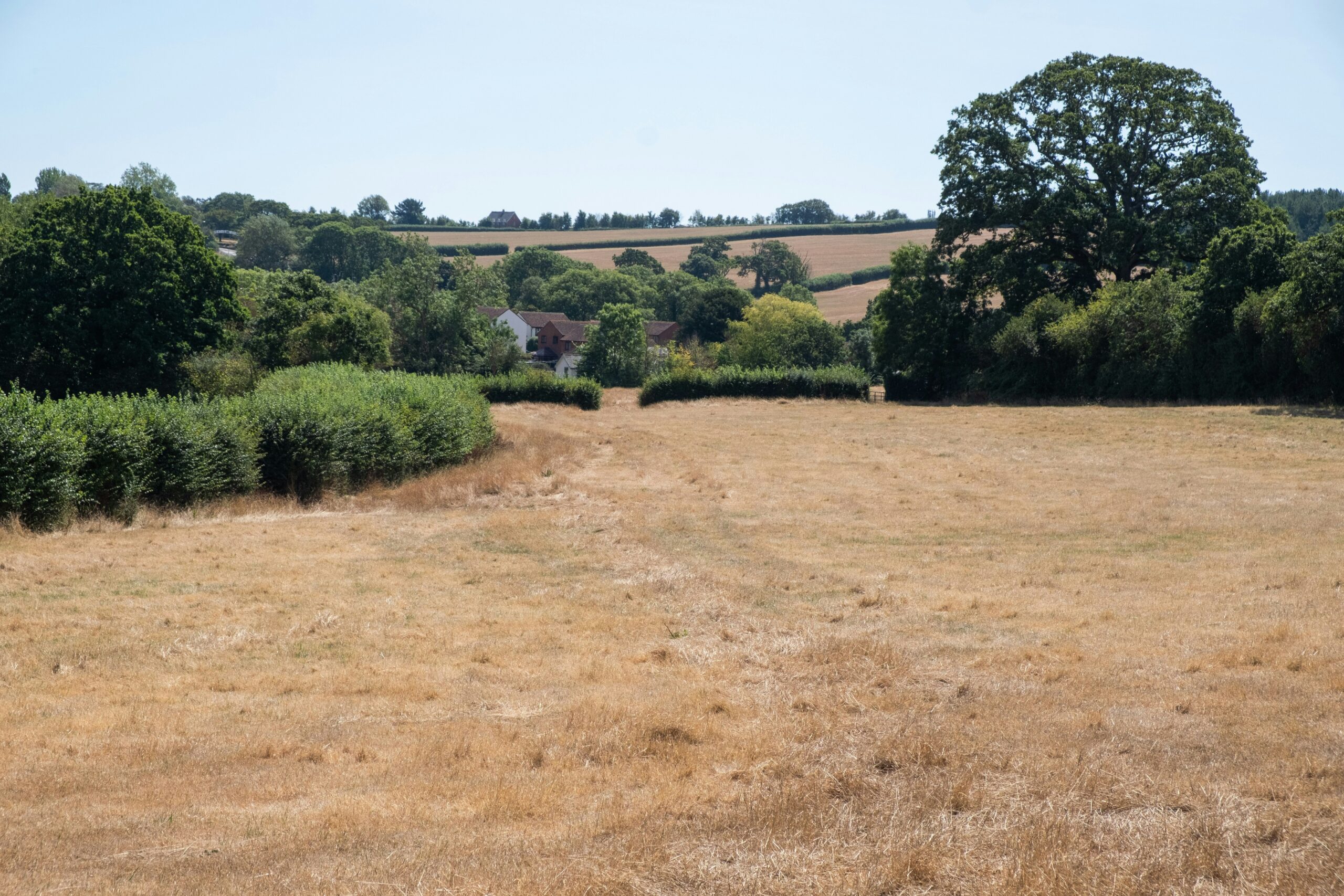
Image description: Devon fields during the summer 2026 drought. The grass is yellowed, with green hedgerows and a house in the background. Photo by Veronica White on Unsplash
There is roughly a one-in-four chance that around half of the country will still be in drought by spring 2027, according to new analysis presented to the National Drought Group at their meeting on 15 September.
The Environment Agency has modelled rainfall scenarios through to April 2027 and found that England would need 120% of typical rainfall over the next seven months for all areas to be considered out of drought. There were no changes in drought status, with almost three-quarters of England remaining in drought after an exceptionally dry spring and summer, alongside a succession of heatwaves.
El Niño to bring wet and windy conditions
The developing El Niño is one of several factors that could influence the UK’s weather, with previous El Niño winters associated with a greater chance of wet and windy conditions in late autumn and early winter, and colder, calmer conditions later in the season.
The outlook for wetter weather in autumn is set to bring some relief to most drought-hit areas; however even in the most likely weather scenario Devon & Cornwall and East Anglia are expected to still be in drought by the start of April 2027. The risk of a severe drought in the coming months, which the EA says currently stands at 1%, depends on future rainfall – but this country has not seen a severe drought since 1976.
EA model scenarios for the next seven months
At the session, the Environment Agency presented data looking at potential rainfall scenarios over the coming seven months.
The most likely scenario for September-March is presented below, based on the Met Office three-month outlook and seasonal indications:
- There remains a geographical divide with the north moving to recovery, followed by the midlands and then finally parts of the south.
- Cumbria & Lancashire and Greater Manchester, Merseyside & Cheshire could move to recovery in October and be declared back to normal in November.
- By December, most areas could see a fragile recovery, although four areas (Devon & Cornwall, East Anglia, Thames Valley and the West Midlands) would stay in drought.
- By February, most places are back to normal. The East and West Midlands plus Thames Valley are in recovery with Devon & Cornwall and East Anglia remaining in drought.
- By the start of spring 2027, Devon & Cornwall and East Anglia would still be in drought – entering the traditionally dry months already with water deficits.
However, the EA also informed the National Drought Group there is a one-in-four likelihood of a dry September-March interval, with 80% of average rainfall:
- A fragile recovery could begin in November, with all four northern areas (Cumbria & Lancashire and Greater Manchester, Merseyside & Cheshire, the North East and Yorkshire) moving from prolonged dry weather to recovery. By January, they would be back to normal status.
- Drought conditions would remain across the midlands and the south for the rest of 2026. The East Midlands could move to recovery in January and be joined by London, Hertfordshire, and Kent the following month.
- East Anglia, Lincolnshire & Northamptonshire, Thames Valley, Devon & Cornwall, Wessex (covering Dorset, Somerset, Wiltshire, and south Gloucestershire) Solent & the South Downs and the West Midlands would still be in drought by the start of April 2027.
You can see the full notes from the National Drought Group meeting here.