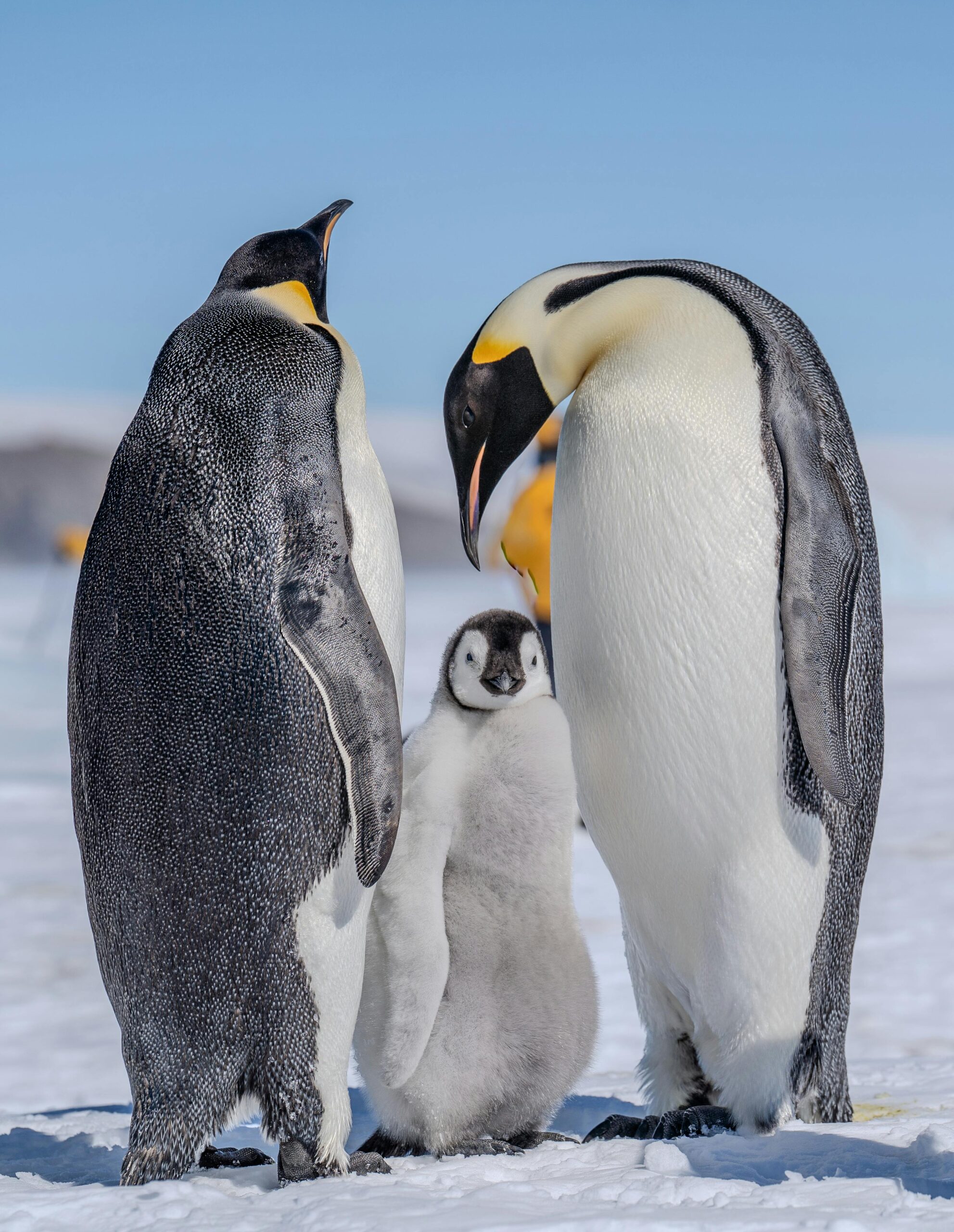
Photo by Jan Tang
Scientists have discovered that the annual process by which Emperor penguins shed and regrow their feathers may be killing thousands of birds, as the collapse of Antarctic sea ice strips them of the stable platforms they depend on to survive it.
The findings, published in Communications Earth & Environment, emerged from an accidental discovery. Researchers at the British Antarctic Survey were analysing satellite images of Marie Byrd Land in West Antarctica when they noticed unusual brown staining along the remote coastline. The timing matched the species’ annual moulting period, and closer inspection revealed the patches to be mounds of discarded feathers – the first time moulting colonies had ever been identified through satellite imagery.
Each austral summer, Emperor penguins from the Ross Sea travel up to 1,000 kilometres to reach Marie Byrd Land, seeking stable fast ice — sea ice anchored to the coastline — on which to complete the moult. The seven breeding colonies that make this journey represent as much as 40% of the global population. Moulting is among the most perilous phases of their life cycle: unable to enter the water to feed for several weeks, and without their waterproof plumage, entering the ocean is likely fatal. The birds burn through up to 50% of their body mass in the process.
Between 2019 and 2021, when sea ice was relatively stable, more than 100 moulting groups were visible in the satellite data. Then, from 2022, Antarctic sea ice began to collapse. Fast ice coverage in the study region declined from a 50-year average of around 500,000 square kilometres – roughly the size of Spain – to just 100,000 square kilometres in 2023, with only 2,000 square kilometres of coastal fast ice remaining. Penguins were compressed onto ever-smaller patches, forming increasingly crowded aggregations. In several of those years, the ice fractured before the birds had finished moulting.
By 2025, only 25 small groups were visible in the same region, despite a modest recovery in sea ice conditions.
“Worse than we thought”
Dr Peter Fretwell, lead author and mapping expert at the British Antarctic Survey, told the BBC the data represented an “oh my God” moment: “You could see this was something game-changing for Emperor penguins. Suddenly you’re thinking, well, have we got time to save them?”
In the BAS press release, he set out two possible explanations for the vanishing birds: “We know they can find new suitable breeding sites after ice loss, so it’s possible they have established new moulting sites elsewhere. But also it’s possible that huge numbers of penguins perished after entering the Southern Ocean before they had replaced their waterproof feathers. If this has happened, the situation for emperors as a species is even worse than we thought.”
If forced prematurely into the ocean, the birds face hypothermia, exhaustion and heightened predation risk, according to the research team. The threat is compounded by the species’ life history: Emperor penguins live up to 20 years and do not begin breeding until aged three to six, meaning adult mortality carries far greater long-term consequences than breeding failure alone. As Oceanographic Magazine noted, for such a long-lived species, losing adults at scale is a threat of a different order.
Population already in sharp decline
The new findings build on an already alarming picture. A separate study published last year in Communications Earth & Environment found that Emperor penguin populations in the Bellingshausen and Weddell Sea declined by 22% between 2009 and 2023 — a rate of 1.6% per year that exceeded even high-emission scenario projections. The global extinction risk for the species is currently estimated at 45% by 2100.
Fretwell told the BBC that figure may now need revising: “Is that coming forwards towards us? Is it the end of the century?” He will next compare his findings with an imminent population count in the Ross Sea, which he expects to clarify the scale of mortality. He reflected on the emotional weight of the research: “It is the only piece of science I’ve ever done that’s really emotionally got me.”
Longer term, the birds’ best prospect may lie in adapting to moult on shallow ice shelves rather than floating sea ice. Fretwell has observed some groups beginning to make this shift — though it is likely to carry costs for breeding and feeding. Emperor penguins are considered more at risk from climate change than any other air-breathing Antarctic animal.