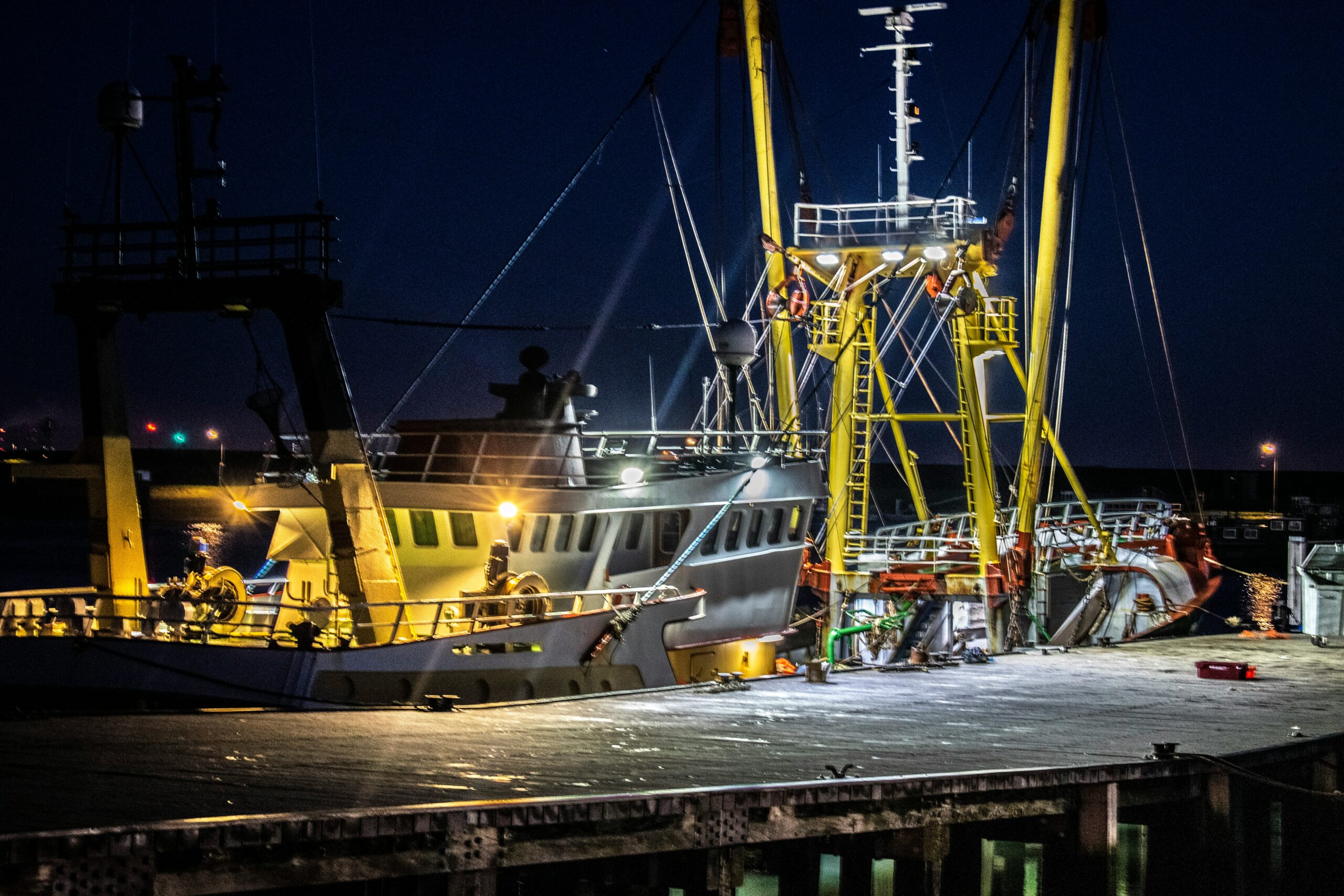
Photo by Paul Einerhand
A Dutch court has ruled that bottom trawling in the Dogger Bank without permits is unlawful, in what is believed to be the first European judgment confirming that governments have a binding legal duty to regulate the impact of bottom trawling on offshore marine protected areas.
The District Court of The Hague found that the Dutch Ministry of Agriculture, Fisheries, Food Security and Nature had acted unlawfully by granting the Dutch fishing fleet a blanket exemption to trawl in the Dogger Bank – the Netherlands’ largest protected nature area, covering 473,500 hectares, and a Natura 2000 site spanning UK, Dutch, German and Danish waters. Under the ruling, Dutch bottom trawlers must now obtain individual permits, each requiring an environmental assessment demonstrating that their fishing activities will not harm marine life within the protected area.
The case was brought by four environmental organisations, Doggerland Foundation, ARK Rewilding Nederland, ClientEarth and Blue Marine Foundation, and heard at the District Court in The Hague in March 2026, following an earlier administrative challenge to the Dutch government that was rejected.
The nursery of the North Sea
The Dogger Bank is a vast, shallow sandbank at the heart of the North Sea, long described as the nursery of the sea. It functions as a critical spawning and feeding ground for plaice, herring, cod, sharks and rays, and supports harbour porpoises, minke whales, grey seals and a range of protected seabirds including gannets, puffins, guillemots and razorbills. Its seabed stores carbon, making its degradation a climate concern as well as an ecological one. Large, long-lived shellfish such as flat oyster, ocean quahog and horse mussels have almost completely disappeared. Despite its protected status, Dutch fishing vessels had operated within the zone for years without the environmental scrutiny the court has now confirmed is legally required.
Emilie Reuchlin, director of Doggerland Foundation, said the ruling was “fantastic news for the North Sea. Bottom trawling poses a huge threat to the Dogger Bank because it destroys life in and on the seabed. This ruling puts the burden of proof back in place with the Dutch Government: they are legally bound to subject Dutch fisheries to a permit obligation. The Dutch government is responsible for protecting this nursery and will have to discuss the future with the fishers: if they cannot demonstrate that their activities cause no harm, they will no longer be allowed to fish with trawls in this area.”
Karel van den Wijngaard, programme leader for the North Sea at ARK Rewilding Nederland, said the ruling created a genuine opportunity for recovery. “Nature is incredibly resilient and can recover under the right conditions. But that will never happen if trawl nets keep scraping the seabed.”
UK implications
The ruling carries direct significance for the UK. Dr Tom Appleby, Chief Legal Affairs Adviser to Blue Marine Foundation, said: “The Dogger Bank is the heart of the North Sea and is meant to have the same levels of protection in the UK, Germany and the Netherlands. Yet the UK has closed nearly all of its portion to bottom trawling, Germany more than half and the Netherlands just over a quarter. But this is not just about the Netherlands meeting international commitments; the North Sea used to be one of the most fertile fisheries on earth. Removing bottom trawling would be a start to a resurgence in marine life, which would benefit everyone.”
John Condon, senior lawyer at ClientEarth, described the judgment as “a landmark legal ruling for ocean protection, which is set to make waves across Europe. The Dutch court has unequivocally confirmed that bottom trawling in protected areas cannot be ignored, ‘protected’ means protected.”
Implications for EU member states
The ruling arrives at a moment of mounting legal pressure across the EU, and its consequences are expected to reach well beyond the Netherlands. It creates a significant legal precedent for several other member states, including France, Spain, Germany and Sweden, that face similar litigation or formal complaints to the European Commission over fishing practices in their own protected waters.
In Germany, Friends of the Earth Germany (BUND) has brought a lawsuit specifically targeting bottom trawling in the German section of the Dogger Bank. Dr Anna von Rebay, BUND’s legal representative at Ocean Vision Legal, said the German government had “issued this license without conducting the mandatory impact assessment required by EU nature conservation law,” and that the case sought “to reinforce the implementation of European nature conservation law and establish a precedent for all EU Member States.” A study co-authored by Seas At Risk and Oceana found that bottom trawling still takes place in as much as 90% of the EU’s offshore protected areas across the countries investigated, amounting to over 730,000 hours of bottom-towed fishing in German marine Natura 2000 sites alone between 2015 and 2023.
The Dutch ruling also reinforces a separate but related legal victory from May 2025, when the General Court of the European Union upheld restrictions on bottom trawling in North Sea MPAs after a legal challenge by German fishing group VDK was rejected. Condon said at the time that the EU ruling sent “a clear signal that we have strong conservation laws for protecting MPAs from destructive activities such as bottom trawling. Now it’s a matter of ensuring that they are urgently enforced.”
Some member states are moving voluntarily. Greece has committed to banning bottom trawling in marine national parks by 2026 and across all its MPAs by 2030, while Sweden has proposed legislation that would ban the practice in its territorial waters. Scotland has proposed bottom trawling bans in 20 MPAs. Yet the overall picture remains stark: over 80% of EU MPAs are currently deemed ineffective because they provide only marginal protection against destructive industrial activities.
Condon has not minced his words on the wider contradiction. “It’s hypocritical of the EU to be portraying itself on the global stage as an ocean conservation leader, and to be striving for the 30×30 target,” he told Mongabay, “when they can’t even get the basics right for their own protected areas.” The upcoming European Oceans Pact is now seen as a critical test of whether the Commission will translate these successive court victories into binding, continent-wide enforcement.
Together, the four litigant organisations are calling on European and UK governments to acknowledge the ruling, accept that their fishing fleets are subject to permit obligations and appropriate assessment requirements, and move to close all Natura 2000 marine protected areas to destructive bottom trawling.