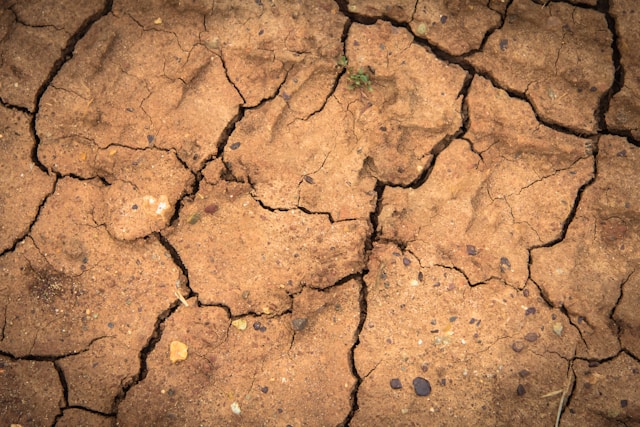
Photo credit: Photoholgic on Unsplash
The Environment Agency has declared drought across seven regions of England, covering just over half the country, following what is set to be the driest July on record. The declaration moves East Anglia, Hertfordshire and North London, Thames, Hampshire and the Isle of Wight, Devon and Cornwall, the West Midlands and Wessex into drought status, after record-low rainfall and a run of heatwaves left water resources depleted.
The picture changed sharply over the year. A very wet winter had replenished reservoirs and groundwater, carrying the country through a dry spring without major impact, but the summer has been exceptionally hot and dry. July delivered just 7 per cent of expected rainfall nationally, falling to 1 per cent across southern England, with no substantial rain forecast. Three heatwaves, including 12 consecutive days above 30C, drove water storage down, while higher temperatures pulled moisture from soils and vegetation, raising the wildfire risk.
A flash drought, and the third in five years
The Environment Agency described the event as a flash drought, one that develops quickly through a combination of very low rainfall and high temperatures. It is the second consecutive summer that parts of England have been in drought, and the third drought in five years, after 2022 and 2025. Several further areas, including Kent and South London, Sussex, Cumbria and the East Midlands, remain in prolonged dry weather status and are being closely monitored.
Moving to drought status allows the Environment Agency to step up its response. That includes increased environmental monitoring, tighter regulation of water abstraction, and closer coordination with water companies, farmers and other sectors through the National Drought Group, which met on 28 July. The group instructed water companies to prioritise leak repairs, and officers have in places been aerating rivers to protect fish from falling oxygen levels.
Helen Wakeham, the Environment Agency’s director of water and chair of the National Drought Group, said the hot, dry weather meant “we are currently using water faster than nature can replenish it”. Rivers are running low, farmers are harvesting crops early, wildfire risk is climbing, and millions of people are already living under water use restrictions. The agency renewed its call for households and businesses to use water efficiently, warning that the situation could persist without sustained rainfall.
Sources: