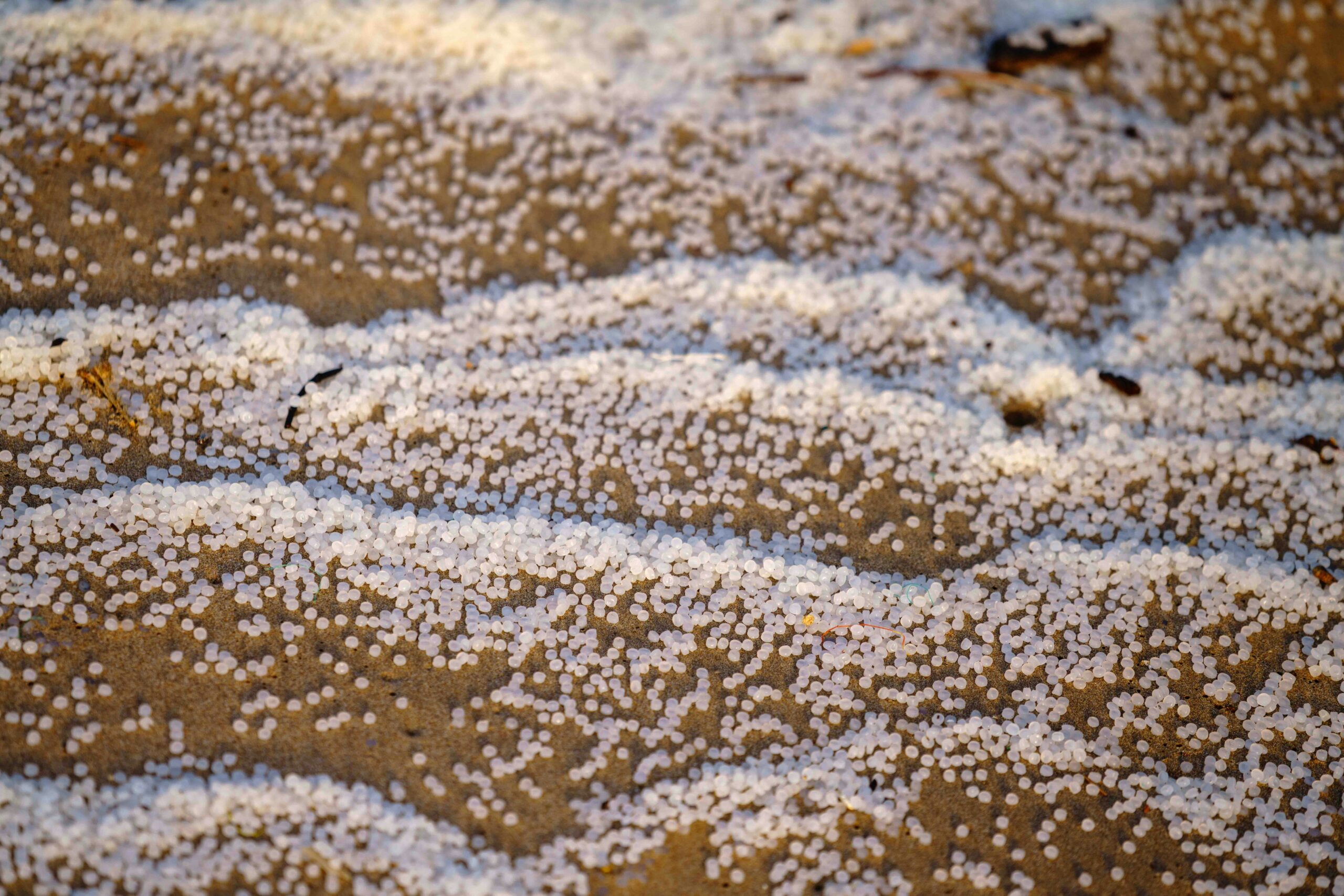
Photo by Soren Funk
A year after millions of plastic pellets washed ashore on the coasts of Norfolk and Lincolnshire, clean-up teams are still working – and the full environmental impact on one of Britain’s most protected coastal ecosystems remains unclear.
On 10 March 2025, the cargo ship Solong ploughed into the anchored oil tanker Stena Immaculate some 14 nautical miles off the Humber estuary, triggering fires on both vessels and releasing millions of plastic nurdles — tiny resin pellets used as raw material for plastic manufacturing — into the North Sea. The pellets subsequently washed ashore across The Wash and along the Norfolk and Lincolnshire coastlines. Filipino crew member Mark Angelo Pernia, 38, who was on the Solong’s bow at the point of impact, remains missing, presumed dead.
The captain jailed
In February, Solong captain Vladimir Motin was sentenced to six years in prison for gross negligence manslaughter. The chief investigator told the BBC that audio evidence had proved decisive. While the bridge of the stricken Stena Immaculate captured immediate, frantic activity — alarms sounding, crew mobilising — the Solong’s bridge revealed 63 seconds of what Detective Chief Superintendent Craig Nicholson of Humberside Police described as “abstract silence” in the wake of the collision.
Investigators found that Motin had identified the anchored tanker on radar from nine miles away, yet took no action. “He doesn’t alter his heading and he doesn’t alter his speed,” Nicholson said. “At 3 miles he says he can see the vessel out of his window, but he still doesn’t take any action whatsoever.” A timely alarm, Nicholson added, “would have prevented the death of Mark Pernia, who was in the bow of the vessel at the point of collision.”
Motin’s defence had argued that automatic controls were faulty and failed to disengage, but prosecutors called this account “ludicrous” and said it had changed repeatedly throughout the investigation.
Wildlife at risk
The Wash is an internationally important protected area. According to the RSPB, it supports more than 400,000 non-breeding waterbirds and the UK’s largest harbour seal colony, as well as rare plants and invertebrates. The Marine Conservation Society described the area as one of deep concern following the spill.
Tammy Smalley, head of conservation at Lincolnshire Wildlife Trust, explained the specific danger nurdles pose to wildlife: “Nurdles look like small fish eggs. If you are a sea bird or a marine mammal, you might go ‘ooh, smorgasbord’, and they’ll feed on them and they’ll either choke or [the nurdles] will go through to the stomach and they think they’ve fed. So, gradually, it could cause starvation.”
The risk is compounded when nurdles burn together into larger masses, allowing toxic pollutants to adhere to their surface. Over time they also break apart into microplastic fragments, entering the food chain and posing risks to smaller animals. At Skegness in the days after the collision, dead seabirds were observed on the beach, though it was impossible to determine whether they had ingested the material.
The clean-up
Wildlife organisations described the retrieval effort as a race against time, with a narrow window of small tides in March and the start of the ground-nesting bird season in April restricting beach access. Specialist counter-pollution vessels collected 36 tonnes of pollution from the sea, while local authorities led onshore operations. By 1 April 2025, around 11 tonnes of plastic had been cleared from Lincolnshire beaches alone. On the Norfolk side, a specialist contractor used vacuum equipment at four locations, and within a month more than 900,000 individual nurdles had been recovered.
Volunteer and landowner-led beach cleans continued throughout last summer, proving “invaluable” according to the Borough Council of King’s Lynn and West Norfolk. The last major piece of recovery work — clearing plastic from Scolt Head Island near Brancaster — had to wait until the end of the bird nesting season. The council has since scaled back its direct role in operations, now supporting landowners with equipment and inspections rather than leading clean-ups itself.
What remains
A year on, the wider impact on marine life is not yet known. “While residual pollution is expected to persist for many years, fewer large burnt-fused nurdles are being reported,” a council spokesman said. Anyone finding nurdles is advised not to handle them, to keep dogs away, and to report them to the relevant landowner.